
Fixed annuities trade market upside for predictable, insurer-backed payouts. Variable annuities trade that predictability for potential market growth plus optional insurance riders, at a higher cost. Retirees who want a floor under their income and lower fees usually lean fixed, while those with a longer horizon and appetite for growth may accept variable’s risk. If you already know you want annuity income, the checklist below tells you exactly what to ask before signing.
TL;DR:
- Fixed annuities offer guaranteed rates set by insurers, but their safety depends on insurer strength and state guaranty associations, not the federal government.
- Variable annuities involve market risk through subaccounts and can include costly riders like guaranteed lifetime withdrawals, which impact long-term returns.
- Surrender charges typically last six to ten years, and high fees from riders, expense ratios, and bonus credits can significantly reduce net payout value.
- Tax treatment applies income taxes at ordinary rates on earnings, with early withdrawals before age 59½ incurring penalties, affecting overall strategy.
- The contract details, including surrender terms and rider costs, matter more than product labels, so thorough review and independent advice are essential before buying.
Table of Contents
- What is a fixed annuity and how does it work?
- What is a variable annuity and how do subaccounts and riders work?
- Which matters more for your income: guarantees or growth potential?
- Costs, fees, and traps to watch for
- U.S. tax rules and withdrawal considerations
- Who fixed and variable annuities actually suit
- Decision checklist before you buy an annuity
- An advisor’s view on choosing between fixed and variable
- What conventional annuity advice tends to miss
- Get a no-pressure annuity review from an independent insurance brokerage
- Sources
- FAQ
What is a fixed annuity and how does it work?
A fixed annuity pays a guaranteed rate of interest during accumulation, then converts to income you cannot outlive if you choose a lifetime payout. An immediate fixed annuity, often called a SPIA, starts payments right after you fund it. A deferred fixed annuity grows for years before payments begin. The insurer sets a crediting rate with a contractual minimum, so your balance never drops from market swings.
That guarantee rests on the insurer’s own financial strength and, as a backstop, state guaranty associations, not federal insurance. Our guide to fixed annuity safety walks through how those protections actually work.
- Immediate fixed annuities begin income right away, often within a month of purchase.
- Deferred fixed annuities accumulate interest for years before you switch to payout mode.
- Crediting rates are set by the insurer and carry a guaranteed minimum stated in the contract.
What is a variable annuity and how do subaccounts and riders work?
A variable annuity puts your money into subaccounts that function like mutual funds, so your account value rises and falls with the market. Investor notes that variable annuities are built for long-term retirement goals and carry real investment risk, unlike their fixed counterparts. During accumulation, subaccount performance drives your balance. At payout, you can annuitize for income or take withdrawals, depending on the contract.
Riders add guarantees on top of that market exposure, at a cost. A guaranteed lifetime withdrawal benefit (GLWB) protects a minimum income stream even if the subaccounts lose value, and a death benefit rider preserves value for heirs. Because a variable annuity is a registered security. The SEC’s variable annuity guide requires a prospectus and limits sales to licensed, registered representatives.
- Subaccounts invest in stock, bond, or balanced portfolios chosen from the insurer’s menu.
- GLWB and death benefit riders guarantee specific outcomes but add annual charges.
- Only FINRA-registered representatives can sell variable annuities, and a prospectus is mandatory.
Which matters more for your income: guarantees or growth potential?
The practical differences between fixed and variable annuities show up most clearly in four places: how your balance can move, how certain your income is, how easily you can access your money, and how well your payout keeps pace with rising prices.
- Performance and downside risk: fixed annuities cannot lose value from market drops, while variable annuities can, since Investor confirms account values fluctuate with the underlying investments.
- Income certainty: fixed payouts are locked in at issue, while variable income (without a rider) moves with subaccount performance, and a rider that stabilizes it adds an annual fee.
- Liquidity: both types typically restrict withdrawals, and the SEC notes surrender charge periods commonly run six to eight years, sometimes up to ten, with a declining schedule and often a 10% annual free-withdrawal allowance.
- Inflation exposure: a level fixed payout loses purchasing power over a long retirement unless you add a cost-of-living rider, while variable growth potential offers a chance, not a guarantee, of outpacing inflation.
Our annuity rates guide breaks down how insurers actually calculate a fixed payout quote.
Costs, fees, and traps to watch for
Variable annuities carry layered costs that reduce your net return: mortality and expense (M&E) charges, administrative fees, subaccount expense ratios, and rider charges stacked on top of each other. Fixed annuities embed cost in the crediting rate rather than itemizing fees, but bonus credits and surrender schedules can still work against you.
- Mortality and expense charges plus administrative fees apply annually to the full contract value.
- Subaccount expense ratios reduce investment returns before you see a statement balance.
- Rider charges for GLWB or death benefit guarantees are billed as a percentage of the benefit base each year.
- Surrender charges and bonus-credit repayment provisions can claw back gains if you withdraw early.
The SEC warns that bonus credits marketed as “free” money are often offset by higher embedded costs or repayment terms, so always ask for the net value after charges. Producer compensation structures can also tilt recommendations toward higher-commission products, which is why an independent second opinion matters. Our breakdown of rider fees shows how a 1% annual charge compounds over 15 years.
Pro Tip: Ask for the illustration’s “net of all fees” column, not just the gross projected value.
U.S. tax rules and withdrawal considerations
Annuity earnings are taxed as ordinary income when withdrawn, not at capital gains rates, according to IRS Publication 575. A qualified annuity held inside an IRA follows IRA distribution rules, while a nonqualified annuity funded with after-tax dollars uses an exclusion ratio to separate principal from earnings. Withdrawals before age 59½ generally trigger a 10% additional tax on the taxable portion, on top of ordinary income tax.
- Earnings are taxed as ordinary income, never at preferential capital gains rates.
- Qualified contracts follow IRA/retirement plan distribution and RMD rules.
- A 10% additional tax applies to most taxable withdrawals taken before age 59½.
- A 1035 exchange lets you swap contracts tax-free, but it usually restarts the surrender clock and may raise fees.
Our tax rules guide covers the penalty exceptions in more detail.
Who fixed and variable annuities actually suit
Fixed annuities tend to suit retirees who want a predictable paycheck, cannot stomach fee layers eating into returns, and prioritize protecting principal over chasing growth. Variable annuities fit people with a longer time horizon who are comfortable paying for riders in exchange for market participation inside an insurance wrapper.
- Fixed fits retirees who need certainty and want to avoid subaccount and rider fees stacking up.
- Variable fits investors with 10 or more years to retirement who value growth potential over guaranteed income today.
- Neither fits someone who needs full liquidity, since both carry surrender periods.
- Someone already maxing out a 401(k) or IRA should compare a bond ladder or CD ladder before adding another tax-deferred wrapper, since tax deferral alone rarely justifies the extra cost inside an account that is already tax-advantaged.
Decision checklist before you buy an annuity
Before signing anything, define your income goal, time horizon, and how much in fees you’re willing to accept, then check the insurer’s financial strength rating and confirm exactly what any rider costs and does.
- Write down your monthly income goal and the date you need it to start.
- Decide your time horizon: under five years favors fixed, over ten opens the door to variable.
- Ask for the insurer’s financial strength ratings before comparing rates.
- Request the full prospectus or contract, not just a one-page illustration.
- Ask what assumptions drive the illustration, and request a lower-return scenario per actuarial guidance on comparing sensitivity runs.
- Confirm the rider’s exact purpose, its annual cost, and whether you actually need it.
- Get the surrender schedule in writing, including the free-look period and any bonus repayment terms.
Red flags include an agent who cannot produce a prospectus, an illustration with no downside scenario, or pressure to sign before you’ve compared at least two insurers.
Pro Tip: Read the illustration’s assumed interest rate first: a 1% difference in that assumption can change your projected payout by thousands over a 20-year horizon.
An advisor’s view on choosing between fixed and variable
Paul Barrett has worked with Medicare-age consumers since 2007, and the annuity conversations that go wrong almost always start with the label, not the contract, as detailed in AI Voice Agents for Medicare & Healthcare Member Support. A product marketed as “fixed” or “variable” tells you the shape of the guarantee, not the actual cost or suitability for your situation.
An independent review means pulling the actual contract, marking up the surrender schedule, checking rider costs against what they promise, and comparing the insurer’s rating against at least one alternative. That’s a different process than a single-carrier pitch.
- Reviews start with your income goal and current retirement accounts, not with a specific product.
- We compare quotes across carriers rather than presenting one option.
- Our fixed annuity guide and safety guide cover the background before any recommendation.
What conventional annuity advice tends to miss
Most annuity comparisons treat “fixed versus variable” as a personality question: are you a risk-taker or not. That framing misses the bigger issue, which is that the contract details, not the category, determine whether an annuity actually helps you. Two fixed annuities can have wildly different guaranteed minimums, and two variable annuities can carry rider costs that differ by a full percentage point a year, which compounds into a meaningfully different retirement outcome.
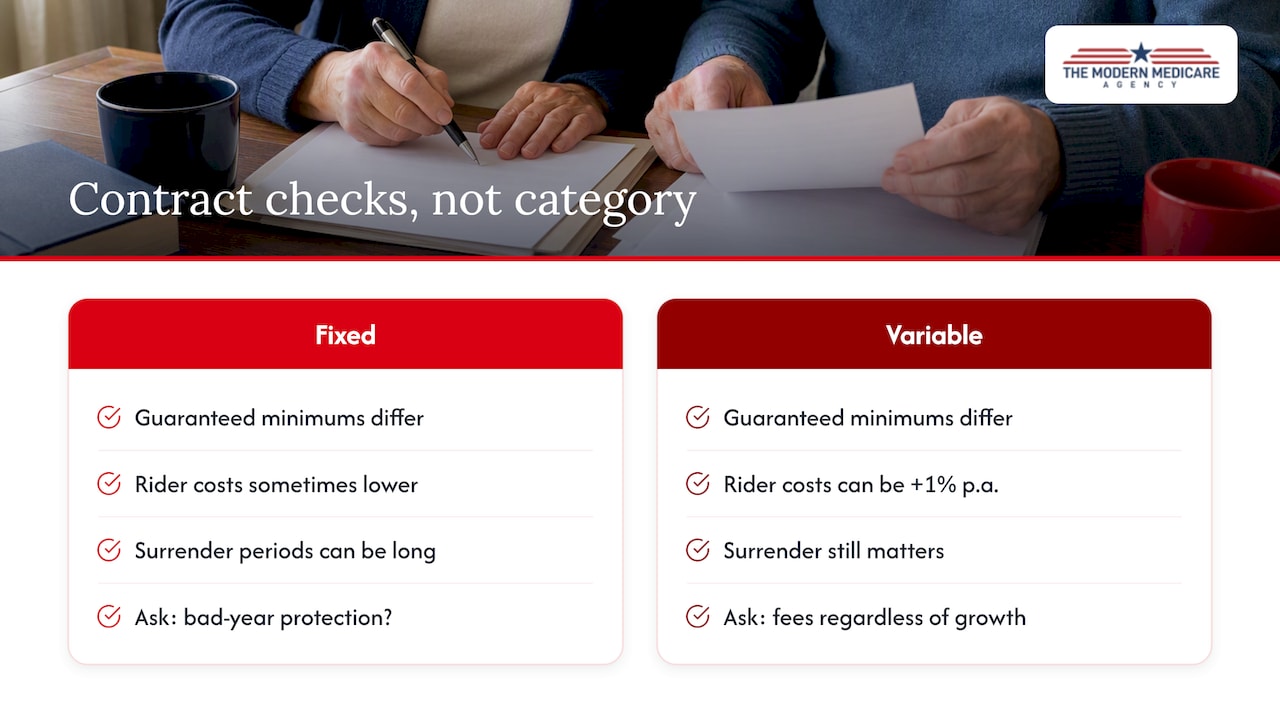
The advice readers underestimate is how much a surrender schedule and a rider’s fine print matter compared to the headline crediting rate or growth story. A retiree chasing a slightly higher fixed rate while ignoring a ten-year surrender period, or a retiree buying a variable annuity for growth while stacking three riders they’ll never use, both end up worse off than someone who read the prospectus first.
Prioritize the contract over the category. Ask what happens in a bad year, what you pay regardless of performance, and what it costs to walk away. Those three answers matter more than whether the product is labeled fixed or variable.
— Paul
Get a no-pressure annuity review from an independent insurance brokerage
Choosing between guaranteed income and growth potential is easier with a second set of eyes on the actual contract. Paul B Insurance reviews your annuity options, compares carriers, walks through payout illustrations, and explains what each rider actually costs, with no obligation to enroll.

What to expect: a contract review, a clear rundown of pros and cons for your situation, a payout illustration you can compare against other quotes, and follow-up support as your needs change. Reach out through our annuities page to get started.
This article is general information, not a substitute for advice from a qualified financial advisor. Consult a qualified financial professional about your own circumstances before acting on anything here.
Sources
- SEC: Variable Annuities (PDF)
- IRS Publication 575
- Investor
- American Academy of Actuaries: Issue Brief — Annuities
FAQ
What does Warren Buffett say about fixed annuities?
There is no dedicated statement from Warren Buffett specifically on fixed annuities in the sources reviewed for this article. General investment commentary attributed to him emphasizes low fees and understanding what you own, principles that apply directly to comparing an annuity’s guarantees against its costs.
How much does a $500,000 fixed annuity pay per month?
There is no single percentage rule for annuity payouts; the amount depends on your age, sex, whether you choose single or joint life, when payments start, and any cost-of-living rider, according to IRS Publication 939 and actuarial guidance. A small change in the insurer’s assumed interest rate can shift the monthly payment by a meaningful margin, so get a current quote from more than one insurer rather than relying on a rule of thumb.
What does Suze Orman say about fixed annuities?
No specific statement from Suze Orman on fixed annuities appears in the sources reviewed here. As a general principle, any annuity purchase should be weighed against your existing retirement accounts, since tax deferral alone rarely justifies the added cost inside an account that is already tax-advantaged.
What does Dave Ramsey say about fixed annuities?
No specific statement from Dave Ramsey on fixed annuities appears in the sources reviewed here. The broader principle worth applying is to compare an annuity’s guaranteed rate and fees against simpler alternatives, such as a bond ladder, before committing your retirement savings.
Is a fixed or variable annuity better for retirement income?
Neither is universally better: a fixed annuity suits retirees who want guaranteed, predictable income and lower fees, while a variable annuity suits those with a longer horizon who want growth potential and are willing to pay for riders that add guarantees. The right choice depends on your income goal, timeline, and how much fee drag you can accept.