




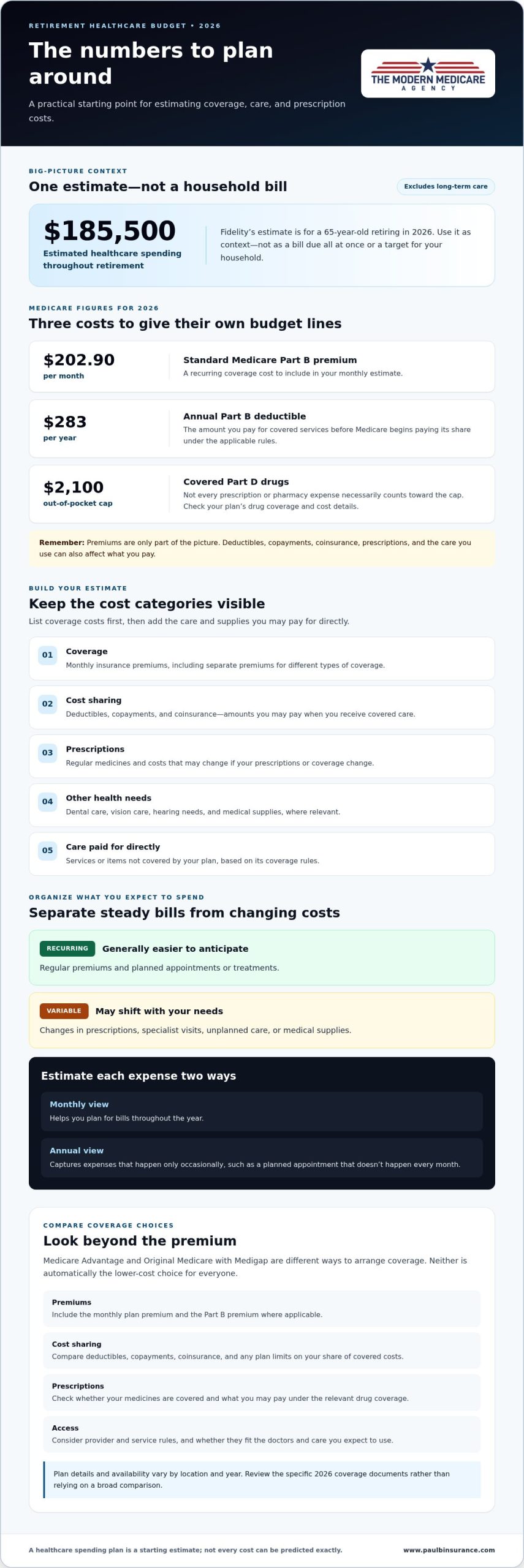
Fidelity estimates that a 65-year-old retiring in 2026 may spend $185,500 on healthcare throughout retirement, excluding long-term care. If you’re figuring out how to create a budget for healthcare in retirement, use that estimate as context, not as a bill you’ll pay all at once or a target for your household.
Premiums, deductibles, copayments, and prescription costs can be difficult to predict. Even with Medicare, what you pay depends on your coverage and the care you use. A clear budget helps you see those costs and plan for changes without assuming every expense will be predictable.
This guide walks you through building a practical monthly and annual estimate. You’ll separate regular bills from costs that may change, compare how coverage choices affect what you pay, and test whether your budget can accommodate different levels of spending.
Key Takeaways
- Learn how to create a budget for healthcare in retirement by listing premiums, expected care, prescriptions, and other health-related expenses.
- See why premiums are only part of the picture, and how cost sharing and access rules can affect what you pay.
- Compare coverage choices using practical categories, including monthly premiums, prescription needs, and expected care.
- Build lower, expected, and higher-spending scenarios to see how your budget may hold up if costs change.
- Know when to revisit your estimates, such as when your health needs, prescriptions, providers, or coverage change.
How to create a healthcare budget for retirement: start with the full picture
It’s hard to know exactly what healthcare will cost in retirement. Your coverage, care needs, prescriptions, and other health expenses all affect the total. Still, a thoughtful estimate gives you a useful starting point. In 2026, how to create a budget for healthcare in retirement starts with listing the expenses you expect and separating regular bills from costs that can change.
Think of this as a healthcare spending plan, not a complete retirement income or investment plan. It focuses on what you may pay for coverage and care, so you can see how those expenses fit into your household budget. That’s one part of broader retirement planning, alongside your other needs and goals.
Which healthcare expenses belong in a retirement budget?
Begin with the costs tied to your coverage, then add the care and supplies you may pay for directly. Keep categories separate so you can see what your plan covers, where cost sharing applies, and which expenses may come out of your own budget.
- Coverage: Monthly insurance premiums, including separate premiums for different types of coverage.
- Cost sharing: Deductibles, copayments, and coinsurance. These are amounts you may pay when you receive covered care.
- Prescriptions: Regular medicines and costs that may change if your prescriptions or coverage change.
- Other health needs: Dental care, vision care, hearing needs, and medical supplies, where relevant.
- Care you pay for directly: Services or items not covered by your plan, based on its coverage rules.
Coverage varies by plan, so don’t assume every service or supply is paid for in full. Review the plan details and note which expenses are covered, which involve cost sharing, and which you may need to pay yourself.
How to organize predictable and variable costs
Sort your expenses into two groups. Recurring costs are generally easier to anticipate, while variable costs can shift with your health and care needs.
- Recurring: Regular premiums and planned appointments or treatments.
- Variable: Changes in prescriptions, specialist visits, unplanned care, or medical supplies as your circumstances change.
Estimate each expense monthly and annually. A monthly view helps you plan for bills throughout the year, while an annual view captures expenses that happen only occasionally. For example, a planned appointment may not happen every month, but it still belongs in your yearly estimate. Looking at both totals makes the budget more useful without suggesting that every cost can be predicted exactly.
How Medicare coverage affects healthcare costs in retirement
Your monthly premium is only one part of your healthcare budget. What you pay for care also depends on deductibles, copayments, coinsurance, prescriptions, and the details of your coverage. As you work out how to create a budget for healthcare in retirement, compare regular monthly costs with the amounts you might pay when you use care.
What Medicare costs should you include?
For 2026, Medicare lists the standard Part B premium as $202.90 per month and the annual Part B deductible as $283. The premium is a regular cost. The deductible is what you pay for covered services before Medicare begins paying its share under the applicable rules. After that, copayments are set amounts for services, while coinsurance is a share of the cost.
Give prescription spending its own budget line. Part D plan premiums and cost sharing for covered drugs can affect your total, and the medicines you take matter. In 2026, Medicare’s out-of-pocket cap for covered Part D drugs is $2,100. Not every prescription or pharmacy expense necessarily counts toward the cap, so review the plan’s drug coverage and cost details. Fidelity also offers guidance to plan for rising health care costs.
How Medicare Advantage and Medigap can affect your estimate
Medicare Advantage and Original Medicare with Medicare Supplement insurance, also called Medigap, are different ways to arrange coverage. Neither is automatically the lower-cost choice for everyone. Compare the costs and how each option fits your care preferences, including:
- Premiums: Include the monthly plan premium and the Part B premium where applicable.
- Cost sharing: Compare deductibles, copayments, coinsurance, and any plan limits on your share of covered costs.
- Prescriptions: Check whether your medicines are covered and what you may pay under the relevant drug coverage.
- Access: Consider provider and service rules, and whether they fit the doctors and care you expect to use.
Plan details and availability vary by location and year. Review the specific 2026 coverage documents rather than relying on a broad comparison. Explore Medicare Advantage plans for 2026 and read Medicare Supplement insurance explained to understand how each approach may affect your estimate. Comparing the details can turn coverage choices into clearer budget categories, without assuming one option costs less for every household.
How to compare coverage choices for your retirement healthcare budget
A useful comparison looks beyond the premium. Two plans can have different monthly costs, rules for accessing care, and amounts you may pay when you use services. In 2026, use current plan documents and information for the year rather than last year’s details or a general impression of what a plan covers. Plan availability and terms can vary by location.
Which coverage details matter most when estimating costs?
Compare each option using the same categories. This keeps the details manageable and helps you see how your expected care may affect your total budget.
- Monthly premium: Record the regular amount, including any separate coverage premiums that apply.
- Cost sharing: Note deductibles, copayments, coinsurance, and any applicable plan limits for covered care.
- Expected care: List routine appointments, specialist visits, tests, and other services you expect to use. Check how each option handles them.
- Provider access: Review provider and service rules, then consider whether they fit your care preferences and the doctors you want to see.
- Prescription coverage: Compare coverage for your current medications and the pharmacies you use. Drug coverage and out-of-pocket costs can differ.
For a broader retirement-cost perspective, Fidelity’s Fidelity Retiree Health Care Cost Estimate can provide additional context. Use it as a reference, not a substitute for reviewing a specific 2026 plan’s terms.
How to compare Part D and other healthcare needs
Give prescription coverage its own line in your budget. List your current medicines and compare how each option covers them, including relevant cost sharing and pharmacy access. A plan’s overall premium alone won’t show how well its drug coverage fits your needs. The Medicare Part D coverage guide can help you understand this part of the comparison.
Keep dental care separate, too. Include expected visits and other dental needs, then account for any dental coverage you’re considering. Explore dental insurance plan options as you build that budget category.
Once you’ve reviewed the details, compare the likely yearly impact, not just the monthly premium. A lower premium may come with different cost sharing or access rules. A higher premium may or may not fit your expected care better. This comparison is a practical step in how to create a budget for healthcare in retirement. The Modern Medicare Agency compares Medicare coverage options from multiple carriers. Explore plan comparison support.
How to build and stress-test your retirement healthcare budget
A useful budget can handle more than one possible year ahead. In 2026, you can build a clear estimate without predicting every appointment or expense. Start with what you know, record your assumptions, and test how the total might change if your care needs shift.
- 1. List your needs. Note your current coverage, regular prescriptions, planned appointments, and any care or supplies you expect to need.
- 2. Estimate each cost category. Use current plan documents and available information to estimate premiums, cost sharing, prescriptions, and other health expenses separately.
- 3. Compare coverage. Review how each option handles the care and medicines you expect to use, along with its access rules and potential out-of-pocket costs.
- 4. Total monthly and annual costs. Include recurring bills and convert less frequent expenses into an annual estimate.
- 5. Review your assumptions. Update the budget when coverage, prescriptions, providers, or health needs change.
A practical worksheet for monthly and annual estimates
For each expense, record four things: expense, expected frequency, estimated amount, and source of estimate. Sources might include a 2026 plan document, a prescription record, or a recent bill. For an expense that happens occasionally, enter its expected annual total and note when it may occur. Label uncertain figures as assumptions so you know what to revisit.
Then create three versions of your budget: a lower-spending scenario based on routine needs, an expected scenario based on the care you currently anticipate, and a higher-spending scenario that allows for additional needs. These aren’t predictions. They help you see how changes might affect your household budget.
How to prepare for costs that are hard to predict
Test the higher-spending scenario by considering additional appointments, a medication change, or more cost sharing than you expected. Keep known healthcare expenses distinct from a general emergency reserve. That separation helps you see which costs are part of your care plan and which funds are meant for broader surprises, without setting an arbitrary savings target.
Use current 2026 plan information and your own care expectations to update your estimates. A Medicare coverage review can help clarify premiums and potential out-of-pocket costs as you compare options. Get help comparing Medicare coverage options as one practical step in building your healthcare budget.
How to keep your healthcare budget current as retirement needs change
Your healthcare budget should change when your healthcare needs do. A prescription change, a new specialist, or a different coverage choice can shift both your expected spending and the services you rely on. Keep a simple record of updates so your estimates stay useful throughout 2026 and beyond.
When should you revisit a retirement healthcare budget?
Review your estimates during annual coverage decisions and whenever your care needs change in a meaningful way. Before comparing plan details, update your medication list, preferred providers, and expected appointments or services. This helps you compare coverage against your current situation rather than an outdated snapshot.
Keep a brief note of what changed and why. For example, record when you add a prescription or change a regular provider. That history gives you a clearer starting point for next year’s budget and helps you spot which estimates need another look.
How an independent Medicare review can clarify coverage costs
Plan details and costs can change from year to year, so use current 2026 plan documents and authoritative Medicare information when refreshing your estimates. Recheck premiums, cost sharing, prescription coverage, and provider access for the specific options you’re considering. Don’t carry forward last year’s figures without verifying them.
An independent review can make the comparison more manageable. The Modern Medicare Agency compares Medicare Advantage, Medigap, and Part D options from more than 40 carriers, helping you consider coverage details alongside your care needs and budget priorities. A review can clarify how plan choices may affect premiums and potential out-of-pocket spending. It focuses on coverage, rather than serving as a complete retirement income or investment plan.
That’s the practical heart of how to create a budget for healthcare in retirement: connect your estimates to your needs, then revisit them as those needs change. You don’t have to sort through every plan detail alone. Explore Medicare Advantage plan options and consider how they fit your current priorities.
Take the next step toward a clearer healthcare budget
In 2026, how to create a budget for healthcare in retirement means building a useful estimate, not predicting every cost perfectly. List regular premiums and planned care, allow room for expenses that can change, and look at monthly costs alongside the annual total.
Medicare coverage is an important part of that picture. Compare more than premiums: consider cost sharing, prescription coverage, expected care, and provider access. Then revisit your estimates when your health needs or coverage change, using current plan information to keep the budget relevant.
If you’d like help understanding how Medicare options fit your needs, The Modern Medicare Agency is an independent brokerage that compares plans from more than 40 carriers. Its agents provide personalized guidance and year-round support across more than 34 states. Explore Medicare coverage options with personal guidance.
Start by listing the expenses you know, then compare coverage choices against your budget and care needs. For personalized help comparing Medicare options, connect with The Modern Medicare Agency.
Frequently Asked Questions
How much should I budget for healthcare in retirement?
There isn’t one amount that fits every household. Fidelity estimates that a 65-year-old retiring in 2026 may spend an average of $185,500 on healthcare and medical expenses over retirement, excluding long-term care. Treat this as context, not a personal target. To work out how to create a budget for healthcare in retirement, estimate your premiums, expected care, prescriptions, and other needs, then adjust for your coverage and circumstances.
Does Medicare cover all healthcare costs in retirement?
No. Medicare helps cover eligible care, but you may still pay premiums, deductibles, copayments, or coinsurance, and some services may not be covered by your plan. In 2026, the standard Medicare Part B premium is $202.90 per month, and the annual Part B deductible is $283, according to Medicare. Medicare Part D also has a $2,100 out-of-pocket cap for covered prescription drugs in 2026. Review your plan’s terms to understand what you may pay.
What healthcare costs should I include in a retirement budget?
Include premiums for your coverage, deductibles, copayments, and coinsurance as separate items. Add prescription costs, planned appointments, specialist care, and any medical supplies you expect to need. Keep dental, vision, and hearing care as distinct categories, too. Some costs may be covered by your plan, while others may come directly from your household budget. Review your coverage details and estimate both recurring expenses and costs that could vary.
How do I compare Medicare plans when creating a healthcare budget?
Compare the full cost picture, not just the monthly premium. Review deductibles and other cost sharing, how the plan handles care you expect to use, prescription coverage for your current medicines, and provider access. Check current plan documents for 2026 because details and availability can vary by location. The Modern Medicare Agency is an independent brokerage that compares Medicare options from more than 40 carriers, helping you review coverage details alongside your needs.
Can healthcare costs change after I retire?
Yes. Your spending may change if you need different care, add or change a prescription, see specialists more often, or choose different coverage. Plan premiums, benefits, and cost-sharing details can also vary by year. For a more useful budget, record the assumptions behind your estimates and revisit them when something changes. Update the numbers using current 2026 plan information rather than relying on old figures.
How often should I update my healthcare budget in retirement?
Review it when you’re making annual coverage decisions, and sooner if your health needs, prescriptions, providers, or coverage change. Before comparing plans, update your medication list and expected care, then check current plan documents and authoritative 2026 information. Keep a brief note of what changed and why. This creates a clear starting point for your next review and helps your estimates stay connected to your actual needs.
Should I include dental and vision care in my retirement healthcare budget?
Yes. Include dental and vision care as separate budget categories, along with hearing needs if they apply to you. Estimate expected visits, services, or supplies, then check which expenses your coverage pays for and which you may pay directly. Keeping these items separate helps you avoid overlooking them or assuming they’re included in another plan. Update the estimates if your care needs or coverage change.

Article by
Paul Barrett
Paul Barrett, CMIP is the founder of The Modern Medicare Agency, an independent Medicare-only brokerage based in Melville, NY. With 18 years of Medicare-exclusive experience, a CMIP designation, and more than 5,000 clients served across 37 states, Paul is one of the most credentialed independent Medicare specialists on Long Island — and one of the most direct.
He represents 40+ carriers with no quotas and no allegiances, which means his recommendations are based entirely on what fits each client's specific situation. He is the author of Medicare Mastery Unlocked and host of the Wise Guys Retirement Talk podcast. His content is grounded in primary sources, real carrier intelligence, and 18 years of watching what happens when people get Medicare right — and when they don't.
📞 631-358-5793 | paulbinsurance.com