




You can delay Medicare Part B without a lifetime penalty only if you or your spouse currently has employer-based group health coverage tied to active work. Once that coverage ends, you get an 8-month Special Enrollment Period to sign up. Miss that window without qualifying coverage, and you face a permanent 10% surcharge on the standard premium for every 12-month period you went without Part B.
TL;DR:
- You can delay Medicare Part B without penalty only if you are actively employed and covered by a group health plan based on current employment; once that ends, you have only eight months to enroll using the SEP.
- Employer size matters: delaying Part B is usually unnecessary for employers with 20 or more employees, but can cause gaps for smaller employers where Medicare becomes the primary payer before enrollment.
- Missing the enrollment window can result in a permanent 10% premium surcharge for each year missed, starting from the standard premium amount of $202.90 in 2026, which can accumulate over years.
- Proper documentation, including employer confirmation and forms like CMS-L564, is essential to prove coverage qualifies and avoid penalties, especially when employer delays happen.
- If you miss your window, enrolling during the January–March GEP, or requesting penalty reconsideration based on documentation, are your main options to mitigate long-term costs.
Table of Contents
- Who Qualifies to Delay Part B Without a Penalty
- Enrollment Timelines: IEP, SEP, and GEP Explained
- How the Part B Late Enrollment Penalty Is Calculated
- How to Delay Part B the Right Way: A Step-by-Step Checklist
- Special Cases: COBRA, Retiree Plans, HSAs, VA, and TRICARE
- If You Missed Your Enrollment Window: What to Do Next
- Why Working With an Experienced Medicare Agent Matters Here
- Our Take: The Real Risk Isn’t the Rule, It’s the Paperwork
- Get Help Avoiding Part B Penalties and Planning Next Steps
- FAQ
- Sources
Who Qualifies to Delay Part B Without a Penalty
The rule that protects you hinges on one phrase: coverage “based on current employment.” If you or your spouse are actively working and enrolled in a group health plan through that job, you can hold off on Part B with no penalty hanging over you later. The moment that employment or that coverage ends, whichever comes first, your 8-month Special Enrollment Period starts.
Employer size changes how this plays out in practice. For employers with 20 or more employees, the group health plan pays first and Medicare pays second, so delaying Part B rarely creates a gap. For employers with fewer than 20 employees, Medicare typically becomes the primary payer, and many group plans will not pay claims properly until you are enrolled in Part A and Part B. In that situation, delaying Part B is usually a mistake even though the SEP rules technically allow it.
Not every type of coverage protects you. Here is the practical breakdown:
- Qualifies: A group health plan (GHP) or large group health plan (LGHP) based on your own or your spouse’s current, active employment.
- Does not qualify: COBRA continuation coverage, even though it extends your old employer plan.
- Does not qualify: Retiree health coverage from a former employer, since it is not tied to active work.
- Does not qualify: Individual marketplace plans, short-term plans, or coverage through a part-time job that does not offer group health benefits.
If you are contributing to a Health Savings Account, delaying Part B matters for a different reason. Once you enroll in any part of Medicare, including Part B, you lose eligibility to contribute to an HSA, and the IRS applies that loss retroactively to the month your Medicare entitlement begins. That timing detail trips up a lot of people who assume they can keep contributing right up until their enrollment paperwork clears.
Enrollment Timelines: IEP, SEP, and GEP Explained
Three different windows govern when you can sign up for Part B, and each one produces a different coverage start date. Getting the sequence right is the difference between a smooth transition and a gap in coverage.
- Initial Enrollment Period (IEP): This seven-month window surrounds your 65th birthday, three months before, your birthday month, and three months after. If you enroll during this window without qualifying employer coverage and skip it, the clock on potential penalties starts running the day your IEP closes.
- Special Enrollment Period (SEP): If you had qualifying group coverage based on current employment, your SEP opens the month after that employment or coverage ends, whichever happens first, and runs for 8 months. Enrolling in the first month or two of this window, rather than waiting until month seven or eight, gives Social Security time to process your application without rushing you into a coverage gap.
- General Enrollment Period (GEP): If you miss both the IEP and any SEP you might have qualified for, your only option is the GEP, which runs January 1 through March 31 each year. Coverage starts July 1 of that same year, which can mean a wait of several months with no Medicare coverage at all.
The practical lesson here is timing discipline. Filing early in your SEP window, rather than near the deadline, protects you against processing delays, lost paperwork, or an employer that takes weeks to sign a form. For a closer look at how each window affects your specific start date, see our breakdown of when Medicare Part B coverage begins.
How the Part B Late Enrollment Penalty Is Calculated
The penalty formula is simple, but its permanence is what makes it expensive. For every full 12-month period you were eligible for Part B but did not enroll, and did not have qualifying employer coverage, Medicare adds 10% to your standard monthly premium. That surcharge is not a one-time fee. It applies for as long as you carry Part B, which for most people means the rest of their life.
The standard Medicare Part B premium in 2026 is $202.90 per month. A two-year delay without qualifying coverage adds a 20% penalty, which is $40.58, bringing the monthly premium to roughly $243.50 for as long as you remain enrolled, according to Medicare’s official penalty guidance. Over a decade, that gap adds up to thousands of dollars in premiums you would not have paid with timely enrollment.
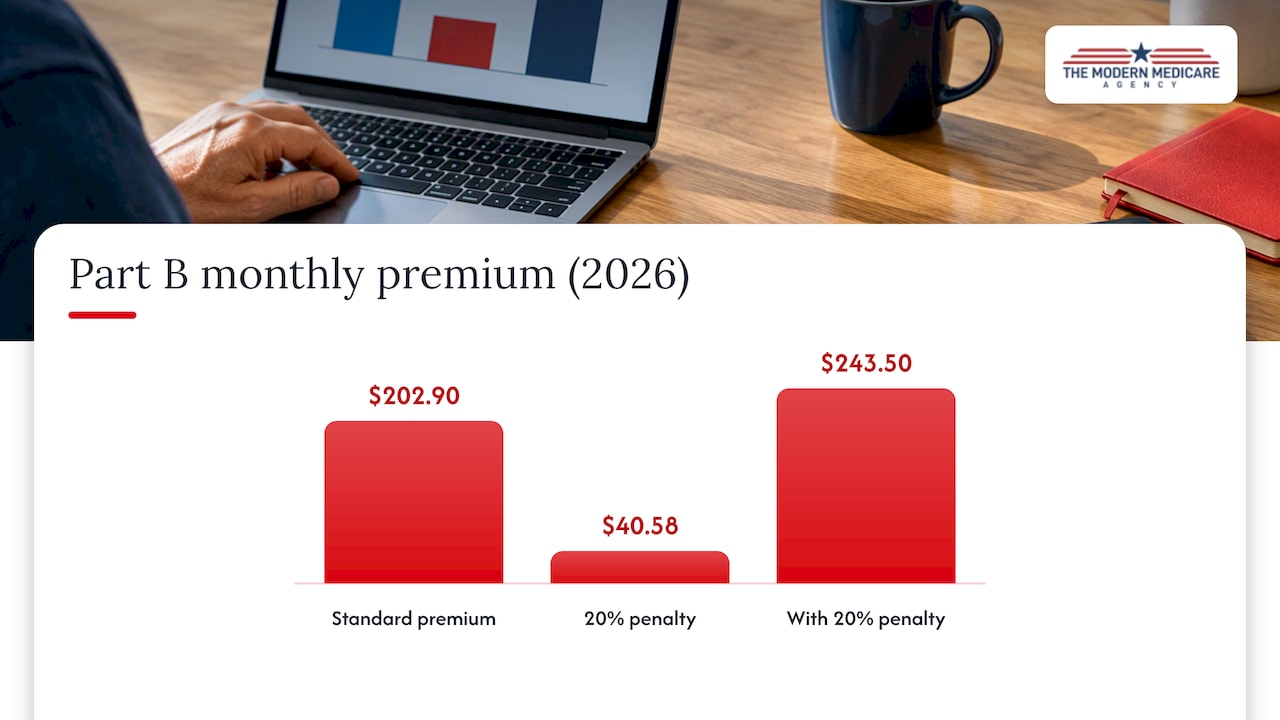
It is worth separating this penalty from IRMAA, the income-related monthly adjustment amount. IRMAA is a separate surcharge based on your income from two years prior, and it applies on top of whatever premium you owe, including any late enrollment penalty. The 10% late enrollment penalty is calculated against the standard premium only, specifically the $202.90 figure for 2026, before any IRMAA adjustment is layered on. For a deeper walkthrough of the math across different delay periods, our guide on how the Part B penalty is calculated covers additional scenarios.
How to Delay Part B the Right Way: A Step-by-Step Checklist
Delaying Part B correctly comes down to proving, on paper, that your coverage qualifies. Social Security will not simply take your word for it, so the documentation has to be airtight before you ever stop by an office or submit anything online.
Step 1: Confirm your coverage status with your benefits administrator. Ask directly whether your plan is a group health plan based on current employment, and get this confirmed in writing. If you are on your spouse’s plan, the same question applies to their employer.
Step 2: Collect your documentation. You will need:
- A completed CMS-L564 (“Request for Employment Information”), with the employer section filled out and signed by your employer.
- A completed CMS-40B (“Application for Enrollment in Medicare Part B”), filed when you are ready to enroll after your qualifying coverage ends.
- A written letter from your employer confirming active coverage, useful as backup if the employer is slow to complete the CMS-L564.
- Recent pay stubs showing health insurance premium deductions, which Social Security accepts as supporting evidence when employer paperwork is delayed.
Step 3: Submit through the right channel. You can submit these forms to Social Security online through your account, by fax, or by mail to your local Social Security office. Online submission tends to generate the fastest confirmation, while mail can take weeks longer to process, so build in extra time if you are filing near the end of your SEP window.
Step 4: Track everything. Note the date you submitted each form, request a confirmation number if one is offered, and keep copies of every document you send. If Social Security’s notice about your enrollment status is unclear or seems to contradict what you expected, a Social Security Office of the Inspector General report found that notices sometimes fail to clearly explain penalty consequences, which is one more reason to keep your own paper trail rather than relying solely on what the agency sends you.
Pro Tip: File your CMS-L564 and employer letter together, and submit at least 60 days before your SEP closes, so you have a buffer if Social Security requests additional verification.
For a complete walkthrough with downloadable checklists, see our 2026 guide to avoiding the Part B late enrollment penalty.
Special Cases: COBRA, Retiree Plans, HSAs, VA, and TRICARE
Several coverage types feel like they should protect you from the Part B penalty, and do not. Knowing the difference now avoids an expensive surprise later.
- COBRA and retiree plans: Neither one counts as coverage based on current employment, so neither one triggers a Special Enrollment Period when it ends. If you are on COBRA or a retiree plan and you are past your Initial Enrollment Period, you are already accruing penalty months even though you have active coverage.
- HSA contributions: Because Medicare entitlement is applied retroactively, often up to six months before your enrollment date, continuing HSA contributions right up until you enroll can trigger a tax penalty on contributions made during months you were technically already entitled to Medicare. The IRS recommends stopping contributions at least six months before you plan to apply.
- VA and TRICARE: Having VA benefits or TRICARE does not, on its own, protect you from the Part B late enrollment penalty. TRICARE for Life specifically requires Part B enrollment to maintain full benefits, so delaying Part B while relying on TRICARE can cost you coverage, not just add a premium surcharge.
- Employer size: When your employer has fewer than 20 employees, Medicare usually becomes the primary payer, and your group plan may stop covering claims properly until you enroll in Part B, regardless of what the SEP rules technically permit.
If You Missed Your Enrollment Window: What to Do Next
Missing the Initial Enrollment Period or a Special Enrollment Period is not the end of the road, but your options narrow considerably.
- Enroll during the General Enrollment Period. This runs January 1 through March 31 each year, with coverage starting July 1. Expect a coverage gap of several months depending on when in the year you missed your original window.
- Check whether you have grounds for penalty relief. Social Security will sometimes waive or reduce a penalty when you can show the delay resulted from misleading information from an employer, an SSA processing error, or another documented extraordinary circumstance. Keep any written correspondence, enrollment confirmations, or employer statements that support your case.
- File a request for reconsideration. This is a formal process through Social Security, and it typically requires supporting documents rather than a verbal explanation. If your situation involves complicated employer-size rules or conflicting paperwork, getting help from an independent agent before you file can prevent a weak appeal from being denied outright.
- Bridge the gap carefully. If you are facing a coverage gap before your GEP enrollment takes effect, look at short-term coverage options, but confirm with a licensed advisor that nothing you choose interferes with your eventual Medicare enrollment or Medigap eligibility.
For more on how penalties are assessed and how to understand their long-term cost, see our explainer on what the penalty for late Medicare enrollment actually means for your monthly premium.
Why Working With an Experienced Medicare Agent Matters Here
We have extensive experience working with Medicare consumers on enrollment and timing questions that affect people working past 65. The practical side of delaying Part B rarely comes down to understanding the rule in theory. It comes down to chasing a signed CMS-L564 from an HR department, figuring out whether a 15-person employer’s plan actually qualifies, or untangling a notice from Social Security that does not clearly explain why a penalty was applied.
Our agency helps with exactly these moments: confirming whether your coverage qualifies, gathering and checking the forms before they go to Social Security, timing your SEP filing to avoid a last-minute scramble, and walking through the appeal process if a penalty gets applied in error. If your situation involves a small employer, a recent COBRA transition, or a notice that does not match what you expected, that is usually the point where a conversation with an agent saves more than it costs, since our guidance costs you nothing out of pocket.
Our Take: The Real Risk Isn’t the Rule, It’s the Paperwork
The Part B delay rule itself is straightforward once you see it written out. It is a missing signature on a CMS-L564, an employer who takes six weeks to respond to a simple form, or an assumption that COBRA counts as active coverage when it does not.
Conventional advice tends to focus on the math of the penalty, which is useful but incomplete. The more consequential decision point is earlier: confirming, in writing, exactly what kind of coverage you have before you lean on it to delay enrollment. People with small employers get this wrong most often, assuming SEP protection applies universally when employer size can flip who pays first.
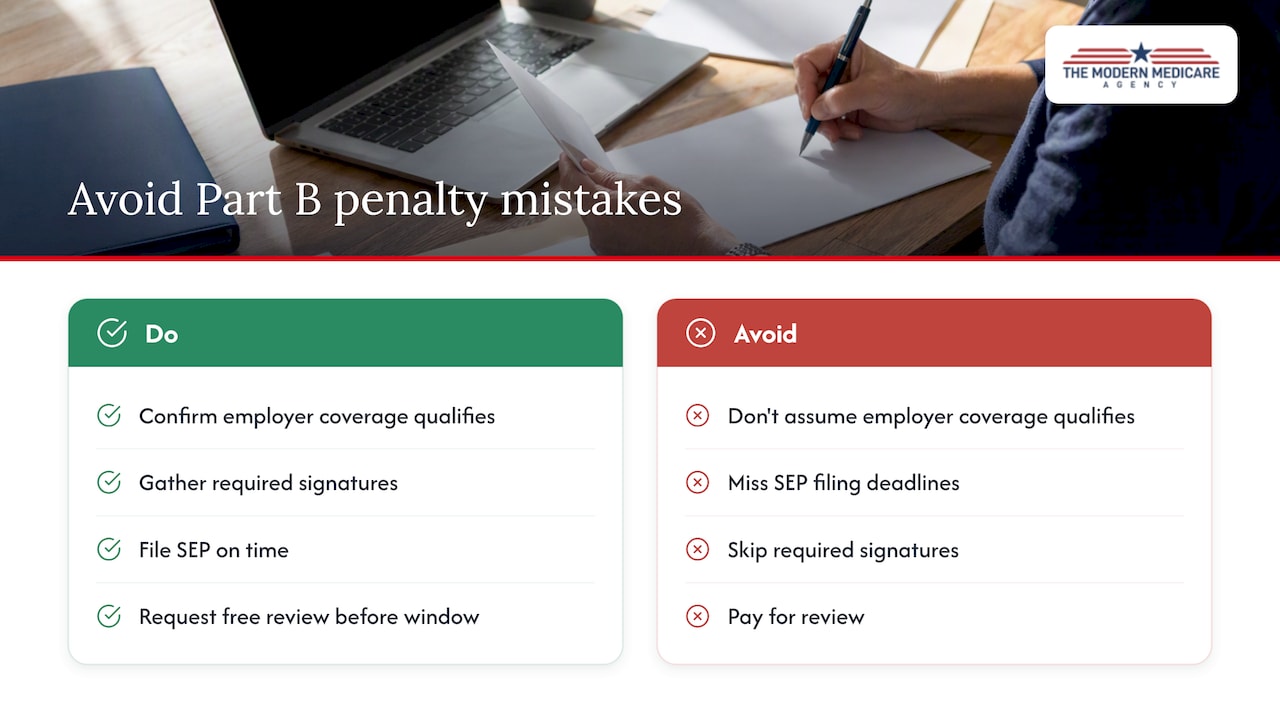
If there is one priority worth acting on now, it is this: get your coverage status confirmed in writing this month, not the month your SEP is about to close. Paperwork delays are the single most avoidable cause of permanent penalties.
— Paul
Get Help Avoiding Part B Penalties and Planning Next Steps
Figuring out whether your coverage qualifies, chasing down the right signatures, and timing an SEP filing correctly takes more effort than most people expect, and a single missed detail can mean a penalty that follows you for life. We spend time confirming the details that actually matter: whether your specific employer coverage qualifies, which forms you need, and when to file them so nothing slips past a deadline.

Once your Part B timing is settled, the next practical question is usually what to pair it with. If you are weighing a Medicare Supplement plan to fill the gaps Original Medicare leaves behind, or comparing it against Medicare Advantage coverage, we can walk through both with you at no cost. If your situation involves changing coverage outside a standard enrollment window, our partners at Sobal Nationwide Health also publish guidance on managing those transitions.
Our review and recommendations cost you nothing directly. Reach out through our Medicare Supplement page to set up a free review of your situation before your enrollment window closes.
This article is general information, not a substitute for advice from a qualified doctor. Consult a qualified healthcare professional about your own circumstances before acting on anything here.
FAQ
What happens if I delay Medicare Part B?
If you delay Part B without qualifying employer-based coverage, you accrue a permanent 10% penalty on your premium for every full 12 months you went without coverage after becoming eligible. If you do have qualifying employer coverage, delaying carries no penalty and you get an 8-month SEP once that coverage ends.
How does Trump’s new bill affect Medicare?
There is no verified, specific legislative change covered here that alters the Part B enrollment, SEP, or penalty rules described in this article. For the current rules governing enrollment and penalties, rely on Medicare’s official guidance rather than secondhand summaries of pending legislation.
How do I delay my Medicare Part B signing up?
You delay Part B by confirming you have group health coverage based on current employment, then holding off on enrollment until that coverage or the employment ends. At that point, your 8-month Special Enrollment Period begins, and you file a CMS-40B along with an employer-signed CMS-L564 to enroll without a penalty.
How do I get rid of a Part B late enrollment penalty?
You can request a reconsideration from Social Security if you believe the penalty was applied in error, such as from misleading employer information or an SSA processing mistake, and support the request with documentation. Removal is not guaranteed, so gathering strong evidence, like written employer statements or pay stubs, matters more than the request itself. For the mechanics of how the penalty is calculated and whether an appeal makes sense in your case, see our detailed breakdown of Part B penalty math.
Sources
- Avoid late enrollment penalties | Medicare
- Special Enrollment Period (working aged) | SSA (CMS-L564 guidance)