




The main routes for covering the gap before Medicare are COBRA, a Marketplace plan bought during a Special Enrollment Period with possible subsidies, Medicaid if your income qualifies, a spouse’s employer plan, a retiree group plan, or part-time work with benefits. The right pick depends on cost, timing, and how each option interacts with Medicare enrollment. If you just lost coverage, check your COBRA notice, apply for a Marketplace SEP, call your employer’s benefits office, and if you are near 65, call 1-800-MEDICARE.
TL;DR:
- Losing employer coverage opens a Marketplace enrollment window from 60 days before through 60 days after the loss, with subsidies based on household income.
- COBRA can preserve your employer plan for up to 18 months, but it does not extend your Medicare Part B enrollment deadline.
- After employer coverage ends, workers past 65 have eight months to enroll in Part B; missing that window can trigger a lifetime penalty.
- Enrolling in a retiree group plan can end Marketplace premium tax credits, but merely qualifying for that plan generally does not.
- Before choosing a Marketplace plan, verify your doctors and hospitals are in network, compare deductibles and out of pocket limits, and check coverage for prescriptions.
Table of Contents
- COBRA continuation coverage: how it works and when to use it
- Health Insurance Marketplace plans: SEP timing, subsidies, and comparing coverage
- Medicaid and safety-net programs: eligibility and state differences
- Spouse’s employer coverage and retiree group plans: what to check
- Part-time work or employer offers: bridging coverage by working longer
- How to decide: timeline, costs, and coordination with Medicare
- Agent checklist and common pitfalls from Paul Barrett
- Detailed explanation of Medicare Supplement plans and how they fill coverage gaps
- Comparison between Medicare Advantage plans and Medigap plans for retirees
- How Medicare Part D prescription drug coverage works and how to choose a plan
- Options for dental, vision, and hearing coverage for retirees
- Long-term care insurance options and how they complement Medicare coverage
- Publisher perspective: why early planning matters
- How we can help with your transition to Medicare
- FAQ
- Sources
COBRA continuation coverage: how it works and when to use it
COBRA lets you keep your employer group plan after your job ends, typically for up to 18 months, sometimes longer for specific qualifying events. The standard Medicare Part B premium runs $202.90 a month in 2026, which provides a point of comparison for anyone close to 65.
COBRA does not count as active employer coverage for Medicare purposes, so it will not delay your Part B enrollment deadline the way a current employer plan can. That makes timing critical if you are within a few months of 65.
COBRA tends to make sense when:
- You need to finish a short treatment course or surgery with your current providers before switching plans.
- Your coverage gap is brief, measured in weeks rather than months.
- Keeping the exact same doctors and network matters more than the premium difference.
Pro Tip: Confirm your COBRA election deadline in writing before assuming you have 60 days: missing it forfeits the option entirely.
Health Insurance Marketplace plans: SEP timing, subsidies, and comparing coverage
Losing employer coverage triggers a 60-day Special Enrollment Period on HealthCare.gov, and you can actually enroll any time from 60 days before your coverage ends to 60 days after. This window matters because missing it can leave you without Marketplace coverage until the next open enrollment.
Premium tax credits are based on household income and family size, and many retirees qualify for meaningful discounts. Subsidized Marketplace premiums often land between roughly $50 and $300 a month depending on income, which can beat COBRA by a wide margin for longer gaps.
When comparing plans, look past the premium:
- Confirm your current doctors and hospitals are in-network before switching.
- Compare deductibles and out-of-pocket maximums across metal tiers.
- Check the prescription drug formulary against your current medications.
Once Medicare begins, Marketplace coverage does not cancel itself. HealthCare.gov advises updating your application up to three months before your Medicare start date to avoid continuing to collect subsidies you are no longer eligible for.
Medicaid and safety-net programs: eligibility and state differences
Medicaid is means-tested, so eligibility depends on your household income and size, and the rules vary considerably from state to state. Some states expanded Medicaid eligibility more broadly than others, which means a retiree with the same income could qualify in one state and not in a neighboring one.
Checking eligibility starts with your state Medicaid agency’s website, which lists current income thresholds and enrollment contacts. If you qualify for both Medicaid and Medicare once you turn 65, known as dual eligibility, Medicaid can cover premiums, copays, and services Medicare does not, significantly lowering your out-of-pocket exposure.
A few things worth confirming early:
- Your state’s current income limit for the Medicaid category you would fall into.
- Whether your state has expanded Medicaid eligibility for adults under 65.
- How dual eligibility works if you expect to qualify for both programs later.
Spouse’s employer coverage and retiree group plans: what to check
If your spouse or partner is still working, their employer plan may let you enroll as a dependent, often during a qualifying life event like your own job loss. Eligibility rules and waiting periods vary by employer, so confirm the specifics with their benefits department rather than assuming standard terms apply.
Retiree group plans, offered by some former employers, sometimes bundle in dental or vision coverage alongside medical, and eligibility usually depends on years of service or a specific retirement date. Our guidance on coordinating Medicare with retiree coverage walks through how these plans typically interact once you turn 65.
One important trade-off: enrolling in retiree coverage can disqualify you from Marketplace premium tax credits, even if the retiree plan costs more than a subsidized Marketplace option would. Being merely eligible for retiree coverage, without enrolling, generally does not create the same restriction.
- Confirm whether your spouse’s plan allows mid-year dependent enrollment after a job loss.
- Ask whether a retiree group plan includes dental or vision, since many retirees assume it does automatically.
- Weigh the subsidy you would lose against what the retiree plan actually covers before enrolling.
Part-time work or employer offers: bridging coverage by working longer
Some retirees extend part-time work specifically to keep employer benefits, and this can work well if the employer is large enough to offer group coverage to part-time staff. Smaller employers often do not extend benefits below a certain hours threshold, so confirm this before counting on it.
Before assuming this path works for you:
- Ask HR the minimum weekly hours required to qualify for group health benefits.
- Confirm whether there is a waiting period before coverage starts.
- Find out what portion of the premium the employer actually covers versus what comes out of your paycheck.
Compared with COBRA or Marketplace plans, employer coverage through continued work often costs less and keeps your network intact, but it depends entirely on your employer’s willingness to offer it.
How to decide: timeline, costs, and coordination with Medicare
Start by mapping your current situation: do you have COBRA eligibility, a working spouse, a retiree plan offer, or none of the above? Then layer in timing, since enrollment windows are unforgiving.
Key deadlines to track:
- The Marketplace SEP runs 60 days before to 60 days after you lose employer coverage.
- Medicare’s Initial Enrollment Period spans three months before your 65th birthday to three months after.
- If you are still working past 65 with employer coverage, you get an 8-month Special Enrollment Period for Part B once that employment or coverage ends.
Missing the Part B window can mean a lifetime late-enrollment penalty and a gap in coverage, so this is not a deadline to treat loosely. For a full walkthrough of these windows, see our guide to Medicare enrollment periods.
On cost, a rough heuristic: COBRA usually costs the most per month but requires no paperwork beyond election, subsidized Marketplace plans often cost the least if your income qualifies, and Medicare Part B plus a Part D plan becomes the baseline once you turn 65.
Pro Tip: Call your former employer’s benefits office within a week of leaving: COBRA notices have strict deadlines, and delays can cost you the option entirely.
Next steps: contact your employer’s benefits office, apply for your Marketplace SEP if eligible, call 1-800-MEDICARE if you are within three months of 65, and talk to a licensed agent about how your specific timeline lines up.
Agent checklist and common pitfalls from Paul Barrett
We have experience helping retirees across the country navigate exactly these transitions. A few checks we walk through with clients before they settle on a bridge option:
- Confirm your Part A and Part B enrollment timing against your actual 65th birthday, not an assumed date.
- Verify whether your COBRA period counts toward your Medicare Special Enrollment Period eligibility, since it does not extend your window the way active employer coverage does.
- Compare Part D formularies against your current prescriptions before assuming any plan covers what you take.
- Check how a retiree group plan would coordinate with Medicare once you turn 65, since coordination-of-benefits rules determine which payer pays first.
The most common mistake we see is retirees assuming COBRA automatically delays their Medicare clock the same way employer coverage does. It does not, and that single misunderstanding causes most of the late-enrollment penalties we help clients avoid.
Pro Tip: Bring your COBRA election notice, a list of current medications, and your Social Security statement to any Medicare consultation: those three documents answer most of the timing questions upfront.
Detailed explanation of Medicare Supplement plans and how they fill coverage gaps
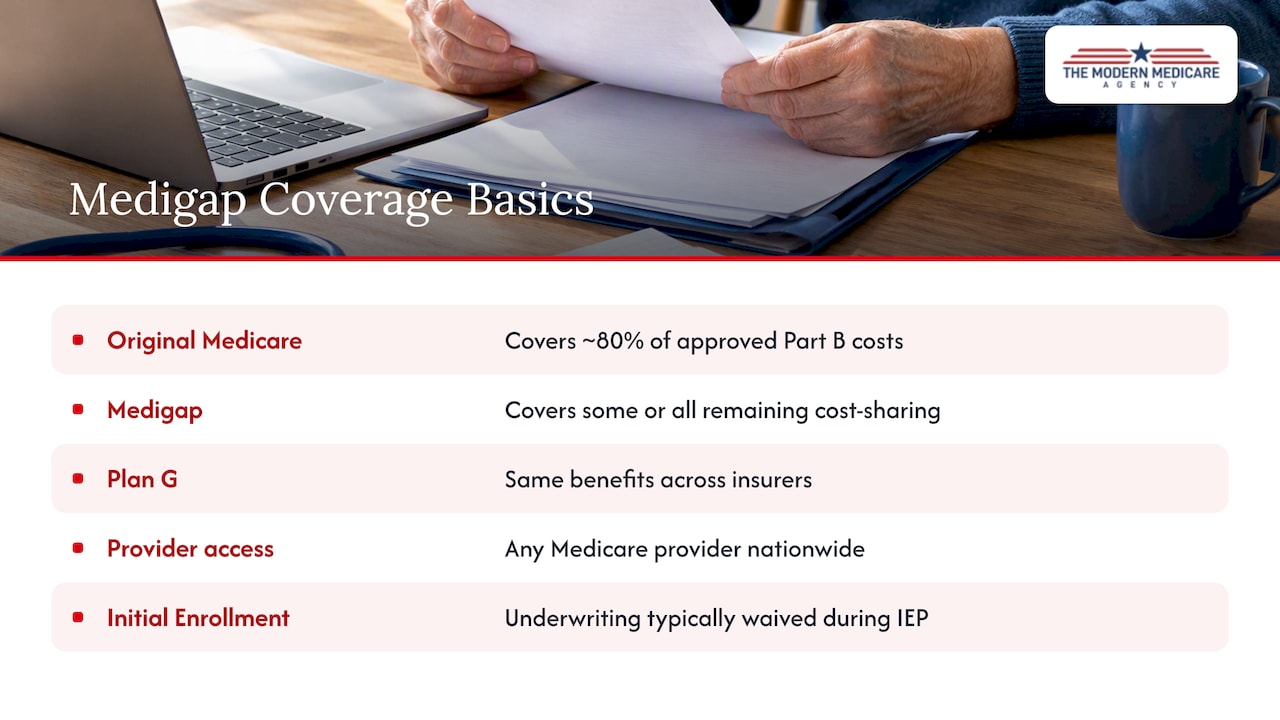
Medicare Supplement plans, also called Medigap, are designed to work alongside Original Medicare rather than replace it. Original Medicare covers roughly 80% of approved costs for Part B services, and Medigap is built to pick up some or all of the remaining coinsurance, copayments, and deductibles depending on the plan letter you choose.
Each Medigap plan is standardized by letter, meaning Plan G from one insurer covers the same benefits as Plan G from another, though premiums vary by carrier and region. This standardization is part of what makes comparison shopping straightforward once you understand the plan letters.
Medigap plans also let you see any provider who accepts Medicare nationwide, without referrals or network restrictions, which matters for retirees who split time between states or travel frequently. The trade-off is a separate monthly premium on top of your Part B premium, since Medigap does not include drug coverage, so most enrollees pair it with a standalone Part D plan.
For retirees coming off COBRA or a Marketplace plan, Medigap is worth evaluating during your Initial Enrollment Period because medical underwriting rules are typically waived during that window. Outside that window, insurers in most states can ask health questions and decline coverage or charge more. Our comparison of Original Medicare against Medicare Advantage covers how this choice interacts with your decision to add a Medigap plan.
Comparison between Medicare Advantage plans and Medigap plans for retirees
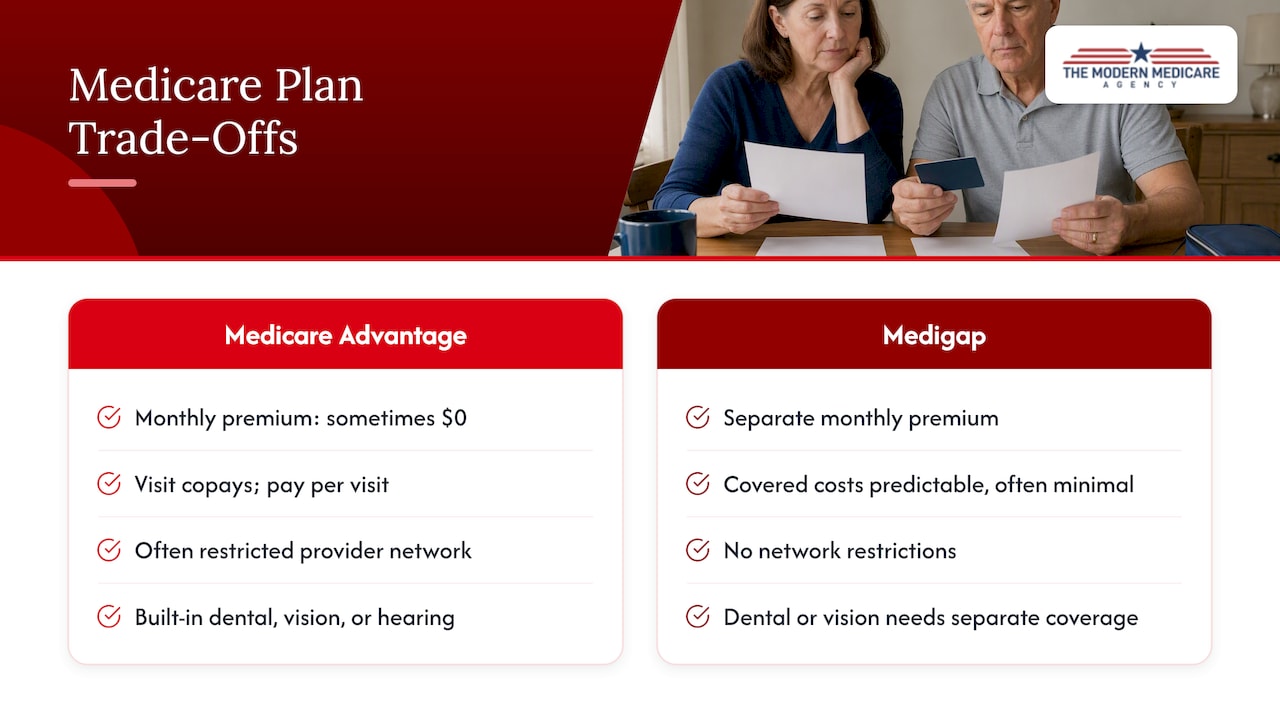
Medicare Advantage plans bundle Part A, Part B, and usually Part D into one plan administered by a private insurer, often with added benefits like dental, vision, or hearing coverage built in. Premiums can be low, sometimes $0, but you typically pay copays for each visit and are often restricted to a network of providers, similar to an HMO or PPO structure you may recognize from employer coverage.
Medigap works differently: you pay a separate monthly premium, but once that is in place, your out-of-pocket costs for covered services are predictable and often minimal, and you are not restricted to a network. The trade-off is that Medigap does not typically include extra benefits like dental or vision, so those need separate coverage.
For a retiree who traveled frequently for work or splits time between two states, the network flexibility of Medigap often outweighs the lower upfront premium of Medicare Advantage. For someone who stays local and wants built-in extra benefits with a lower monthly cost, Medicare Advantage can be the more practical fit. Our side-by-side guide to choosing between Medicare Advantage and Medicare Supplement walks through this decision in more depth, including how your current health status and provider preferences should factor in.
How Medicare Part D prescription drug coverage works and how to choose a plan
Part D plans are sold by private insurers and cover prescription drugs that Original Medicare does not. The Part D national base premium for 2026 is $38.99, though actual plan premiums vary based on the insurer and coverage tier you select, and Part B carries a separate annual deductible of $283 in 2026.
Choosing a plan comes down to formulary match: every Part D plan maintains a list of covered drugs organized into tiers, and the tier your medications fall into determines your copay. The cheapest premium is not always the cheapest plan overall if your prescriptions fall into a high-cost tier or are not covered at all. Our complete guide to Part D prescription drug coverage covers how to run this comparison against your actual medication list rather than guessing from premium alone.
Enrolling late, without other creditable drug coverage, can trigger a permanent late-enrollment penalty added to your premium for as long as you have Part D, which makes this a decision worth making deliberately rather than skipping.
Options for dental, vision, and hearing coverage for retirees
Original Medicare does not cover routine dental, vision, or hearing services, which surprises many new retirees. Some Medicare Advantage plans include these benefits, though the scope varies significantly between plans, from basic cleanings to more comprehensive coverage.
For retirees who choose Original Medicare plus Medigap, standalone dental insurance fills this gap directly. Standalone plans typically cover preventive care like cleanings and exams at little to no cost, with coinsurance applying to larger procedures like crowns or dentures. Our guide to dental insurance plans covers how these standalone policies compare for retirees who went the Medigap route and need separate coverage.
Vision and hearing follow a similar pattern: routine eye exams and hearing tests are sometimes bundled into Medicare Advantage extras, while Original Medicare enrollees typically need a standalone policy or plan to pay out of pocket for routine exams, glasses, or hearing aids.
Long-term care insurance options and how they complement Medicare coverage
Medicare covers only limited, short-term skilled nursing or rehabilitation care under specific conditions, not ongoing custodial care like help with daily living activities. This is one of the most misunderstood gaps in Medicare coverage, and it is where long-term care insurance fills a real need.
Long-term care policies are designed to cover costs Medicare does not, including extended nursing home stays, assisted living, and in-home custodial care, often for years rather than the limited weeks Medicare might cover after a hospital stay. Premiums depend heavily on your age and health at the time you apply, which is why many financial planners suggest considering a policy well before you need the coverage, ideally in your 50s or early 60s.
For retirees already managing COBRA, Marketplace, or Medigap decisions, long-term care insurance is a separate but complementary piece of the puzzle rather than a replacement for any of those choices. It works alongside whatever medical coverage you choose, addressing the custodial care gap that none of the other options are built to cover.
Publisher perspective: why early planning matters
What we have seen over the years is that retirees who start mapping their coverage timeline three to six months before a job change rarely scramble, while those who wait until a coverage letter arrives often miss a window they did not know existed. The 60-day and 8-month clocks do not pause for anyone, and a missed deadline tends to cost far more than a planning conversation would have. If you are even considering retiring before 65, start the timeline now rather than when the notice shows up.
— Paul
How we can help with your transition to Medicare
We built our practice around helping retirees sort through exactly these decisions, from comparing COBRA against a subsidized Marketplace plan to timing your Medicare enrollment so nothing slips through the cracks. As independent agents with access to many carriers, we are not tied to pushing one insurer’s product, so our plan reviews focus on what actually fits your prescriptions, your providers, and your budget.

Our work covers Medicare Supplement and Medicare Advantage plan selection, Part D formulary comparisons, and coordinating the switch from retiree or Marketplace coverage once your Medicare start date approaches. If working with a home care coordination service is part of your planning, partners like Boss Healthcare handle that side of care coordination, while we focus on getting your insurance coverage right from day one.
If you want a free, no-pressure review of your Medicare Supplement options, reach out to our team and we will walk through your timeline together.
This article is general information, not a substitute for advice from a qualified doctor. Consult a qualified healthcare professional about your own circumstances before acting on anything here.
FAQ
What is a retiree healthcare account?
A retiree healthcare account, often a Health Reimbursement Arrangement or Health Savings Account carried into retirement, is a fund set aside specifically to reimburse qualified medical expenses after you stop working. Some employers fund these accounts as part of a retiree benefits package, while HSAs are individually owned and can be used tax-free for qualified expenses including Medicare premiums.
Is $600,000 enough to retire at 62?
Whether any specific savings figure is enough depends on your expected expenses, health status, Social Security timing, and how you plan to cover health insurance until Medicare starts at 65. Health coverage costs for those three years, through COBRA or a Marketplace plan, should be built into that calculation specifically rather than assumed as a minor expense.
Which states have the best healthcare for retirees?
There is no single official ranking of “best” states for retiree healthcare, since Medicaid eligibility, Marketplace plan availability, and Medicare Advantage plan options all vary by state and even by county. The most reliable approach is checking your own state’s Medicaid income limits and comparing available Marketplace and Medicare plans directly for your area.
How much does the average retiree pay for health insurance?
Costs vary widely based on the path chosen: COBRA premiums commonly run from several hundred dollars to over a thousand per month, while subsidized Marketplace plans often cost between roughly $50 and $300 monthly depending on income. Once Medicare begins, the standard Part B premium is $202.90 a month in 2026, plus any Part D or Medigap premium you add.