




An annuity can cost you to leave before its surrender period ends. In 2026, surrender periods commonly last six to eight years, and charges are typically around 7% of the amount withdrawn. Knowing what the surrender charge on an annuity is can help you understand how much of your money you may receive if you take funds out early.
It’s understandable to feel uncertain when you need access to money and your contract has unfamiliar rules. A surrender charge is a fee the insurer may deduct from a withdrawal during a set period, and the percentage often declines over time. Some contracts also allow limited withdrawals without a charge, while others do not.
This article explains how the fee is calculated, what a declining schedule can look like, and how a 1035 transfer to another annuity may still involve surrender charges. You’ll also see why the contract’s terms matter: they determine when a charge applies, how much is exempt, and what other effects a withdrawal may have.
Key Takeaways
- Whether a withdrawal triggers a surrender charge depends on the contract’s schedule and any amount it lets you take out without a charge.
- Some contracts waive charges in specific situations, so the circumstances and terms that apply can matter as much as the withdrawal itself.
- A declining schedule can reduce the charge over time; the article’s example shows how rates may change from one contract year to the next.
- A 1035 transfer to another annuity may still be subject to surrender charges on the contract being transferred.
- Keep the insurer’s charge separate from possible taxes or an IRS early-withdrawal penalty when considering what you may owe.
How exactly does a surrender charge work?
A surrender charge is a fee an insurer may apply to certain withdrawals during an annuity’s surrender period. Understanding what the surrender charge on an annuity is can make the contract’s withdrawal rules easier to follow.
Free Withdrawal Provisions
A free-withdrawal provision lets you take a permitted portion of your annuity without a surrender charge. This allowance can give you access to funds while leaving the rest of the contract in place.
Some contracts allow withdrawals of up to 10% each year without a surrender charge; others don’t allow free withdrawals. The contract determines how the amount is measured and whether the provision applies to each withdrawal or to the total taken during that period.
For example, if you request more than your contract’s permitted free-withdrawal amount, the allowance may protect the permitted portion while the excess is subject to a surrender charge. This explains why the fee may apply to only part of a withdrawal, not the full amount requested.
Early Withdrawal Charges
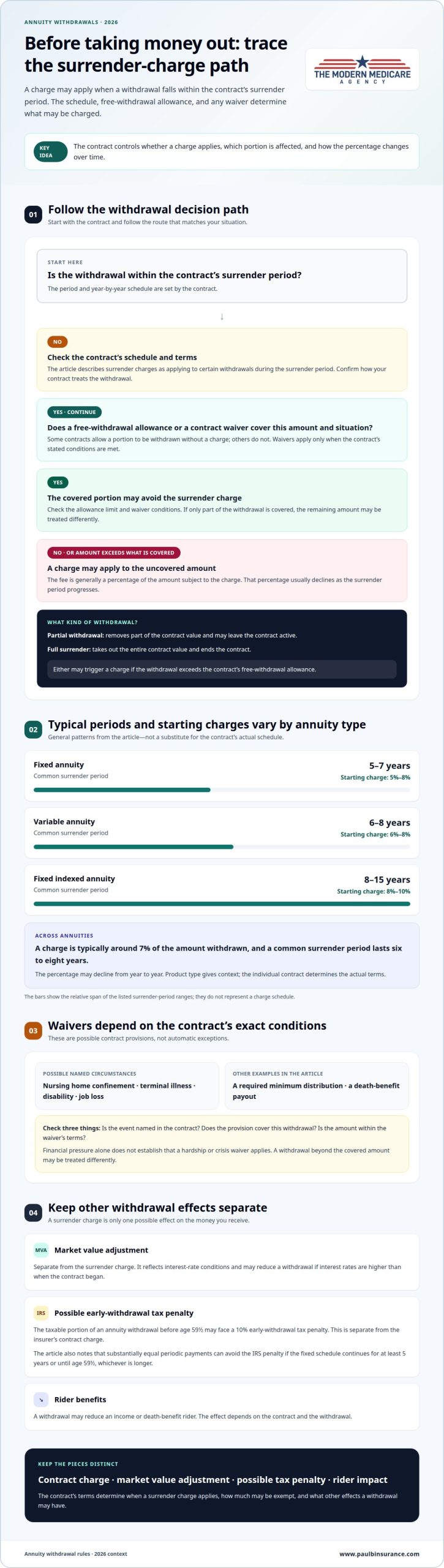
An early withdrawal charge may apply when money leaves an annuity during its surrender period. It is generally calculated as a percentage of the amount withdrawn, and that percentage usually decreases as the period progresses.
A full surrender takes out the entire contract value and ends the contract. A partial withdrawal removes only part of the value and may leave the contract active. Either can trigger a charge if the withdrawal exceeds the contract’s free-withdrawal allowance.
Withdrawals can also affect annuity benefits. For example, taking money from a contract with an income or death-benefit rider may reduce that benefit. The effect depends on the contract and the withdrawal, so consider how the rider supports your plans before taking funds out.
The Internal Revenue Service says substantially equal periodic payments can avoid the IRS penalty if the fixed payment schedule continues for at least 5 years or until age 59 1/2, whichever is longer. That tax rule is separate from the insurer’s surrender charge.
Withdrawal Types and Adjustments
A market value adjustment, or MVA, changes the amount paid based on interest-rate conditions. It is separate from a surrender charge, which is set by the contract. An MVA may reduce a withdrawal if interest rates are higher than when the contract began.
Tax penalties are different again. According to the Internal Revenue Service, the taxable portion of an annuity withdrawal before age 59 1/2 may face a 10% early-withdrawal tax penalty. The surrender charge comes from the contract, the MVA reflects its adjustment terms, and the tax penalty arises under federal tax rules.
For a partial withdrawal, what the surrender charge on an annuity is depends on which portion is subject to the fee. A full surrender may affect the entire amount withdrawn. In either case, consider the combined effect on the cash you receive, your income, and any rider benefits before deciding.
What is a typical annuity surrender charge?
Yes. Surrender periods and starting charges can differ across fixed, variable, and fixed indexed annuities. Fixed annuities commonly have periods of 5 to 7 years and starting charges of 5% to 8%. Variable annuities commonly have periods of 6 to 8 years and starting charges of 6% to 8%. Fixed indexed annuities commonly have periods of 8 to 15 years and starting charges of 8% to 10%.
Across annuities, a charge is typically around 7% of the amount withdrawn. A common surrender period lasts six to eight years, but the contract’s schedule determines the charge for each year. These figures are general patterns, not a single schedule that applies to every contract. The product type offers context; the contract controls the actual terms.
When a contract may waive the charge
Some annuity contracts waive surrender charges in specific situations. Examples may include nursing home confinement, terminal illness, or taking a required minimum distribution. Other contracts may include waivers for job loss, disability, or a death-benefit payout. These are contract provisions, not automatic exceptions that apply to every annuity.
Required minimum distributions are one example. A contract may waive its charge when a federally mandated distribution is due, but the waiver depends on the contract’s terms. A withdrawal beyond the amount covered by the waiver may be treated differently. The key is whether the stated circumstance applies to that withdrawal.
Crisis and hardship waivers
A crisis waiver may provide relief when a contract names an event such as terminal illness or nursing home confinement. A hardship waiver may cover circumstances such as disability or job loss, if those events appear in the contract. The exact trigger matters. Financial pressure alone does not establish that a waiver applies.
For example, two annuity owners facing medical costs could have different outcomes. One contract might include a nursing home waiver, while another does not. A terminal illness provision may also set specific conditions. The event, covered withdrawal, and timing all affect whether the charge is waived.
When considering a retirement decision, separate the waiver question from the reason for taking money out. Identify the event listed in the contract, then compare it with the circumstances and amount of the withdrawal. A waiver may reduce the insurer’s charge, but it does not necessarily remove other tax consequences or contract adjustments. Keeping these effects distinct helps clarify the impact on your investments.
Explore annuity guidance to better understand how contract terms can fit your retirement needs.
Typical surrender-charge rates and declining schedules
A typical surrender charge is around 7% of the withdrawal amount, but the rate depends on the contract year. A common schedule decreases over time, often by roughly 1 percentage point each year. This gradual decline can make the timing of a withdrawal important, especially when you need access to retirement savings.
How declining schedules work
The insurance company applies the listed percentage to the amount subject to the charge. As the surrender period progresses, that percentage decreases until the schedule reaches zero. Your contract’s schedule, rather than a general rate, determines the charge.
For example, a hypothetical schedule might charge 6% in year one, then 5% in year two, and 4% in year three. It could fall to 3% in year four, 2% in year five, and 1% in year six, reaching zero by year seven. The exact schedule varies by contract.
Example schedule and withdrawal calculation
Consider a hypothetical contract with a $10,000 withdrawal subject to its charge. The difference comes from the schedule, not from a change in the withdrawal amount.
| Contract year | Example charge rate | Charge on $10,000 |
|---|---|---|
| Year one | 6% | |
| Year two | 5% | |
| Year three | 4% | $400 |
| Year four | 3% | |
| Year five | 2% | |
| Year six | 1% | |
| Year seven | 0% |
This example shows why the contract year matters. A free-withdrawal allowance may also exempt part of a payment, so the listed rate might apply only to the remaining amount. Surrender charges are separate from income tax, which may also apply to taxable withdrawals.
Finding the rate in your contract
To find your charge, locate the contract’s surrender-charge schedule and match your withdrawal date to its contract year. Then look for free-withdrawal provisions and any separate schedule for later premium payments. Some contracts start a new surrender period for each additional payment, so the original purchase date may not determine every rate.
Use the schedule to estimate the charge on the amount subject to it, then account for any applicable free-withdrawal portion. This gives you a clearer estimate of how much the withdrawal may reduce your available funds and affect your ability to keep payments or other annuity benefits intact.
1035 Transfers and surrender charges
A transfer from one annuity to another is also called a 1035 exchange. It can change where your annuity funds are held, but it doesn’t automatically remove charges attached to the original contract. In the United States, a 1035 transfer remains subject to any surrender charges on that contract.
That distinction matters when you’re weighing a financial change. A new annuity may offer a benefit that better suits your situation, but transferring before the original surrender period ends can still trigger a charge under the old contract. The fee depends on its schedule and the amount subject to the charge, not simply on the fact that you’re moving funds.
How the existing charge can apply
Think of the 1035 exchange and the surrender schedule as separate parts of the decision. The exchange describes moving an annuity to another annuity. The surrender charge is a contract cost that may apply to the funds leaving the original annuity.
For example, if an original contract has a surrender charge during its current period, transferring its value does not by itself erase that charge. The contract’s rate and any applicable free-withdrawal provision determine the amount. A transfer can therefore carry a cost even if you are not asking to receive the funds as cash.
Keep charges and tax penalties distinct
A surrender charge is assessed under the annuity contract. An IRS early-withdrawal penalty is a separate tax issue and does not replace or cancel the insurer’s charge. Treatment depends on the transaction and the tax rules that apply to the funds.
For context, the research example of a $20,000 surrender before age 59½ shows a separate IRS penalty of $2,000, in addition to ordinary income tax and the insurer’s surrender charge. That example concerns a surrender, not a rule that every 1035 exchange incurs the same penalty. Keep the potential costs distinct when assessing a proposed transfer.
Before deciding, identify the original contract’s surrender period, current rate, and amount subject to the charge. Then compare that cost with the benefit you expect from the new arrangement. If the original contract has a rolling schedule, later premium payments can have separate surrender periods, so the contract’s age alone may not reveal every applicable charge.
A 1035 exchange can be worth considering when your financial situation or goals have changed, but the transfer does not make the old contract’s terms disappear. A clear comparison includes the existing surrender charge, possible tax consequences, and the purpose of changing annuities. That helps you understand the cost of leaving before weighing the new contract’s potential benefits.
Definition of annuity surrender charges
In 2026, an annuity surrender charge is a fee the insurer may deduct when you withdraw money during the contract’s surrender period. It can apply to a full surrender or to a withdrawal amount above the contract’s permitted free portion. In practical terms, it reduces the money you receive from that transaction.
The fee is part of the contract, not a separate payment made in advance. An insurer may use surrender charges to recover contract setup expenses, including commissions. The charge can also discourage buyers from using a deferred annuity as a short-term place to hold money they may soon need.
For example, imagine an annuity owner who needs funds before the surrender period ends. The contract’s terms determine whether a charge applies and how it is calculated. If the withdrawal is subject to a percentage charge, the insurer deducts that amount from the proceeds, so the owner receives less than the amount requested.
This definition distinguishes the charge from the annuity’s premium and account value. A premium is money paid into the contract; a surrender charge applies when money leaves under conditions described in the contract. The distinction matters when estimating what will be available for an unexpected expense or a change in retirement plans.
The charge is also different from a tax bill. An insurer assesses a surrender charge under the contract, while income tax rules apply separately to taxable withdrawals. For an owner taking money out early, both costs can affect the same transaction but arise for different reasons. Treating them separately makes the financial effect easier to understand.
A surrender charge is a contract feature with a defined purpose and time frame. It can affect your access to funds, but it does not mean every withdrawal has the same result. A contract may allow a portion to be withdrawn without a fee, while a larger amount may trigger one. The terms and timing determine how the charge applies.
Before paying a charge, connect the reason for the withdrawal with the contract’s terms. Someone considering a full surrender faces a different decision from someone taking only a limited portion. The potential fee, remaining benefits, and need for accessible funds all matter. A careful review can clarify whether keeping the original contract or changing course better fits your situation.
Discuss annuity contract features to better understand how an annuity may fit your needs.
The Modern Medicare Agency
The Modern Medicare Agency helps people compare insurance options and understand how coverage choices fit their needs. If annuity withdrawal rules have you reconsidering your broader insurance picture, the agency’s independent guidance can help clarify your decisions. It offers Medicare Advantage Plans, Medicare Supplement (Medigap) Plans, Medicare Part D Plans, and Life Insurance.
Annuity surrender charges depend on contract terms, while insurance decisions can affect other parts of your protection. The Modern Medicare Agency can help you compare its insurance options and consider how they fit your priorities. This guidance may be useful when you want a clearer view of coverage choices alongside a changing financial situation.
For a calm conversation about your insurance options, contact The Modern Medicare Agency.
Make Your Next Decision With Confidence
In 2026, a financial decision about an annuity can be part of a wider conversation about security and future needs. Understanding what the surrender charge on an annuity means is one piece of that picture. The next step is to consider how your choices fit together, without letting one contract term define every decision.
Give yourself room to weigh what matters most. Your priorities may change, and a thoughtful conversation can help you gain clarity about the insurance options available for your situation. The Modern Medicare Agency offers personalized guidance as you explore coverage choices and decide how to move forward.
Start a conversation with The Modern Medicare Agency when you’re ready to discuss your insurance needs. A clearer path begins with one considered step, and you can take that step when it feels right.
Frequently Asked Questions
What Is a Surrender Period?
A surrender period is the span when certain withdrawals can trigger a contract charge. It commonly lasts three to 10 years, and some contracts extend to 15 years. The period’s start date matters: some annuities apply a separate schedule to each later premium payment. That means a newer contribution can still be within its own charge period even after the original payment’s schedule has ended.
What Is an Annuity?
An annuity is a contract with an insurance company. You pay premiums into it, and under its terms, the contract can provide income payments. These payments may be monthly, quarterly, or annually. Some annuities are designed to provide income soon after purchase, while deferred annuities begin paying income later. The contract explains how its payments, withdrawals, and benefits work, so annuities can function differently.
Are there other ways to withdraw money without a surrender charge?
Yes. Depending on the contract, you may use a permitted free-withdrawal amount, qualify for a specific waiver, or wait until the surrender period ends. Some contracts allow withdrawals of up to 10% each year without a surrender charge; others offer no free withdrawals. For example, if you need only part of your funds, a contract’s free-withdrawal provision may let you access that portion without paying the charge.
What is the difference between surrendering and selling an annuity?
Surrendering means asking the insurer to end the contract and pay its surrender value under the contract terms. Selling generally means transferring rights to some or all future payments in exchange for payment from a buyer. These choices affect your annuity differently: surrendering ends the contract, while selling can change who receives future payments. Consider the effect on your income and remaining benefits before choosing.
What should you consider?
Consider how much money you need, whether the contract allows a free withdrawal, and whether a charge or market value adjustment applies. Also weigh possible changes to income or rider benefits, along with tax consequences. A smaller withdrawal may leave the contract active, while a full surrender ends it. Compare the cash you receive with the benefits and access you give up.
What is an annuity surrender charge?
An annuity surrender charge is an insurer’s contract fee for certain withdrawals during a set period. Insurers may use these charges to recover contract setup expenses, including commissions. It is not the same as income tax or an IRS penalty. For instance, a withdrawal may be subject to a contract charge even though its tax treatment is determined separately. The contract sets when and how the fee applies.
How are annuity surrender charges calculated?
The insurer generally calculates the charge as a percentage of the withdrawal amount subject to the fee. To estimate it, identify the applicable rate, subtract any amount exempt under the contract, then apply the rate to the remaining portion. With a rolling schedule, the calculation may differ across payments because each later premium may have its own surrender period. A market value adjustment is separate from this calculation.
What are typical annuity surrender charge rates and periods?
Rates and periods vary by annuity type and contract. Fixed annuities commonly have surrender periods of 5 to 7 years and starting charges of 5% to 8%; variable annuities commonly have periods of 6 to 8 years and starting charges of 6% to 8%. Fixed indexed annuities commonly have periods of 8 to 15 years, with starting charges of 8% to 10%. The schedule determines the charge for a particular withdrawal.

Article by
Paul Barrett
Paul Barrett, CMIP is the founder of The Modern Medicare Agency, an independent Medicare-only brokerage based in Melville, NY. With 18 years of Medicare-exclusive experience, a CMIP designation, and more than 5,000 clients served across 37 states, Paul is one of the most credentialed independent Medicare specialists on Long Island — and one of the most direct.
He represents 40+ carriers with no quotas and no allegiances, which means his recommendations are based entirely on what fits each client's specific situation. He is the author of Medicare Mastery Unlocked and host of the Wise Guys Retirement Talk podcast. His content is grounded in primary sources, real carrier intelligence, and 18 years of watching what happens when people get Medicare right — and when they don't.
📞 631-358-5793 | paulbinsurance.com