




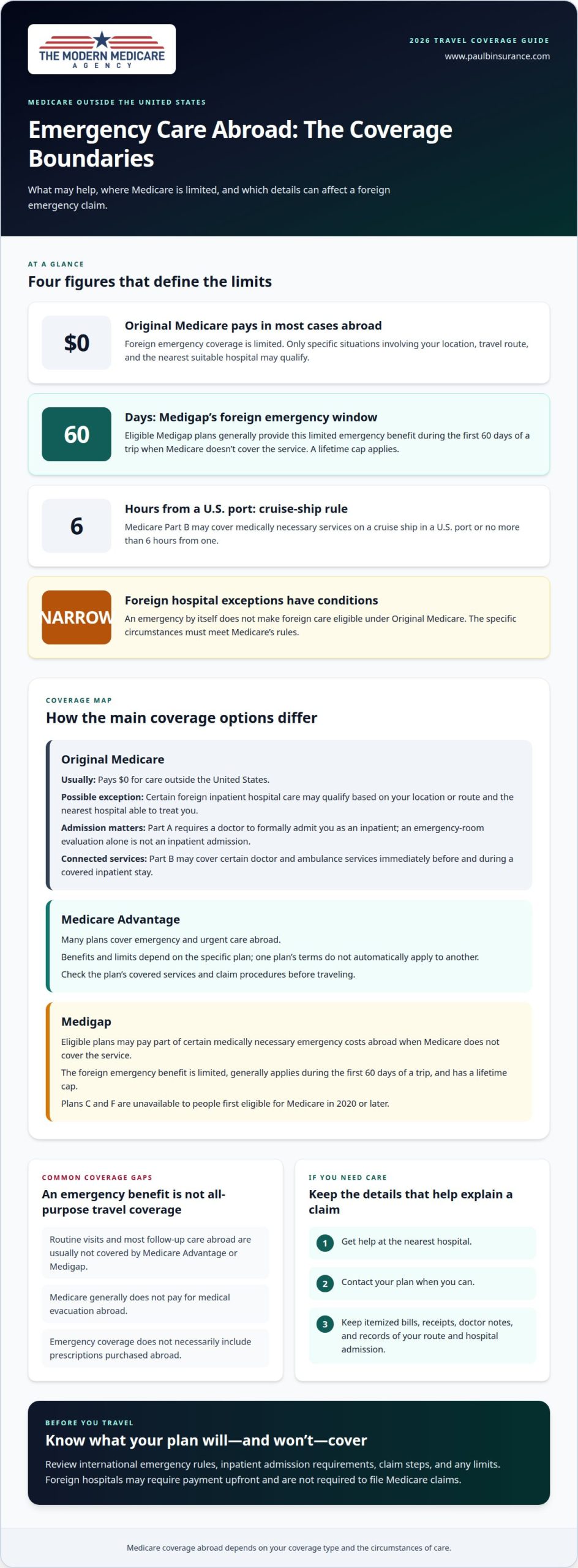
A medical emergency abroad can leave you dealing with two worries at once: getting care and understanding who will pay. In 2026, Medicare coverage for emergency services abroad is limited. Original Medicare pays $0 in most cases, although narrow exceptions apply. Some Medicare Advantage plans may cover emergency care outside the United States, while evacuation costs are usually not covered by Medicare.
It’s understandable to expect your coverage to travel with you, especially when an emergency can happen without warning. What Medicare covers abroad depends on your type of coverage and the circumstances, so understanding the differences can help you prepare before a trip.
This guide explains when Original Medicare may cover care abroad, how Medicare Advantage and Medigap benefits may help, and what to know about medical bills, prescriptions, and evacuation. Emergency coverage doesn’t necessarily include routine care or transportation home, so it’s important to understand where gaps may arise.
Key Takeaways
- Original Medicare’s foreign coverage is limited to specific situations involving inpatient hospital care, so the circumstances of an emergency matter.
- Medicare Advantage plans may include emergency benefits abroad, while Medigap offers limited foreign emergency coverage under eligible plans.
- Emergency coverage doesn’t necessarily include routine follow-up care, prescriptions bought abroad, or medical evacuation to the United States.
- Overseas providers may require payment upfront, so keep medical bills, receipts, and doctor notes in case you need to submit a claim.
- Medicare Part B may cover medically necessary services on a cruise ship in a U.S. port or no more than 6 hours from one, according to the Centers for Medicare & Medicaid Services.
Will Medicare cover me while I’m traveling abroad?
Original Medicare pays $0 in most cases for care outside the United States, with a few narrow exceptions. If you need emergency care overseas, get help at the nearest hospital, contact your plan when you can, and keep itemized bills and doctor notes.
Exceptions for Foreign Emergency Care
Original Medicare may cover foreign hospital care in specific situations involving your location, route, and the nearest hospital able to treat you. An emergency alone does not make care abroad eligible. For example, care may qualify when an emergency begins in the United States and a foreign hospital is closer than the nearest suitable U.S. hospital.
You may also qualify when traveling directly between Alaska and another U.S. state through Canada. The trip must have no unreasonable delay, and the Canadian hospital must be closer than the nearest U.S. hospital able to treat the emergency. Keep records of your route and hospital admission, as these details help explain how the exception applies.
Eligibility at Foreign Hospitals
Eligibility depends on whether your care meets a Medicare exception and its conditions. Medicare Part A covers foreign hospital care when a doctor formally admits you as an inpatient. A hospital visit or emergency-room evaluation alone does not establish inpatient admission. This distinction matters because Part B may then cover doctor and ambulance services immediately before and during a covered stay.
Medically necessary ambulance transportation to a foreign hospital may qualify only when you’re admitted for covered inpatient hospital services. Foreign hospitals aren’t required to file Medicare claims. If the hospital doesn’t submit one, you may need an itemized bill for eligible inpatient, doctor, and ambulance services.
Foreign Inpatient Hospital Coverage
Foreign inpatient coverage is limited to specific situations where the hospital’s location or your travel route meets Medicare’s rules. As a U.S. resident, you may qualify when a foreign hospital is closer to your home than the nearest U.S. hospital able to treat your condition, even without an emergency. The comparison is about the hospital’s ability to provide the care you need, not simply its distance from any U.S. facility.
Medicare may also cover foreign inpatient care when you travel directly between Alaska and another U.S. state through Canada, subject to the route and hospital conditions above. In either case, a doctor’s inpatient admission order matters for Part A. Part B may cover certain doctor and ambulance services connected to that covered stay.
Lifetime Limit for Travel Emergencies
This is separate from Original Medicare’s narrow exceptions for foreign hospital care. The lifetime cap applies across eligible claims over time, rather than resetting for each trip.
Medigap emergency benefits generally apply during the first 60 days of a trip when Medicare doesn’t cover the services. That benefit does not make routine foreign care eligible. Before traveling, review how your coverage treats emergency services, inpatient admission, and bills paid directly to a foreign hospital.
Medicare Advantage and Medigap international benefits
In 2026, international benefits depend on whether you have a Medicare Advantage plan or Medigap. Their emergency protections differ, and neither should be assumed to cover every expense abroad.
International Benefits by Plan Type
Medicare Advantage and Medigap can help with certain emergency care outside the United States, but their benefits work differently. Many Medicare Advantage plans cover emergency and urgent care abroad, subject to plan-specific limits. Your plan type determines which rules and limits apply.
Routine visits and most follow-up care abroad are usually not covered by either option. Before traveling, review your plan’s international emergency rules, including covered services and claim procedures. A Medicare Advantage plan’s terms may differ from another plan’s, so benefits aren’t interchangeable. Medicare Advantage plan options can help you understand the coverage choices relevant to your needs.
Medigap Emergency Care Abroad
Eligible Medigap plans can pay part of certain medically necessary emergency costs during foreign travel. Plans C and F are unavailable to people first eligible for Medicare in 2020 or later.
For qualifying emergencies, the benefit generally applies during the first 60 days of a trip when Medicare doesn’t cover the service. These rules make the trip length, emergency circumstances, and remaining lifetime benefit important. The coverage is limited, not an open-ended payment for all foreign medical care.
Medigap and Travel Medical Insurance
Medigap’s foreign emergency benefit is a limited part of a broader policy, while travel medical insurance is a separate type of coverage. Their terms and covered situations can differ, so Medigap doesn’t necessarily cover every international medical bill. This matters if you expect care beyond a qualifying emergency.
Compare the expenses each policy covers, such as emergency treatment, follow-up care, or transportation. Medicare generally doesn’t pay for medical evacuation abroad, and Medigap’s foreign emergency benefit has a lifetime cap. Understanding these gaps can help you decide whether your existing coverage fits your travel plans, without assuming one policy replaces another.
Submitting Claims for Care Abroad
For a Medicare claim, keep the foreign hospital’s itemized bill and records showing the doctor’s services, inpatient stay, or ambulance transport. Foreign hospitals aren’t required to file Medicare claims. If an eligible hospital doesn’t submit one, you may need to send Medicare the itemized bill for covered services.
For Medigap, keep the bills, receipts, and doctor notes, then follow your policy’s claim instructions. Save copies of what you submit and note which services relate to the emergency. This documentation helps explain the care received and the charges claimed. A foreign hospital may require payment upfront, so keep proof of payment with the itemized bill.
Medical costs and evacuation expenses abroad
In 2026, an overseas emergency can create expenses beyond the hospital bill. Original Medicare generally doesn’t pay for care outside the United States, prescriptions bought abroad, or medical evacuation to another country. The gap matters because treatment, transport, and medicines are separate costs. A covered hospital service doesn’t automatically make every related expense eligible.
Hospital charges vary by country, facility, and treatment. That range is a reason to consider how a lengthy admission could affect your budget, not a quote for a particular hospital. A foreign hospital may also expect payment before discharge, so you may need to arrange payment even if you later submit a claim.
Evacuation is a separate and potentially substantial expense. Original Medicare usually doesn’t pay for transportation to another country for care. It also generally doesn’t pay for a return ambulance trip home if it didn’t cover the hospital stay, or if the ambulance service occurs after that covered stay ends.
Some Medicare plans may cover emergency transportation abroad, depending on the plan. That benefit is separate from coverage for treatment at a foreign hospital. Before traveling, review your plan’s emergency transport terms alongside its medical-care limits. Don’t assume an emergency benefit automatically covers evacuation to the United States.
Prescription costs need separate attention. Medicare generally doesn’t cover prescriptions purchased outside the United States, even if a doctor abroad prescribed them during an emergency. Keep prescription details and pharmacy receipts with your other medical records. Having a Medicare Part D plan doesn’t mean it will reimburse a foreign pharmacy purchase.
After emergency care, keep useful records together, such as the hospital’s itemized charges, payment receipts, doctor notes, and ambulance records. These documents show what care you received, when it happened, and what you paid. If your plan may cover a claim, the records can support your request. Reimbursement depends on the applicable coverage rules.
- Separate hospital treatment, prescriptions, and evacuation when estimating possible expenses.
- Keep receipts and medical records for every service, including ambulance transport.
- Review your plan’s overseas emergency transportation terms before traveling.
Medicare Advantage worldwide emergency coverage
In 2026, Medicare Advantage plans generally include worldwide emergency coverage, but benefits focus on emergencies, not routine doctor visits abroad. The plan’s terms shape how those benefits work, so the same trip can be covered differently under different plans.
Emergency Care Outside the United States
A Medicare Advantage plan may cover emergency and urgent care while you’re outside the United States. This can help if an unexpected illness or injury needs prompt attention during international travel. It doesn’t mean routine appointments, planned treatment, or most follow-up care abroad are covered. Emergency benefits address urgent health needs, not ongoing medical care during a trip.
Before departure, review your plan’s written details for foreign emergency care. Note which services count as emergency or urgent, how the plan handles claims, and whether limits apply. Keep your member ID card and the plan’s phone number with your travel documents. These details can help you reach the plan after an emergency and understand which records to keep.
Plan Terms and Possible Limits
Worldwide emergency coverage varies among Medicare Advantage plans. Plans may define covered emergency services differently and set plan-specific limits. Review the terms for care abroad, including what counts as an emergency and how payment or reimbursement works. Canada is outside the United States for these international benefit considerations.
Keep emergency-room paperwork, doctor notes, itemized bills, and proof of payment. These records can show why care was needed and which services you received. If your plan requires a claim, follow its process and submit the requested documents. Don’t assume a foreign hospital will file paperwork directly with your Medicare Advantage plan.
Travel Within the United States
International benefits differ from emergency coverage within the United States. Medicare Advantage plans may cover emergency and urgent care within the United States, but coverage can depend on the plan. Foreign emergency benefits work differently and depend on plan-specific terms.
Some Medicare Advantage plans may let members travel continuously within the United States for up to one year while retaining benefits. This domestic travel provision doesn’t guarantee worldwide coverage. If you plan an extended absence, distinguish travel within the country from travel abroad when reviewing your plan’s rules.
Extended Travel Abroad
Travel duration can affect Medicare Advantage enrollment. Members who travel outside the United States for more than six months may be disenrolled and returned to Original Medicare. A long stay is different from a brief vacation, even if the plan includes worldwide emergency benefits.
Before a stay longer than six months, understand how its duration may affect your enrollment and benefits. Emergency coverage during a trip and continued enrollment are separate issues. Keep your plan information accessible and note your expected travel dates to help address both before leaving.
Does Medicare cover emergency services on a cruise ship outside U.S. territorial waters?
Sometimes. According to the Centers for Medicare & Medicaid Services, Medicare Part B may cover medically necessary services received on a cruise ship when it’s in a U.S. port or no more than 6 hours from one. The ship’s location when care is provided matters. Being outside U.S. territorial waters alone doesn’t answer whether this limited rule applies.
Think about the ship’s position when you receive care, not only the cruise’s itinerary. A scheduled stop at a U.S. port doesn’t establish that the ship was within the required distance at another point in the trip. For example, a medical visit during an ocean crossing calls for considering where the ship was at that time. The 6-hour condition concerns proximity to a U.S. port.
The care must also be medically necessary, a requirement separate from the ship’s location. The timing of a service or the fact that it happened in the ship’s medical area doesn’t by itself establish eligibility. Medicare Part B may cover qualifying services, but that doesn’t mean every onboard visit or charge is covered.
If you receive care, keep records that explain both the service and the ship’s location. Useful records may include:
- The date and time of the onboard medical service.
- The ship’s location or distance from a U.S. port at that time.
- The medical records and itemized bill describing the care.
- Receipts showing any amount you paid onboard.
These details can help you assess whether the cruise-ship rule applies to your situation and support a claim. Keep copies together, especially if the cruise includes days at sea and several port calls. A later stop at a U.S. port doesn’t change where the ship was during an earlier medical visit.
Medicare coverage for emergency services abroad is generally limited, and this cruise-ship rule is a specific Part B exception. It concerns medically necessary services on a ship near a U.S. port. It doesn’t establish coverage for care at a foreign port or transportation to another country. Those are separate situations with different coverage considerations.
Before sailing, keep your Medicare information accessible and know how to reach your plan. If care is needed, prioritize getting medical attention, then save the records and bills. For help understanding how your Medicare coverage options fit your travel needs, review your Medicare coverage options.
The Modern Medicare Agency
The Modern Medicare Agency helps you compare Medicare plan options and understand how their benefits relate to international travel. If you’re weighing emergency coverage abroad, an independent review can help you consider Medicare Advantage, Medigap, and Part D options alongside your needs. The agency provides personalized, unbiased guidance and helps eligible individuals compare plans from over 40 carriers. This can be useful when you want to understand the differences between plan types, including where emergency benefits may have limits and what questions to consider before traveling. The right choice depends on your coverage needs, travel plans, and the benefits available in your area. For a clearer view of your Medicare options, contact The Modern Medicare Agency.
Make your next trip with a clearer plan
Before your next international trip, take time to consider how your health coverage fits your travel plans. Understanding Medicare coverage for emergency services abroad is one part of preparation, but your broader Medicare choices matter too. A plan that suits your everyday care may not address every concern you have about traveling.
The Modern Medicare Agency can help you compare Medicare Advantage Plans, Medicare Supplement (Medigap) Plans, and Medicare Part D Plans based on your needs. A free consultation can help you understand your options and make an informed decision, without pressure to choose a particular plan.
When you’re ready to talk through your coverage, contact The Modern Medicare Agency. Taking this step can help you feel more prepared as you plan what comes next.
Frequently Asked Questions
Can I use my Medicare in other countries?
Usually, Medicare doesn’t pay for health care in other countries, though limited exceptions apply. For Medicare’s rules, the United States includes the 50 states, the District of Columbia, Puerto Rico, the U.S. Virgin Islands, Guam, the Northern Mariana Islands, and American Samoa. So care in those territories is treated differently from care in a foreign country. Check which location rules apply to your destination before planning around Medicare benefits.
How do I prepare before traveling internationally?
Before an international trip, bring your Medicare or plan member ID card and your plan’s phone number. Pack enough prescription medication for the trip and, if possible, a few extra days. If you need travel vaccines, some vaccines recommended by the Advisory Committee on Immunization Practices are covered through Medicare Part D without a copayment or deductible. Keep medication details accessible in case you need to explain your treatment.
Does my Medigap plan have foreign coverage?
Some Medigap plans include limited emergency coverage during foreign travel. The benefit generally applies during the first 60 days of a trip when Medicare doesn’t cover the service. Review your specific plan’s terms, including which services qualify and how to submit bills for consideration.
How can I make sure I’m covered while abroad or away?
No single Medicare arrangement covers every type of travel or medical need. Before leaving, contact your plan to understand its emergency rules outside the United States, and keep its phone number with your member ID card. If you’ll be away for an extended period, consider how long you’ll be outside the country: Medicare Advantage members may be disenrolled and returned to Original Medicare after more than six months abroad.
How can you avoid unexpected health care costs while traveling?
Plan for bills Medicare may not pay, especially prescriptions purchased abroad and medical evacuation. Ask your plan about its emergency benefits before departure, and keep receipts, itemized bills, and doctor notes if you receive care. Overseas hospitals may require upfront payment, so keep proof of payment with your records. These steps can help you understand charges and support a reimbursement request, though they won’t eliminate every coverage gap.
Does Original Medicare cover emergency medical care outside the United States?
Original Medicare pays $0 in most cases for emergency care outside the United States. Limited exceptions can apply based on the hospital’s location, your travel route, and whether you’re formally admitted as an inpatient. For example, a foreign hospital may qualify when it’s closer than the nearest U.S. hospital able to treat your condition. An emergency alone doesn’t make foreign care eligible for Medicare payment.
What limited situations qualify for Medicare coverage of emergency care abroad?
Coverage may apply when a U.S. resident needs a foreign hospital closer than the nearest suitable U.S. hospital, or when traveling directly between Alaska and another U.S. state through Canada without unreasonable delay. It may also apply when an emergency occurs in the United States and a foreign facility is closer than the nearest U.S. hospital able to treat it. Covered inpatient care requires formal admission.
How much does Medicare pay for emergency treatment abroad, and what costs remain?
In most cases, Original Medicare doesn’t pay for emergency treatment abroad, leaving travelers responsible for the bill. When a narrow exception applies, coverage depends on the eligible hospital stay and related services. Foreign hospitals aren’t required to file Medicare claims, so you may need to submit an itemized bill. Prescriptions purchased abroad and medical evacuation are generally separate expenses that Medicare doesn’t cover.

Article by
Paul Barrett
Paul Barrett, CMIP is the founder of The Modern Medicare Agency, an independent Medicare-only brokerage based in Melville, NY. With 18 years of Medicare-exclusive experience, a CMIP designation, and more than 5,000 clients served across 37 states, Paul is one of the most credentialed independent Medicare specialists on Long Island — and one of the most direct.
He represents 40+ carriers with no quotas and no allegiances, which means his recommendations are based entirely on what fits each client's specific situation. He is the author of Medicare Mastery Unlocked and host of the Wise Guys Retirement Talk podcast. His content is grounded in primary sources, real carrier intelligence, and 18 years of watching what happens when people get Medicare right — and when they don't.
📞 631-358-5793 | paulbinsurance.com