




Yes, Medicare can pay for an air ambulance, but only in a narrow set of emergencies. Medicare.gov says it may pay for emergency airplane or helicopter transport when you need immediate, rapid transport that a ground ambulance can’t provide. Part B then pays 80% of the Medicare-approved amount, and you are responsible for the rest. How much that rest comes to depends on the coverage you pair with Original Medicare, and that is the choice worth making before you ever need a flight.
TL;DR
- Medicare Part B covers air ambulance only when the flight is medically necessary and a ground ambulance would be too slow or unsafe.
- Medicare pays for transport to the nearest hospital that can give you the care you need, not the one you would prefer.
- After your Part B deductible ($283 in 2026), you generally owe about 20% of the Medicare-approved amount.
- A Medigap or Medicare Advantage plan changes how much of that 20% lands on you, so the plan you choose matters before an emergency.
- If Medicare denies a claim for a service you already received, you have the right to appeal.
Table of Contents
- When Medicare considers an air ambulance necessary
- The nearest appropriate facility rule
- What Medicare pays and what you owe
- Ground ambulance changes you may hear about
- When an ambulance ride falls under Part A
- Original Medicare, Medigap and Medicare Advantage compared
- Air ambulance memberships and how they fit
- If Medicare denies the claim
- What this means if you are new to Medicare
- Get your coverage reviewed before an emergency
- FAQ
- Sources
When Medicare considers an air ambulance necessary
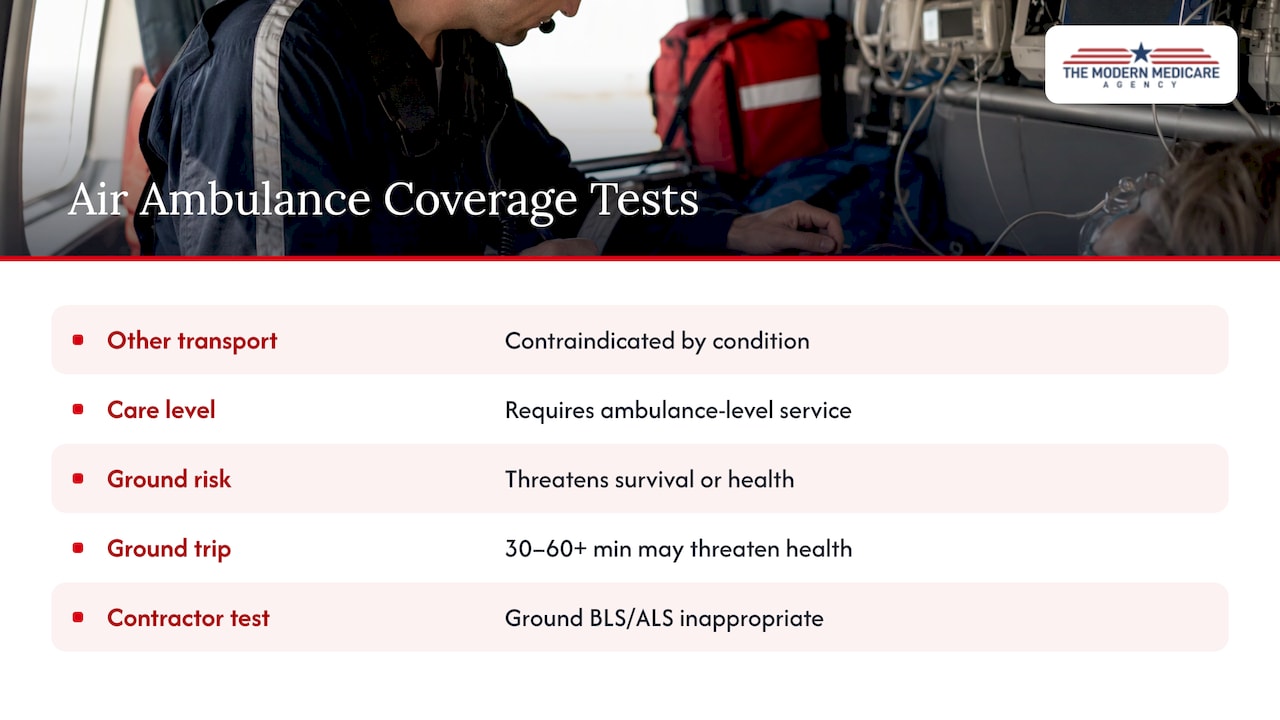
Medicare does not pay for a helicopter because it is faster or more comfortable. It pays when your condition makes every other way of travelling unsafe. The federal rule, 42 CFR 410.40, covers both airplane (fixed wing) and helicopter (rotary wing) ambulances only if other means of transportation are contraindicated. In plain terms: a car, a van or a regular ambulance would put your health at risk.
The condition must also require the level of service the ambulance provides. A flight is not covered simply because you are far from a hospital.
The CMS Benefit Policy Manual adds the test that decides most claims. Air transport is reasonable when the time a ground trip would take, or the instability of ground travel, threatens your survival or seriously endangers your health. As a general guideline, that means a condition needing immediate, rapid transport where a ground ambulance would take 30 to 60 minutes or more. The manual also says air transport is a covered service regardless of state or region, but the Medicare contractors that process claims approve it only when a basic or advanced life support ground ambulance would be inappropriate for your condition.
Situations that often fit
These are illustrations of the rule, not a guarantee of coverage. Any claim is judged on the medical record.
- A stroke, heart attack or major trauma in a rural area where the nearest capable hospital is a long drive away.
- A patient whose condition is too unstable for a long road trip, such as a serious head injury.
- A situation where road access is blocked and only an aircraft can reach you in time.
What the record says matters. The crew’s documentation of your condition at pickup is what supports the claim later. You do not control that paperwork, but you can make sure the hospital and the ambulance company have your Medicare information.
The nearest appropriate facility rule
This is where many families get a surprise. Medicare pays only for transport to the nearest hospital, critical access hospital, rural emergency hospital or skilled nursing facility that can provide the care you need. Medicare’s ambulance publication puts it the same way: if no local facility can provide that care, Medicare pays to the nearest facility outside your local area that can.
So if you ask to be flown to a hospital across the state because your own doctor practices there, and a capable hospital is closer, the extra distance is not what Medicare is built to pay for. A CMS claims manual also states that air ambulance is payable only for transport to a hospital. Flights to a doctor’s office, a skilled nursing facility or your home are not payable as air ambulance.
In a true emergency, the crew and the emergency physician usually decide the destination in minutes. The practical lesson is to know which hospitals near you handle strokes, heart attacks and trauma, and to tell the family which ones are in your plan’s network if you have a Medicare Advantage plan.
What Medicare pays and what you owe
Ambulance transport falls under Part B, which is Medicare’s outpatient coverage. MedPAC’s 2026 report states that Part B covers 80% of the Medicare-approved amount, so you pay about 20% after meeting the yearly Part B deductible, which is $283 in 2026. The deductible is set each year, so check the current figure on Medicare.gov.
The word that matters is approved. Medicare does not pay 80% of whatever the air ambulance company bills. It pays 80% of its own fee schedule amount.
How Medicare sets the air ambulance rate
According to the CMS Ambulance Fee Schedule page, air ambulance payment uses nationally uniform base rates for fixed-wing and rotary-wing aircraft, plus nationally uniform rates per loaded mile. Loaded miles are the miles flown with the patient on board. Flights that start in a rural area are paid at 1.5 times the urban air base and mileage rates.
The claims manual identifies these billing codes, which you may see on an explanation of benefits: A0430 for fixed wing and A0431 for rotary wing, with mileage codes A0435 and A0436.
A worked example
This is a simple illustration with made-up numbers, not a real bill. Say Medicare’s approved amount for a helicopter transport is $10,000 and you have already met your Part B deductible. Medicare pays 80%, or $8,000. Your 20% share is $2,000. If you have not met the deductible, the deductible comes off first and you owe it in addition to your coinsurance share of what is left.

The approved amount is set by Medicare’s fee schedule, and the number on the air ambulance company’s invoice can be different. A coverage review before an emergency is how you learn what your plan does with the 20%.
What the federal surprise billing law does and does not do
The No Surprises Act banned balance billing for air ambulance services from out-of-network providers for many people with private coverage starting in 2022. CMS’s overview says those provider requirements do not apply to Medicare beneficiaries, who have other protections against high medical bills. If you are on Medicare, do not assume that law covers you. Plan your coverage around the Medicare rules instead.
Ground ambulance changes you may hear about
CMS reports that the Consolidated Appropriations Act, 2026 extended temporary add-on payments for ground ambulance transport through December 31, 2027, as described on the fee schedule page. Those add-ons affect how Medicare pays ground ambulance suppliers, not air ambulance rates, and they do not change what you owe for a flight.
When an ambulance ride falls under Part A
If you are admitted as an inpatient or are in a skilled nursing facility stay covered by Part A, ambulance transport is generally included in the Part A payment. MedPAC lists exceptions that get separate Part B payment, such as emergency transport from a skilled nursing facility to a hospital, and transport to and from dialysis. If your situation involves a facility stay, ask the facility’s billing office which part pays.
Original Medicare, Medigap and Medicare Advantage compared
The same flight can produce very different bills depending on how you receive Medicare.
| Your coverage | How an air ambulance is typically handled | What to review before you need it |
|---|---|---|
| Original Medicare only | Part B pays 80% of the approved amount after the deductible; you owe about 20% | You carry the full coinsurance with no cap |
| Original Medicare plus a Medigap plan | Medicare pays first, and the Medigap plan is designed to help with Part B coinsurance depending on the plan letter | Which letter plan fits your budget and risk |
| Medicare Advantage | The plan sets its own cost sharing for ambulance trips, and rules on authorization apply | Your plan’s ambulance copay and out-of-pocket maximum |
A Medigap plan is a supplement sold by private insurers that works alongside Original Medicare. Standardized plan letters differ in which gaps they fill, so the details of each plan matter more than the label. Our Medicare Supplement page walks through the options.
If you prefer an Advantage plan, the ambulance line in the plan’s Evidence of Coverage is the number to find. Advantage plans generally apply a cost share to each one-way ambulance trip, and a flight to a hospital and a later transfer can each count as a trip. Out-of-network and out-of-country transport rules vary by plan. Our Medicare Advantage guide explains what to look for, including the maximum out-of-pocket limit that caps your yearly spending on covered services.
For a wider view of ground transport rules, see our page on Medicare ambulance coverage, and for what happens once you arrive, our guide to emergency room visits under Medicare.
Air ambulance memberships and how they fit
You may see regional air ambulance memberships advertised for a modest yearly fee. These are not insurance. One program’s published terms state that its membership is not an insurance program, that the flight is decided by medical need rather than member status, and that transport goes to the closest appropriate medical facility. The membership is designed to address the part of the bill that insurance does not pay.
The coverage that decides whether Medicare pays in the first place is still your Medicare plan structure. A membership is a separate matter from choosing the right Part B supplement or Advantage plan, and programs differ by region and terms. If you are weighing both, start with the Medicare layer, because it determines the size of the bill the rest has to address.
If Medicare denies the claim
Air ambulance claims get reviewed, and a denial is not the end. Medicare.gov explains that you can appeal if Medicare refuses to pay for a health care service you already received or to change the amount you owe. Here is a sensible order of steps:
- Read your Medicare Summary Notice. It shows what was billed, what Medicare approved and why a claim was denied.
- Get the medical records. The hospital’s and crew’s records describing your condition at pickup are the evidence of medical necessity.
- Ask your doctor for a statement. A physician’s explanation of why ground transport was unsafe strengthens the appeal.
- File the appeal by the deadline on your notice. Follow the instructions printed on the notice.
- Call 1-800-MEDICARE if you are unsure how to start, as Medicare.gov lists for ambulance questions.
An Advance Beneficiary Notice of Noncoverage is a form a provider gives you before a service Medicare may not pay for. Medicare.gov explains that it is not an official denial, and that if you choose the option to receive the service and have the claim submitted, you can still appeal if Medicare denies payment. In a real emergency flight, you are rarely handed such a form, but the same appeal rights apply for services you received.
With a Medicare Advantage plan, the appeal goes through the plan first. The plan’s materials explain the steps.
What this means if you are new to Medicare
Most people who turn 65, retire from employer coverage, or qualify through disability worry about the large, rare events, and a flight to a trauma center is a good example. The facts are reassuring in one way. Medicare does not leave air transport out. It also has limits that are easy to miss: the necessity test, the nearest-facility rule, and the 20% that remains.
For perspective on how common ambulance use is, MedPAC reports that about 14% of fee-for-service Medicare beneficiaries used ambulance services in 2024, with ambulance spending of $4.7 billion. Most of those trips are ground transport, and air transport is a small piece. That is exactly why a plan review should focus on the coverage that scales with any big medical event, not on air transport alone.
Questions to bring to a plan review
- What is the Part B coinsurance I would owe on an ambulance trip, and does a supplement pick it up?
- If I have Medicare Advantage, what is the copay per one-way ambulance trip, and what is my out-of-pocket maximum?
- Which hospitals near me can handle stroke, cardiac and trauma emergencies?
- Does my plan cover emergency transport while I travel in the US?
- Do I live in a rural area where flights are more likely?
Our perspective
People often ask us about air ambulance as if it were a separate product. It is not. It is one more place where the 20% that Original Medicare leaves with you can show up, and it shows up on the worst day, when nobody is comparing plans. We have been helping Medicare consumers since 2007, and our view has stayed the same: education first, then the plan. If you understand the nearest-facility rule, the necessity test and the 20%, the decision between a Medigap plan and an Advantage plan becomes a lot less abstract.
Because we are independent agents with access to 40+ carriers, we can look at both paths for your situation and your budget rather than starting from one product. We would rather you leave a conversation knowing what your plan does in an emergency than sign something you do not understand. A yearly coverage checkup is a good habit, because your health, your doctors and your plan’s rules can all change.
Paul
Get your coverage reviewed before an emergency
We are a team of independent agents who specialize in Medicare. We compare Medigap plans and Medicare Advantage plans from many carriers, look at how each handles ambulance transport and large bills, and stay available through the year, including annual coverage checkups. If you are new to Medicare, retiring from employer coverage, or unhappy with what you have now, start with our Medicare Supplement options or our Medicare Advantage guide, or visit Paul B Insurance to talk with an agent.

FAQ
Does Medicare cover air ambulance?
Yes, in limited cases. Part B may pay for helicopter or airplane transport when you need immediate, rapid transport that ground transportation can’t provide. Medicare pays 80% of its approved amount after your deductible, and you owe roughly 20%.
Will Medicare pay for a flight to the hospital I prefer?
Not necessarily. Medicare pays for transport to the nearest facility that can give you the care you need. If no local facility can provide it, Medicare pays to the nearest one outside your local area that can.
Does Medicare Advantage cover air ambulance too?
Medicare Advantage plans must cover what Original Medicare covers, but each plan sets its own cost sharing and rules. Check the ambulance copay and out-of-pocket maximum in your plan documents, or ask an agent to compare plans for you.
Is an air ambulance membership the same as insurance?
No. One program’s terms say its membership is not an insurance program, and the flight is based on medical need, not membership. Your Medicare coverage still determines what is paid first.
What can I do if Medicare denies an air ambulance claim?
You can appeal. Medicare allows appeals when it refuses to pay for a service you already received or to change the amount you owe. Start with the instructions on your Medicare Summary Notice, gather the medical records, and call 1-800-MEDICARE if you need help.
Sources
- Ambulance services coverage, Medicare.gov
- Medicare Coverage of Ambulance Services, Medicare.gov
- Medicare Benefit Policy Manual, Chapter 10, CMS
- 42 CFR 410.40, eCFR
- Medicare Claims Processing Manual, Chapter 15, CMS
- Ambulance Fee Schedule Public Use Files, CMS
- Ambulance Services Payment System, MedPAC 2026
- High level overview of No Surprises Act provider requirements, CMS
- Filing an appeal, Medicare.gov
- Your Protections, Medicare.gov
- Air ambulance membership terms and conditions