




A familiar insurance carrier name does not tell you whether your doctors participate in a plan’s network. In a Devon Health Services vs. major carriers comparison, focus on the specific plan’s participating doctors, copays, and out-of-network costs. These details can differ between plans, even when they’re offered by the same carrier.
It’s understandable to feel unsure when provider directories and cost details don’t line up neatly. For 2026 coverage, a careful comparison can help you see which doctors participate and how each plan handles the care you may need. This article explains what to look for in provider directories, how to compare copays, and what out-of-network terms mean for your choices.
The key is to check participation for the specific plan rather than assume it from the carrier’s name, then weigh network access alongside the costs you may pay for care.
Key Takeaways
- Learn what a professional looks for in a provider directory and why the specific plan matters.
- See how to compare primary care and specialist copays without focusing on one cost alone.
- Understand how doctor participation can differ across plans, even when carriers are familiar.
- Find out which out-of-network details can affect your share of care costs.
- Explore how Medicare Advantage, Medigap, and Part D coverage options relate to your needs.
How a professional checks provider directories
Start a directory review with the exact plan name and coverage year. “Devon Health Services” alone may not identify the specific plan behind a listing. Match the full plan name, service area, and plan type before comparing it with plans from major carriers. This avoids treating a familiar company name as if it described a specific network.
Search for each doctor and care location you want to keep. A physician may appear under a practice name, while the directory lists the clinic separately. Check both the individual provider and the location where you receive care. For example, one office may appear in the directory while another does not.
Read each directory entry in context. Check the plan year, network label, and any notes about accepting new patients. A provider listed for one plan should not automatically be assumed to participate in another plan from the same carrier. When comparing Devon Health Services with major insurers, review each plan’s directory separately.
CMS Star Ratings are specific to each contract and updated annually. They provide a separate comparison point, not proof that a doctor participates or that a directory entry is current. Customer service, claims handling, and member satisfaction also require comparable measures. Keep those service measures separate from network access, which a provider directory does not rate.
Licensing and state availability require separate checks. Match the insurer and plan name against official state and plan records to determine whether that specific plan is available where you live. A national carrier name alone does not establish local availability. The state and exact plan matter.
Financial strength ratings and complaint records are also separate from directory results. A directory cannot establish either measure. A meaningful comparison uses records tied to the named insurer and comparable time periods. Neither measure replaces checking doctors, clinics, and plan participation.
A professional can organize the findings by plan and provider:
- Doctor: Match the provider’s name and practice location.
- Plan: Record the exact plan name and coverage year.
- Network: Note the participation status and any directory limits.
- Other measures: Keep ratings, complaints, licensing, and claims handling separate from network findings.
This review makes plan differences easier to understand and can distinguish a location mismatch from a difference in provider participation. That helps clarify network access before it becomes part of a coverage decision.
Primary care and specialist copays
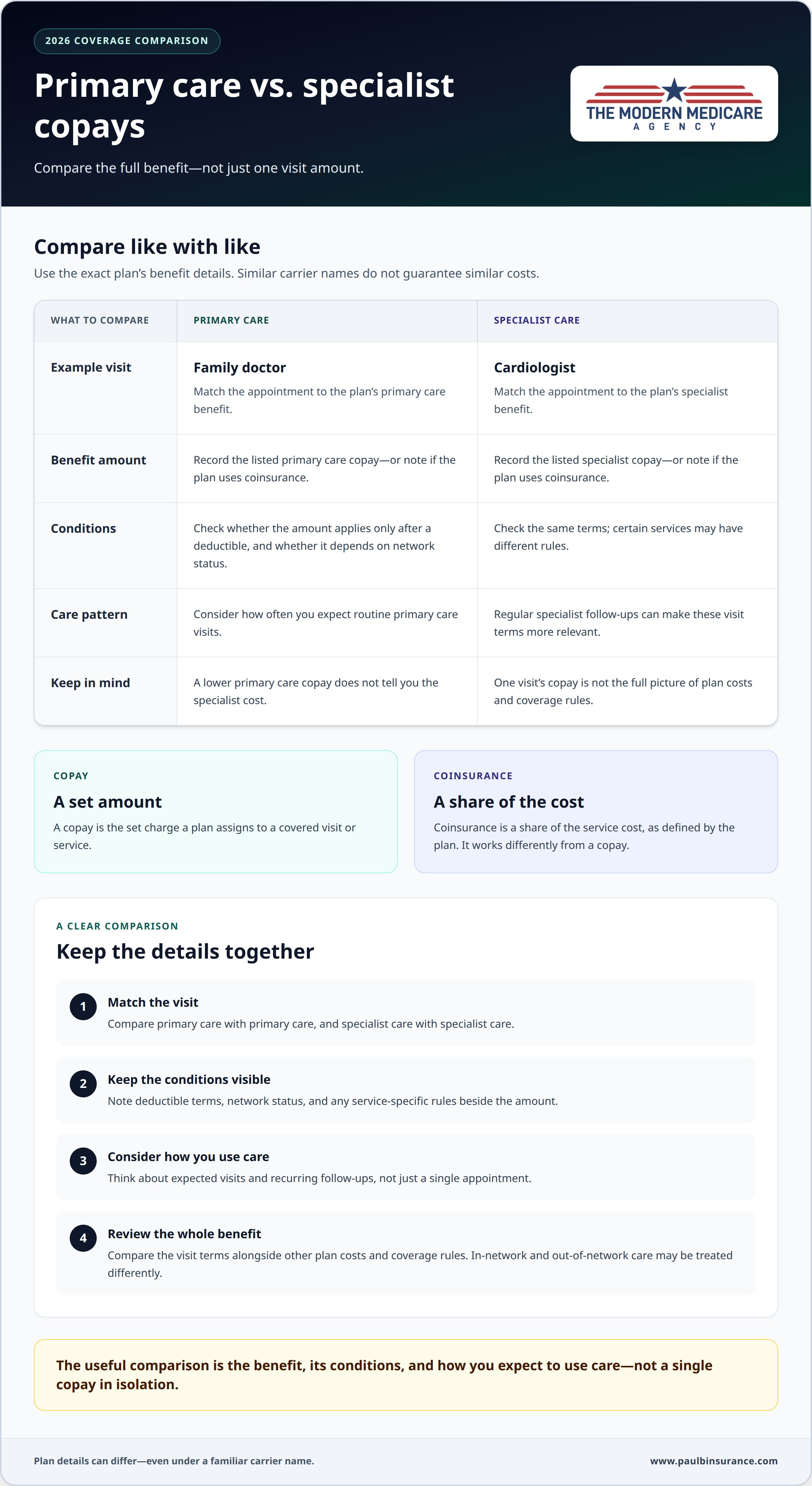
A copay is the set amount a plan assigns to a covered visit. The exact amount depends on the plan and service. For 2026 comparisons, a professional reads each plan’s benefit details rather than assuming similar carrier names mean similar costs. A primary care visit and a specialist visit may have different copays. The plan document shows which cost applies to each type of appointment.
Compare routine primary care and specialist care separately. For example, match a family doctor visit to the primary care benefit and a cardiologist visit to the specialist benefit. This prevents a lower primary care copay from obscuring a higher specialist copay. Check whether the listed amount applies to the specific service.
Read the rules attached to each benefit. A copay may apply only after a deductible, or a plan may list different terms for certain services. The benefit summary may also distinguish in-network visits from out-of-network care. These conditions can change what you pay, even when the visit types seem similar. Record the amount and its conditions together.
Visit frequency matters too. Someone who sees a specialist regularly may weigh that copay differently from someone who rarely needs specialist care. Compare the expected pattern of care rather than treating one visit’s copay as the full cost picture. Recurring follow-ups, for example, make specialist visit terms more relevant. The comparison should still account for other plan costs and coverage rules.
For a clear comparison, place each plan’s primary care and specialist benefits side by side, using the same service type and network status. If one plan lists a copay and another uses coinsurance, note that they work differently. A copay is a set charge for a covered service. Coinsurance is a share of the service cost, as defined by the plan.
- Match the visit: Compare primary care with primary care, and specialist care with specialist care.
- Keep conditions visible: Record whether the benefit depends on network status or deductible terms.
- Consider care patterns: Note regular follow-ups as well as occasional appointments.
- Compare the full benefit: Review other plan costs and coverage rules alongside each copay.
A Devon Health Services vs. major carriers comparison should connect each benefit to your likely care needs. A lower copay for one visit type does not automatically make a plan the better fit. Consider the benefit amount, its conditions, and how you expect to use care. These details put routine visit costs in context rather than treating them in isolation.
When comparing copays, check whether the plan treats residential mental health care separately from primary care or specialist visits. Recovery Centers of America at Devon in Pennsylvania began admitting patients to its primary mental health residential program on April 13.
Provider networks and doctor participation
No single doctor, hospital, and pharmacy list applies to every Devon Health Services plan. Participation depends on the specific plan and where a member lives. A familiar carrier name alone cannot establish whether a doctor or facility participates. A comparison of Devon Health Services vs. major carriers is useful only when it examines the plans themselves.
Begin by identifying the exact plan under consideration. Then match its network information to your location and coverage needs. A doctor may participate in one plan but not another. A hospital may appear in a directory while a particular department or location has different participation details.
Check doctor participation at the practice level. For example, you may see a primary care doctor at one clinic and a specialist at another. Review each provider and care location separately. If a doctor works at more than one office, the address where you plan to visit matters too.
Hospitals and pharmacies need their own checks. A hospital’s network participation does not automatically establish that every affiliated doctor participates. Likewise, a pharmacy listing does not tell the whole story about prescription coverage. For Medicare Part D, consider both the plan’s pharmacy information and your usual pharmacy.
A professional can organize the findings by the type of care involved:
- Doctors: Primary care providers and specialists, matched to their practice locations.
- Hospitals: Facilities relevant to the person’s preferred care arrangements.
- Pharmacies: Locations used for prescriptions, considered alongside the plan’s pharmacy terms.
This structure distinguishes a provider listing from a match for the plan you intend to use and makes gaps easier to spot. If a preferred cardiologist appears under one plan but not another, that difference may matter more than a broad carrier comparison. The same applies to a nearby hospital or familiar pharmacy.
In a Devon Health Services vs. major carriers comparison, the useful question is not which company has the largest-looking directory. Ask whether the exact plan includes the people and facilities that matter to you. Keep plan, provider, and location details together so a match in one category is not mistaken for a match across the entire network.
Network participation is only one part of a plan decision. You may prioritize a particular specialist, a nearby hospital, or a convenient pharmacy. Keeping those preferences visible helps explain why people can choose different plans even when comparing the same carriers. Focus on your care priorities and the specific plan’s participation details.
Participation depends on the specific plan and where you live. Check its network information for each doctor and practice location, hospital, and pharmacy.
Provider networks and out-of-network costs
For 2026, out-of-network costs depend on the plan’s terms and the care involved. A provider outside a plan’s network may be covered differently from an in-network provider. The exact plan documents describe how its benefits apply. A carrier’s name alone doesn’t reveal the cost for a particular service.
For a Devon Health Services vs. major carriers comparison, first identify the coverage type and specific plan. Then review the relevant benefit details for out-of-network care. A specialist visit, hospital service, and laboratory test may fall under different benefit categories. Compare each with the matching service in the other plan documents.
Next, distinguish the cost-sharing terms. A plan may describe a copay, coinsurance, or another member cost. Coinsurance means paying a share of a covered service’s cost, as described by the plan. Record the amount or method together with its conditions instead of comparing a label on its own.
If you want to keep seeing a specialist outside the listed network, check whether the plan covers that care and which benefit terms apply. The specialist’s office and the facility where care takes place may have separate participation details. Review both so one provider’s status is not mistaken for the other’s.
The care setting can also change which benefit applies. An office appointment and treatment at a hospital, for example, may appear under different sections of a plan’s materials. Match the care you expect to the relevant category. This is more useful than applying one out-of-network example to every service.
- Identify the plan: Use the specific plan name and coverage year.
- Match the service: Find the benefit category for the care being considered.
- Read the cost terms: Compare copays, coinsurance, and their stated conditions.
- Review each provider: Consider the doctor and facility separately.
When comparing Devon Health Services with major carriers, actual plan terms are more useful than broad assumptions about which carrier costs less. Plans may describe coverage differently, even for similar care. Focus on the service, provider, facility, and applicable benefit conditions.
This review connects network access with likely out-of-network expenses. If you expect to see a particular specialist, weigh the applicable terms alongside your other plan priorities. If hospital care is a priority, consider the relevant facility benefits. Either way, ground the comparison in the plan documents and your needs, not a general claim about a carrier.
What health plans and coverage options does Devon Health Services offer?
A company name alone doesn’t identify the Medicare plans available to you. For a 2026 comparison involving Devon Health Services, start with the exact plan name, coverage type, and service area. Those details distinguish a particular plan from a broad company label. They also make it possible to compare benefits without assuming every carrier offers the same choices.
Medicare Advantage, Medicare Supplement, and Medicare Part D are different coverage categories. Medicare Advantage plans provide Medicare coverage through a private plan. Medigap is Medicare Supplement coverage, while Part D concerns prescription drug coverage. Knowing the category helps frame which benefits and costs to compare, but does not establish which specific plans are available in your location.
First identify what you want coverage to address. If you’re focused on doctors and hospitals, compare plan networks and visit costs. For prescription coverage, consider the Part D plan’s drug coverage and pharmacy terms. If you’re considering Medigap, compare its role alongside your existing Medicare coverage. Each path calls for a different plan review.
Then connect the plan category to your priorities. Relevant details may include provider access, prescription needs, out-of-network terms, and costs described in each plan’s materials. Use those factors to compare specific options available in your location. A carrier name or broad product label cannot replace a plan-level review.
Keep the categories distinct as you weigh choices:
- Medicare Advantage: Compare the plan’s benefits, provider network, and cost-sharing terms.
- Medicare Supplement: Consider how the coverage fits with the person’s Medicare arrangement.
- Medicare Part D: Focus on prescription coverage and the plan’s pharmacy terms.
These categories are not interchangeable, and the right comparison depends on the coverage question. Comparing a drug plan’s pharmacy terms with a doctor network, for instance, does not address the same need. Keep each plan’s purpose and terms in view, then compare like with like across available options.
For a useful Devon Health Services and major-carrier comparison, the next step is to examine specific plan documents for the relevant coverage year and location. That keeps the discussion grounded in actual benefits rather than assumptions about a company name. Review Medicare coverage options with a professional who can explain how the available categories fit your priorities.
The Modern Medicare Agency
The Modern Medicare Agency helps you compare Medicare plan options when network details, copays, and out-of-network terms feel difficult to weigh. As an independent brokerage, it can compare plans from multiple carriers and explain how each option fits your priorities. That support can be useful when you want to keep specific doctors, understand prescription coverage, or compare Medicare Advantage, Medigap, and Part D choices for 2026.
A professional review brings plan documents together with your coverage needs. Discuss which doctors matter, what care you expect, and which costs you want to understand. The goal is informed guidance, not pressure to choose a particular carrier.
If you’d like help comparing your Medicare options, contact The Modern Medicare Agency.
Make Your 2026 Coverage Choice With Confidence
Comparing Devon Health Services with major carriers is most useful when the decision reflects the care and coverage you value. Connect the information you’ve reviewed with your priorities, such as keeping preferred care relationships or understanding prescription coverage.
A thoughtful conversation can help put those priorities in order. The Modern Medicare Agency offers Medicare Advantage Plans, Medicare Supplement (Medigap) Plans, and Medicare Part D Plans. An independent comparison can help you understand how available options relate to your needs, without reducing the decision to a carrier name alone.
You don’t need to have every detail settled before asking for guidance. Share what matters most, and take the discussion one step at a time. Contact The Modern Medicare Agency to talk through your Medicare coverage options. A clearer next step is within reach.
Frequently Asked Questions
How does Devon Health Services compare with major health insurance carriers in the industry?
Compare each plan’s participating doctors and locations, primary care and specialist copays, and out-of-network terms. Carrier names alone do not establish network access or costs.
What are the pros and cons of choosing Devon Health Services over a major health insurance carrier?
One potential advantage is a better match for your preferred doctors and expected care costs. A drawback is that a doctor or facility you want may not participate, and out-of-network terms can affect what you pay.

Article by
Paul Barrett
Paul Barrett, CMIP is the founder of The Modern Medicare Agency, an independent Medicare-only brokerage based in Melville, NY. With 18 years of Medicare-exclusive experience, a CMIP designation, and more than 5,000 clients served across 37 states, Paul is one of the most credentialed independent Medicare specialists on Long Island — and one of the most direct.
He represents 40+ carriers with no quotas and no allegiances, which means his recommendations are based entirely on what fits each client's specific situation. He is the author of Medicare Mastery Unlocked and host of the Wise Guys Retirement Talk podcast. His content is grounded in primary sources, real carrier intelligence, and 18 years of watching what happens when people get Medicare right — and when they don't.
📞 631-358-5793 | paulbinsurance.com