




Did you know that according to federal audit data released in late 2025, nearly 13% of Medicare Advantage prior authorization denials actually met coverage rules and should have been approved? This figure proves that learning how to appeal a medicare advantage claim denial is a vital skill for protecting your health and your savings. We understand the fear of being stuck with a massive medical bill and the headache of trying to decode complex insurance letters that make you feel like just another number in a giant system.
You deserve clarity and the benefits you were promised. We are here to walk you through the process with a simple, step-by-step approach that removes the anxiety from the situation. We provide a clear roadmap of the five appeal levels and show you exactly which documents to ask your doctor for so you can move from confusion to confidence. This guide breaks down the 2026 requirements into plain English, ensuring you have the tools to fight for your care and your peace of mind.
Key Takeaways
- Learn how to decode your “Notice of Denial” and identify the most common 2026 reasons for rejected claims so you can address them head-on.
- We break down the exact five-level process on how to appeal a medicare advantage claim denial, starting with a simple reconsideration request to your plan.
- Discover why your doctor is your strongest ally and how to gather the specific clinical evidence needed to prove medical necessity in today’s system.
- Understand the critical difference between standard and expedited appeals, including how to trigger the “72-Hour Rule” when your health can’t wait.
- Find out how working with an independent advocate ensures you have year-round support to navigate these insurance hurdles with confidence and peace of mind.
Understanding Why Your Medicare Advantage Claim Was Denied
Opening a letter from your insurance company to find a denial can feel like a punch to the gut. We understand that feeling of confusion and worry because we see it every day. It’s easy to feel like the system is working against you, but we want you to know that a denial isn’t a final “no.” It’s often just the start of a conversation. In 2026, the “Notice of Denial of Medical Coverage” is a standard document that triggers your right to ask for a second look. We believe in moving you from confusion to confidence by showing you exactly how to appeal a medicare advantage claim denial.
There are two main ways these denials happen. A “pre-service” denial occurs before you receive care, often stopping a procedure before it starts. A “payment” denial happens after you’ve already received the service, leaving you with an unexpected bill. In 2026, data shows that roughly 12% of initial claims are denied for simple administrative reasons. Whether it’s a “not medically necessary” label or a simple coding error, we view these as hurdles we can clear together rather than dead ends.
Decoding the Jargon in Your Denial Letter
Your denial letter might look like it’s written in a different language. We simplify the jargon so you know exactly how it works. Look for the “reason code” on your statement; this is usually a three-digit number that explains the specific problem. In 2026, many Medicare Advantage Plans use automated systems that flag “Prior Authorization” issues if the paperwork wasn’t filed 48 hours in advance. Sometimes, the denial isn’t about your health at all. It’s simply a missing signature or a typo in your member ID number.
Your Rights as a Medicare Advantage Member
You have powerful protections under federal law. You have the right to a written explanation that a layperson can actually understand, not just a string of medical codes. If the explanation is blurry, you have the right to request your full case file from the insurance company at no cost. This file contains the internal notes the company used to make their decision. Medicare rules in 2026 require plans to handle your appeal within specific timeframes, ensuring you aren’t left waiting in limbo while your health is on the line. We are here to ensure those rights are respected and that you feel protected throughout the process.
The 5 Levels of the Medicare Appeal Process
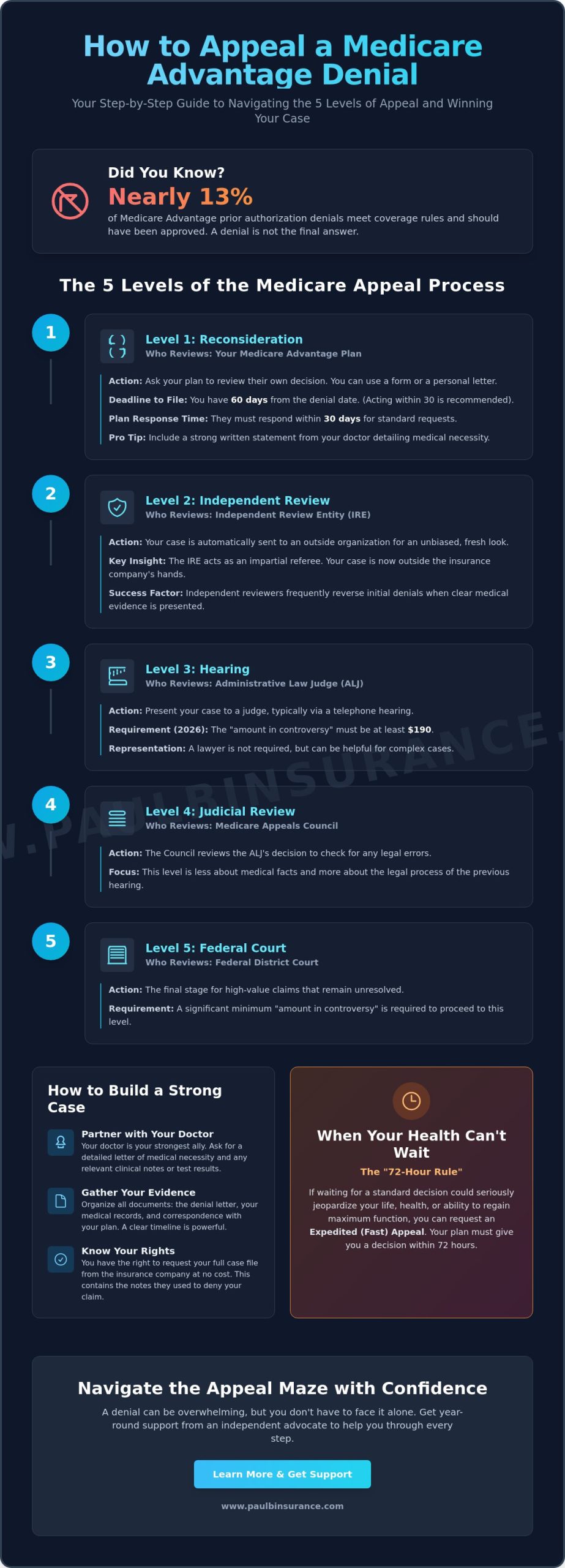
We know that opening a denial letter feels like a punch to the gut. It’s confusing and stressful. However, the system has a built-in safety net. There are five specific levels designed to protect you. Each level gives you a fresh chance to prove why your care is necessary. We want to help you move from feeling overwhelmed to feeling in control. Understanding how to appeal a medicare advantage claim denial starts with knowing where you stand in this five-step climb.
- Step 1: Reconsideration. You ask your current plan to review their own decision based on new or existing evidence.
- Step 2: Independent Review. An outside organization, known as the Independent Review Entity (IRE), looks at the facts with fresh eyes.
- Step 3: The Hearing. You present your case to an Administrative Law Judge (ALJ) via a telephone hearing.
- Step 4: Judicial Review. The Medicare Appeals Council reviews the judge’s decision for errors.
- Step 5: Federal Court. This is the final stop for high-value claims that remain unresolved.
Level 1: The Request for Reconsideration
This is your first opportunity to fix a mistake. You can use the standard CMS-20033 form, but a clear, personal letter often works better. We recommend including a written statement from your doctor. While the law gives you 60 days from the date of your denial notice to file, we suggest acting within 30 days. Speed matters. If your plan doesn’t respond within their required 30-day window for standard requests, your case automatically moves to Level 2. This protects you from being ignored by the insurance company. If you need help gathering your documents, our Medicare Advantage guide offers more tips on organizing your records.
Level 2 and Beyond: Moving Outside the Insurance Company
If the plan says “no” again, your case leaves their hands. In Level 2, the IRE acts as an unbiased referee. As of 2026, these independent reviewers reverse a significant percentage of initial denials when clear medical evidence is provided. If you reach Level 3, you’ll speak with an Administrative Law Judge. These hearings are usually telephonic. You don’t need a lawyer, but having one is helpful if your claim is complex. For Level 3 appeals in 2026, the “amount in controversy” must be at least $190. For the final level in Federal Court, that amount jumps to $1,920. We find that most cases are settled long before they reach a courtroom. Our goal is to provide the how to appeal a medicare advantage claim denial steps you need to find a resolution early. If you feel stuck, let’s talk about your options and find a path forward together.
How to Build a Strong Case for Your Appeal
Receiving a denial letter can feel like a heavy weight on your shoulders, but it is helpful to view it as a starting point rather than a final decision. We have seen that the most successful appeals aren’t just about being right; they are about being organized. When you learn how to appeal a medicare advantage claim denial, you are essentially building a bridge of evidence that leads the insurance company to a different conclusion. You want to make it impossible for the reviewer to ignore the facts of your situation. We find that combining clinical data with your personal story creates the strongest possible case for your health.
Working With Your Healthcare Provider
Your doctor is your most vital ally in this fight. You should schedule a brief appointment specifically to discuss the denial. Ask your physician to write a “Letter of Medical Necessity” that speaks directly to the reason the plan gave for the “no.” In 2026, insurance reviewers are strictly looking for the updated ICD-10 codes that CMS finalized in late 2025. If your doctor uses an old code, the plan might reject the appeal on a technicality. We help our clients by coordinating these details, ensuring the doctor’s office provides the specific clinical notes that prove the service is essential for your recovery. We take the pressure off you by acting as a liaison between your medical team and the insurance company.
Creating Your Evidence Binder
We recommend that every client keeps a dedicated “Evidence Binder” to stay organized and calm. This binder serves as your command center. It keeps you from feeling overwhelmed when you need to find a specific date or name. Your binder should include a checklist of these essential items:
- The original “Notice of Denial” and any previous correspondence.
- A copy of your medical records and any 2026 test results or imaging reports.
- Peer-reviewed medical journal articles that support your specific treatment.
- A “Human Impact” statement where you describe, in your own words, how this denial affects your daily quality of life and independence.
Always send your final appeal package through certified mail with a return receipt requested. This simple step provides you with legal proof that the insurance company received your documents before the 60-day deadline. It is also vital to maintain a “Communication Log.” Write down the date, the time, and the full name of every representative you speak with on the phone. This level of detail shows the insurance company that you are a prepared and serious advocate for your own care. If you need more help understanding your plan’s specific rules, our Medicare Advantage guide offers more details on your rights as a member.
Important Deadlines and Fast-Track Options
Time is your most valuable asset when you learn how to appeal a medicare advantage claim denial. Typically, you have 60 days from the date printed on your “Notice of Denial” to start the process. We know that life happens. If you miss this window because of a hospital stay, a death in the family, or even a simple misunderstanding of the paperwork, you can request a “Good Cause” exception. In 2026, Medicare guidelines have become more flexible regarding these exceptions, ensuring that honest mistakes don’t prevent you from getting the care you need.
The 2026 regulations also brought significant changes to “at-risk” drug management programs. If your plan has placed you in a program that limits your access to certain medications, such as opioids or benzodiazepines, your appeal rights are now prioritized. These appeals follow a strict timeline to ensure you don’t face a dangerous gap in your medication schedule. We help you move from confusion to confidence by identifying which deadline applies to your specific situation.
When Your Health Can’t Wait: The Fast Appeal
A standard appeal can take up to 30 days for a decision. If your health is fragile, 30 days is too long to wait. You should request an expedited review, often called the “72-Hour Rule.” This fast-track option is available if waiting for a standard decision could seriously jeopardize your life, your health, or your ability to regain maximum function. You don’t need to use complex medical jargon to qualify. We recommend asking your doctor to provide a simple statement supporting the urgency of your request. When a physician explains the risk to your health, the insurance plan is required to grant the fast-track status.
If you are currently in the hospital and the plan says it’s time to go home before you feel ready, the process is even faster. In these cases, a Quality Improvement Organization (QIO) steps in. These are independent groups of doctors who review your case immediately to decide if your discharge is safe. This protection is a vital safety net for seniors navigating the 2026 healthcare landscape.
Tracking Your Appeal Status
Once you submit your paperwork, you shouldn’t have to wonder where it went. Most Medicare Advantage plans in 2026 provide an online member portal where you can track the status of your appeal in real time. We suggest checking this portal every 48 hours to confirm your documents were received. If the plan claims they never got your mail, your tracking number or fax confirmation sheet will be your best evidence. You can also learn more about Medicare Part D drug appeals if your denial is specifically related to a prescription medication.
Don’t let a ticking clock stop you from getting the benefits you’ve earned. If you are feeling overwhelmed by dates and deadlines, schedule a free consultation with Paul to get the expert guidance you deserve.
How We Support You Through the Appeal Maze
Dealing with a claim denial is exhausting. We know how it feels to open a letter and see a “Denied” stamp after a necessary doctor’s visit. It is why we don’t just sign you up for a plan and disappear. Our team acts as your personal advocate. We move you from confusion to confidence by standing in your corner when the insurance company pushes back.
Most people don’t realize there is a massive difference between the types of agents available. A captive agent works for one specific insurance company. They are required to sell that company’s products, even if they aren’t the best fit for your health needs. We are independent brokers. We work for you, not the insurance giant. This allows us to compare over 40 different carriers to find your perfect match. When you have an advocate like Paul Barrett, you are never just a number in a database.
The Value of an Independent Medicare Broker
When a claim gets messy, the jargon can feel like a foreign language. We step in to translate the fine print. We help you understand exactly how to appeal a medicare advantage claim denial without the typical headache. Our role is to simplify the process so you can focus on your recovery. If you feel lost in the sea of options, our Medicare Advantage Guide helps you see how we compare plans to avoid these issues from the start.
In 2026, CMS requirements have evolved, making the timeline for appeals even tighter. You shouldn’t have to track these deadlines alone. We provide year-round support. Whether it is January or October, we are here to handle the insurance hiccups that pop up long after your plan starts. We simplify the jargon so you know exactly how the system works for you.
Next Steps: Getting the Support You Deserve
You should never feel rushed or pressured when it comes to your healthcare. Some agencies treat you like a transaction, but we treat you like family. We offer a “Peace of Mind” review to look at your current coverage. This review ensures your plan still fits your budget and your doctor network as we move through 2026. It is a simple way to ensure you aren’t overpaying for benefits you don’t use.
The right to fight a denial is yours by law. Don’t let a “no” from an insurance company be the final word on your health. Knowing how to appeal a medicare advantage claim denial is easier when you have a partner to gather the facts and file the paperwork. We are here to help. Schedule a call with us today and let’s turn that stress into a clear, confident plan of action.
Take Control of Your Medicare Coverage Today
Receiving a denial letter is stressful, but it’s never the final word on your healthcare. In 2026, the appeals process remains a vital tool for seniors to secure the benefits they’ve earned. Success comes down to two things: acting quickly within those strict 60 day windows and building a case backed by solid medical evidence. We’ve spent years helping people navigate these five levels of review, turning frustration into clear results. Learning how to appeal a medicare advantage claim denial shouldn’t feel like a lonely battle against a giant system. We simplify the jargon and handle the heavy lifting so you can focus on your health. Our team represents over 40 carriers to provide truly unbiased guidance; we are currently licensed in 34+ states to support seniors across the country. Since our founding, we’ve acted as dedicated advocates who believe you deserve a fair shake. You’ve worked hard for your benefits; we’ll work hard to help you keep them. If you’re feeling overwhelmed by paperwork or deadlines, let’s talk about your options together.
You have the power to challenge a decision, and we’re ready to stand right beside you.
Frequently Asked Questions
How long do I have to appeal a Medicare Advantage denial in 2026?
You have exactly 60 days from the date printed on your “Notice of Denial of Medical Coverage” to start the appeal process. This 60-day window is the standard timeframe for all Medicare Advantage plans in 2026. We recommend acting within the first 10 days to ensure you have enough time to gather supporting medical records. If you wait until day 59, you might feel rushed and overwhelmed.
Can I lose my Medicare coverage if I file an appeal against my plan?
You cannot lose your Medicare coverage or be removed from your plan for filing an appeal. Federal law protects your right to challenge a decision without any fear of retaliation. In 2025, over 15 percent of Medicare Advantage beneficiaries filed some form of grievance or appeal, and their coverage remained fully intact. We are here to ensure you feel safe and protected throughout this entire process.
What is the most common reason for a Medicare Advantage claim denial?
The most common reason for a denial is a claim that the service wasn’t “medically necessary.” According to 2024 CMS data, this accounts for nearly 80 percent of all initial denials. Other frequent causes include simple coding errors or missing prior authorization forms. Learning how to appeal a medicare advantage claim denial often starts with proving your doctor’s orders align with standard clinical guidelines.
Do I need a lawyer to file an appeal for my Medicare Advantage plan?
You don’t need a lawyer to file an appeal for your Medicare Advantage plan. Most seniors successfully navigate the first few levels of appeal by working with their doctor or a trusted advisor. While legal counsel is an option for Level 3 judicial reviews, it’s rarely necessary for Level 1 or Level 2 reconsiderations. We focus on making the paperwork simple so you don’t have to hire expensive legal help.
What happens if I miss the 60-day deadline for my appeal?
If you miss the 60-day deadline, you must provide a written explanation showing “good cause” for the delay. Valid reasons include a serious illness, a death in the family, or not receiving the denial notice on time. The Social Security Administration’s 2026 guidelines are strict, so we suggest documenting your reason clearly. Without a proven “good cause,” your plan will likely refuse to review the appeal at all.
Can my doctor file the Medicare appeal for me?
Your doctor can file the appeal on your behalf, and their clinical expertise is often the key to winning. You will need to sign an “Appointment of Representative” form, also known as CMS-1696, to give them official permission. Having your physician explain the medical necessity of your care is a powerful way to move from confusion to confidence. We often see higher success rates when doctors provide specific clinical notes.
What is an “expedited” appeal and how do I get one?
An expedited appeal is a fast-track review that requires your plan to make a decision within 72 hours. You can request this if waiting the standard 30 days could seriously jeopardize your health or life. In 2026, you don’t need a lawyer for this; you or your doctor just need to state that a standard delay would cause physical harm. It’s a vital tool for urgent medical situations.
Where can I find the forms to start my Level 1 reconsideration?
You can find the specific forms for a Level 1 reconsideration on your insurance company’s website or attached to your denial letter. Every Medicare Advantage plan is required by law to provide these instructions clearly. Learning how to appeal a medicare advantage claim denial becomes much easier once you have the right paperwork in hand. We can help you locate these documents if the plan’s website feels like a maze.

Article by
Paul Barrett
Paul Barrett, CMIP is the founder of The Modern Medicare Agency, an independent Medicare-only brokerage based in Melville, NY. With 18 years of Medicare-exclusive experience, a CMIP designation, and more than 5,000 clients served across 37 states, Paul is one of the most credentialed independent Medicare specialists on Long Island — and one of the most direct.
He represents 40+ carriers with no quotas and no allegiances, which means his recommendations are based entirely on what fits each client's specific situation. He is the author of Medicare Mastery Unlocked and host of the Wise Guys Retirement Talk podcast. His content is grounded in primary sources, real carrier intelligence, and 18 years of watching what happens when people get Medicare right — and when they don't.
📞 631-358-5793 | paulbinsurance.com