




What if Medicare felt less like one high-stakes decision and more like a few manageable steps? If you’re wondering how to avoid feeling stressed about Medicare in 2026, give yourself permission to slow down. It’s understandable to worry about choosing the wrong coverage, especially when the information feels complicated or conflicting.
You don’t have to figure everything out at once. This guide will help you break Medicare decisions into smaller steps, focus on information that matters to your situation, and identify which questions to tackle first. You’ll also learn how to get support at a comfortable pace, rather than feeling rushed to decide.
Start by organizing your options, noting what you want to understand, and taking one question at a time. If talking things through would help, Paul B Insurance, operating as The Modern Medicare Agency, is an independent Medicare broker that compares plans from 40+ carriers. Its initial consultation and Medicare review are free. The goal is clarity, not pressure.
Key Takeaways
- Feeling overwhelmed by Medicare choices doesn’t mean you’ve made a mistake. Slow down and focus on one question at a time.
- Sort information into your personal needs, plan details, and facts to verify. Keep your notes together so you don’t have to restart your search.
- Use a simple comparison table to record questions, relevant details, and follow-up actions instead of searching for one universally best plan.
- To learn how to avoid feeling stressed about medicare, try a steady routine: pause, name your concern, gather relevant information, ask questions, and choose one next step.
- Personalized guidance can help you organize questions and compare relevant options, with support that continues after enrollment.
Why Medicare Can Feel Stressful, and What You Can Control
Medicare decisions can bring unfamiliar terms, several coverage choices, and timing questions all at once. In 2026, it’s understandable if you’re unsure what to read first or which details apply to you. Feeling stressed doesn’t mean you’ve made a mistake. It means you’re facing decisions that deserve clear information and room to think.
A helpful starting point is to separate what you can organize from what you need to verify. Write down your questions, gather relevant documents, and note what matters most to you. Details about current rules, costs, and plan options need reliable, up-to-date information. You don’t have to settle every question before taking a first step.
Which parts of Medicare decisions can feel overwhelming?
Some questions are general: What do the different parts of Medicare refer to? How do Medicare Advantage and prescription drug coverage fit into the picture? A broad overview, such as the Medicare (United States) Wikipedia article, can help you get familiar with the program’s parts and history. Treat it as background reading, then use current sources to verify details that affect decisions in 2026.
Other questions are personal. The options worth exploring can depend on your health needs, prescriptions, preferred doctors, budget, and where you live. General explanations can build understanding, but they can’t determine what suits every individual. If you’re trying to understand one type of plan, this guide to Medicare Advantage can help clarify the topic.
When everything feels tangled, pause. Write each question down, then address them in order. Start with the one that affects your next decision most, rather than trying to understand every Medicare detail in one sitting.
What can you control when Medicare feels complicated?
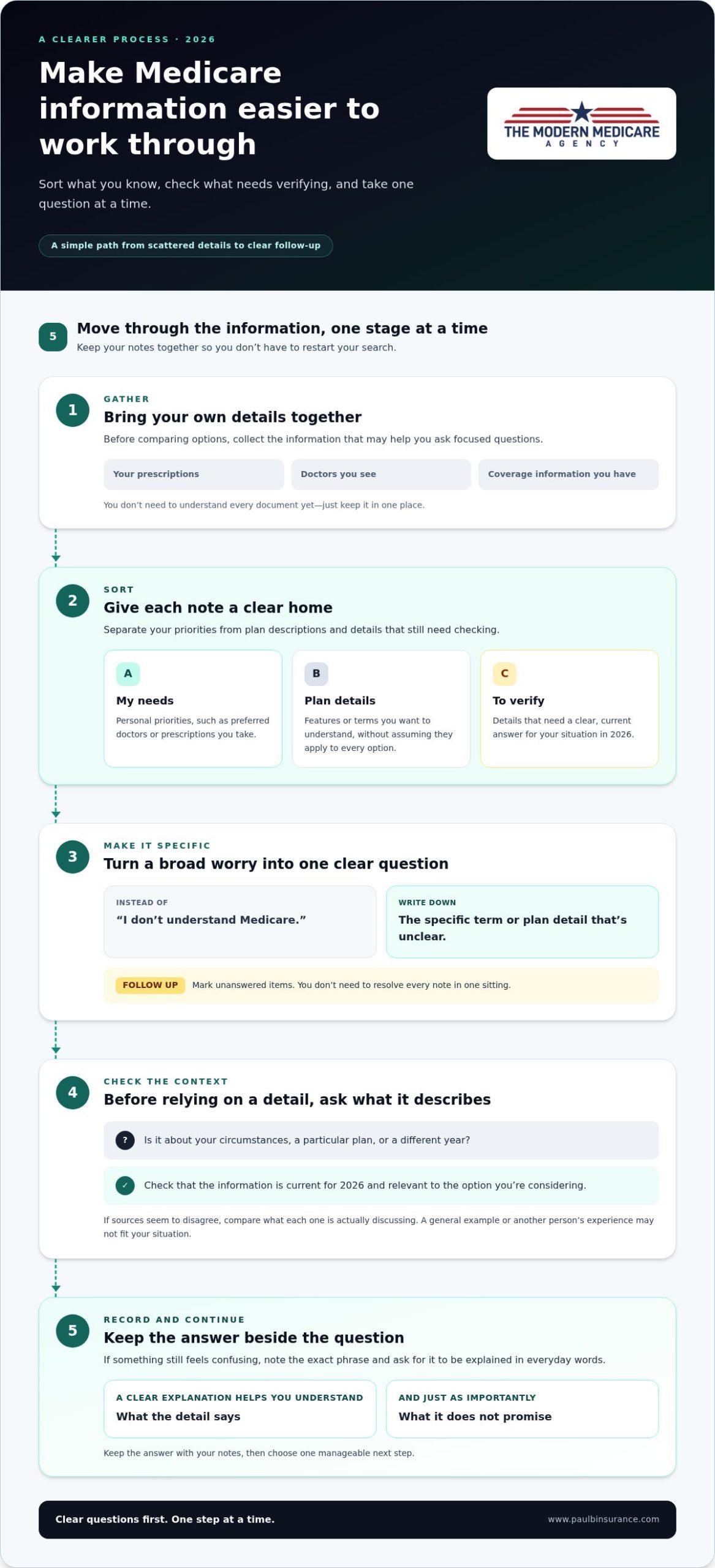
Start with your own information. Before comparing options, gather documents and details that may help you ask focused questions, such as a list of your prescriptions, the doctors you see, and any coverage information you already have. You don’t need to know what every document means yet. Having it in one place can make later conversations and comparisons easier.
Next, choose a small set of reliable sources instead of collecting every opinion or article you find. Online information can be useful, but it may describe a different year or situation. Check whether a detail is current for 2026 and relevant to your question. If something is unclear, mark it for follow-up rather than guessing.
This is a practical way to think about how to avoid feeling stressed about medicare: organize what you know, separate it from what needs checking, and choose one manageable next step. You’re not required to choose a plan just because you’ve started learning. A calmer process begins with clear questions, not pressure to reach an immediate answer.
How to Make Medicare Information Easier to Understand
Medicare information gets easier to work with when you stop treating it as one large puzzle. Give each question a place, then handle one group at a time. A notes page or notebook can become your home base in 2026, so you’re not repeating searches or relying on memory when details start to blur together.
How can you organize Medicare questions without getting overwhelmed?
Begin with your priorities, not plan comparisons. What do you want your coverage to help you manage? Which questions are you trying to answer now? Keep personal concerns separate from descriptions of plan features and facts that still need verification. This helps you see whether you’re gathering background information or considering a choice based on your own circumstances.
Try three headings in your notes:
- My needs: Personal priorities, such as the doctors you prefer or prescriptions you take.
- Plan details: Features or terms you want to understand, without assuming they apply to every option.
- To verify: Details that need a clear, current answer for your situation in 2026.
Keep each question short. Instead of writing “I don’t understand Medicare,” note the specific point that’s unclear, such as what a term means or how a plan detail relates to a priority. Mark unanswered items with “follow up.” You don’t need to resolve every note in one sitting.
How can you handle confusing or conflicting Medicare information?
First, check what the information is describing. Does it apply to your circumstances, a particular plan, or a different year? The official Medicare.gov guide to getting started can help with foundational topics, including getting started and understanding coverage choices. For a specific plan detail, make sure the explanation is current for 2026 and relevant to the option you’re considering.
If two sources seem to disagree, don’t rush to decide which one is right. Compare what each source is actually discussing. One may give a general example while another covers a particular situation. Another person’s experience can suggest a useful question, but it isn’t automatically a recommendation for your needs.
Plain language matters. If a term or explanation still feels confusing, write down the exact phrase and ask for it to be explained in everyday words. A clear explanation should help you understand what the detail says and what it does not promise. Avoid turning a broad statement into an assumption about your own coverage.
This is a practical part of how to avoid feeling stressed about medicare: keep the question specific, check the year and context, and record the answer beside it. If you’d like help making sense of plan information, learn about support from an independent Medicare broker. Then return to your notes and take up the next question when you’re ready.
How to Think Through Medicare Choices Without Second-Guessing
Medicare choices make more sense when you separate learning about plan types from deciding what fits your circumstances. A plan that works well for one person may not suit another. Your priorities, current coverage, and personal situation all matter. There isn’t one universally best choice, and you don’t need to compare every detail at once.
What information should you gather before comparing options?
Start with a short list of what you want to understand. Note your priorities, questions, current coverage, and personal details that may be relevant to a discussion. For example, you might want to understand how a plan handles a specific need. First identify which plan details could answer that question. Keep what you know separate from what you still need to learn.
As you read about plan types, focus on understanding how they differ, not on deciding immediately. If you’re learning about Medicare Advantage, this Medicare Advantage guide can help you explore the basics. Then consider specific plan details in the context of 2026 and your circumstances. A general description can explain a type of coverage, but it can’t tell you by itself whether a particular option fits your needs.
A simple comparison template can keep your thinking focused. Fill it in as you find information, and leave a question open if you don’t yet have a clear answer.
| Question | Relevant details | Follow-up action |
|---|---|---|
| What matters most to me? | Personal priorities or current coverage | Clarify what information would help |
| What does this plan detail mean? | Explanation that applies in 2026 | Ask for a plain-language explanation |
| What am I still unsure about? | Information that’s missing or unclear | Keep the question visible and verify it |
How can you compare choices without trying to decide everything at once?
Choose one question from your notes and compare only the details that help answer it. If you’re thinking about doctors, focus on information relevant to that concern. If prescription drug coverage is on your mind, review the Medicare Part D guide to understand that coverage category before considering specific plan details. This keeps your attention on what matters to you instead of inviting a comparison of every feature.
Record where each answer came from and whether it applies to the plan and year you’re considering. If a detail is missing, mark it as unanswered. Don’t fill gaps with assumptions or treat another person’s experience as proof that the same choice is right for you. Return to open questions when you have clearer information.
That steady approach can help with how to avoid feeling stressed about medicare: understand the options first, then weigh relevant details against your own priorities. A thoughtful decision doesn’t require instant certainty. It requires clear questions and enough reliable information to take your next step with confidence.
A Simple Step-by-Step Routine for Less Medicare Stress
When Medicare starts to feel like too much, you don’t have to solve every question before moving forward. Use a short routine to steady your thoughts and identify one useful next action. Repeat it whenever a new question comes up, whether you’re getting oriented or reviewing your coverage in 2026.
What should you do first when Medicare feels like too much?
Begin by pausing. Set aside conflicting information for a moment and write down the concern that feels most pressing. A broad worry such as “I might choose the wrong coverage” can become a more answerable question: “What information do I need to understand whether this option fits my situation?”
Then move through these steps at a comfortable pace:
- Name the concern. Write one clear question, such as whether a plan detail relates to a priority you’ve identified.
- Gather relevant information. Find the documents or current details that speak directly to that question. Set aside information that doesn’t apply.
- Ask for clarity. If a term or explanation remains confusing, note exactly what you need explained in plain language.
- Choose one next step. You might save a source, make a note to follow up, or set a time to review the information. You don’t have to make a plan decision just because you’ve taken an action.
If you’d like help organizing the discussion, consider inviting a trusted caregiver or family member to sit with you. They can help track questions or take notes, while the decision stays centered on your needs and preferences. Sharing the process can make it feel less isolating.
How can you keep the process manageable over time?
Set aside a regular, comfortable time to review your notes. It might be a quiet moment during the week or another time that works for you. Keep your current question, useful information, and pending follow-ups together. When you return, you can pick up where you left off instead of searching from the beginning.
A calm pace still needs to account for applicable enrollment dates. For example, Medicare’s Annual Enrollment Period in 2026 runs from October 15 through December 7 for changes that take effect January 1, 2027. That window applies to those making eligible changes during that period; it doesn’t mean every Medicare decision follows the same timeline. Check the dates that apply to your situation, and give yourself time to understand what action, if any, you need to take.
Learning how to avoid feeling stressed about medicare can mean following a steady routine, not forcing a quick answer. If you’d like help talking through your questions, connect with an independent Medicare broker and take the next step with support.
How Personalized Medicare Guidance Can Help You Move Forward
Organizing questions on your own can help, but you don’t have to interpret every plan detail alone. An independent Medicare broker can listen to what matters to you, help clarify questions, and compare relevant options. The goal is to make the information easier to understand, not to rush you toward a decision.
What does supportive Medicare guidance look like?
Personalized plan comparisons start with your needs and circumstances. Bring the questions you’ve collected, explain what you’re trying to understand, and take time to discuss the options. Paul B Insurance, operating as The Modern Medicare Agency, is an independent Medicare broker that compares plans from 40+ carriers. This gives you options to review in the context of your priorities in 2026.
Support can continue after enrollment. Paul B Insurance provides year-round support for questions about claims, billing, and plan changes. This doesn’t guarantee a particular outcome for every issue. It gives you a place to turn for help understanding what to ask or what information may be relevant as questions come up.
If you’re weighing whether personalized guidance would be useful, a Medicare broker guide can help you understand what to expect from this kind of support. You can also bring a short list of questions to a conversation and ask for explanations in everyday language. A clear, unhurried discussion can help you see which details need attention without feeling that you must resolve everything at once.
How can you begin without feeling pressured?
Paul B Insurance’s 5-step Medicare Process provides a structured path from an initial free consultation toward ongoing support. It gives you a way to discuss your situation, review your needs, compare relevant plans, enroll if you choose, and receive year-round support. Use the conversation to understand your options and decide on a next step at your own pace.
The initial consultation and Medicare review are free. Use a review to bring your questions and organize what you want to understand; having one doesn’t obligate you to make a decision. Paul B Insurance has 5,000+ clients served and 18 years of experience. These facts may offer useful context as you consider whether a conversation would help you feel more prepared.
Learning how to avoid feeling stressed about medicare doesn’t require doing everything alone or having every answer before asking for help. If you’re ready to talk through your questions, you’re welcome to book a free Medicare review. Take the next step when it feels right, and move forward at a pace that works for you.
Take Your Next Medicare Step at Your Own Pace
You don’t need every answer before moving forward. In 2026, give yourself permission to ask one clear question, understand the information that applies to you, and decide what you’d like to do next. Learning how to avoid feeling stressed about medicare can begin with a simple shift: you’re allowed to take this process one step at a time.
If a calm conversation would help, a free Medicare review is available. Bring the questions you still have and talk through your next step without needing to make a rushed decision. The choice to seek support is yours, and you can move at a comfortable pace.
Book a free Medicare review and take your next step with confidence. You deserve clear answers and the time to make a thoughtful choice.
Frequently Asked Questions
Why does Medicare feel so stressful?
Medicare can feel stressful because several unfamiliar choices and terms may come up together. That reaction is understandable and doesn’t mean you’ve done anything wrong. Identify the one question that’s making you pause, such as what a term means or which information applies to you. Focus on that question first, and set aside other concerns until you’re ready to address them.
How can I stop feeling overwhelmed by Medicare decisions?
Start with a short note about what’s bothering you most, then decide what would help clarify it. For example, if you’re unsure what a plan description means, write down the phrase and where you saw it. You don’t have to resolve every concern at once. This routine can help you figure out how to avoid feeling stressed about medicare and make a manageable next move.
Can someone help me understand my Medicare options without pressuring me?
Yes. An independent Medicare broker can discuss your priorities and compare relevant plan options with you. Paul B Insurance offers a free Medicare review and personalized plan comparisons. Bring a specific question, such as how to understand a plan detail, and ask for a plain-language explanation. The conversation can help you understand your options without promising a particular outcome or rushing your decision.
What should I do if I am worried I chose the wrong Medicare plan?
First, pinpoint what’s causing the concern. Is there a document you don’t understand, or has something about your needs changed? Write down the detail you want clarified, then review the information that applies to your plan and situation in 2026. Don’t use a friend’s experience as a substitute for your own circumstances. If questions remain, a personalized review can help you understand possible next steps.
How can I keep Medicare information from becoming confusing?
Keep a simple record of what you read: the question you were researching, the source, and the date you checked it. This makes it easier to distinguish current information from older notes if you revisit a topic later in 2026. You can also mark statements as “general information” or “applies to my situation” after verifying the context. That distinction can reduce repeated searching and mistaken assumptions.
Can a caregiver help me manage Medicare stress?
Yes, if you want support. You might ask a caregiver to help sort paperwork, write down questions before a call, or take notes during a discussion. Before you begin, decide what role would feel useful, such as listening or helping you remember follow-up items. Keep your preferences central. A caregiver can help you stay organized while you remain involved in understanding and making your Medicare decisions.
Is a Medicare review free with Paul B Insurance?
Yes. The initial consultation and Medicare review with Paul B Insurance are free. A review gives you an opportunity to discuss your questions and receive personalized guidance comparing Medicare options. Paul B Insurance is an independent Medicare broker, not a plan provider or carrier. Use the conversation to clarify what information matters to you and consider a next step without expecting a particular plan outcome.

Article by
Paul Barrett
Paul Barrett, CMIP is the founder of The Modern Medicare Agency, an independent Medicare-only brokerage based in Melville, NY. With 18 years of Medicare-exclusive experience, a CMIP designation, and more than 5,000 clients served across 37 states, Paul is one of the most credentialed independent Medicare specialists on Long Island — and one of the most direct.
He represents 40+ carriers with no quotas and no allegiances, which means his recommendations are based entirely on what fits each client's specific situation. He is the author of Medicare Mastery Unlocked and host of the Wise Guys Retirement Talk podcast. His content is grounded in primary sources, real carrier intelligence, and 18 years of watching what happens when people get Medicare right — and when they don't.
📞 631-358-5793 | paulbinsurance.com