
Imagine standing at the pharmacy counter this year, wondering if the price on the screen will be a relief or a shock. We know that many people feel a sense of dread when a new year starts because drug lists often shift without warning. You shouldn’t have to guess whether your medications are still protected. Learning how to check if a drug is covered by medicare part d is the first step toward reclaiming your peace of mind and ensuring your health stays affordable.
We understand that the constant changes in Medicare can feel like a heavy burden. It’s stressful to worry about high costs or whether you’ll hit your deductible before you can afford your pills. We’re here to help you understand the 2026 rules, including the new $2,100 out-of-pocket spending cap that protects you from unlimited costs. This article provides a clear, step-by-step path to verify your prescriptions and explains your options if a drug isn’t on your plan’s list. We’ll guide you through the search process so you can stop worrying and start feeling secure about your coverage.
Key Takeaways
- We explain how to navigate plan formularies so you can understand which medications are covered before you ever reach the pharmacy counter.
- Follow our simple, step-by-step guide on how to check if a drug is covered by medicare part d using your exact dosages and names.
- Learn how the new $2,100 out-of-pocket maximum for 2026 offers you a clear limit on what you’ll pay for prescriptions this year.
- Discover what to do if your medication is not on the list, including how to talk to your doctor about alternatives or requesting an exception.
- See how an independent broker can help you compare dozens of plans to find the specific coverage that fits your unique health needs.
What Is a Medicare Part D Formulary and Why Does It Matter?
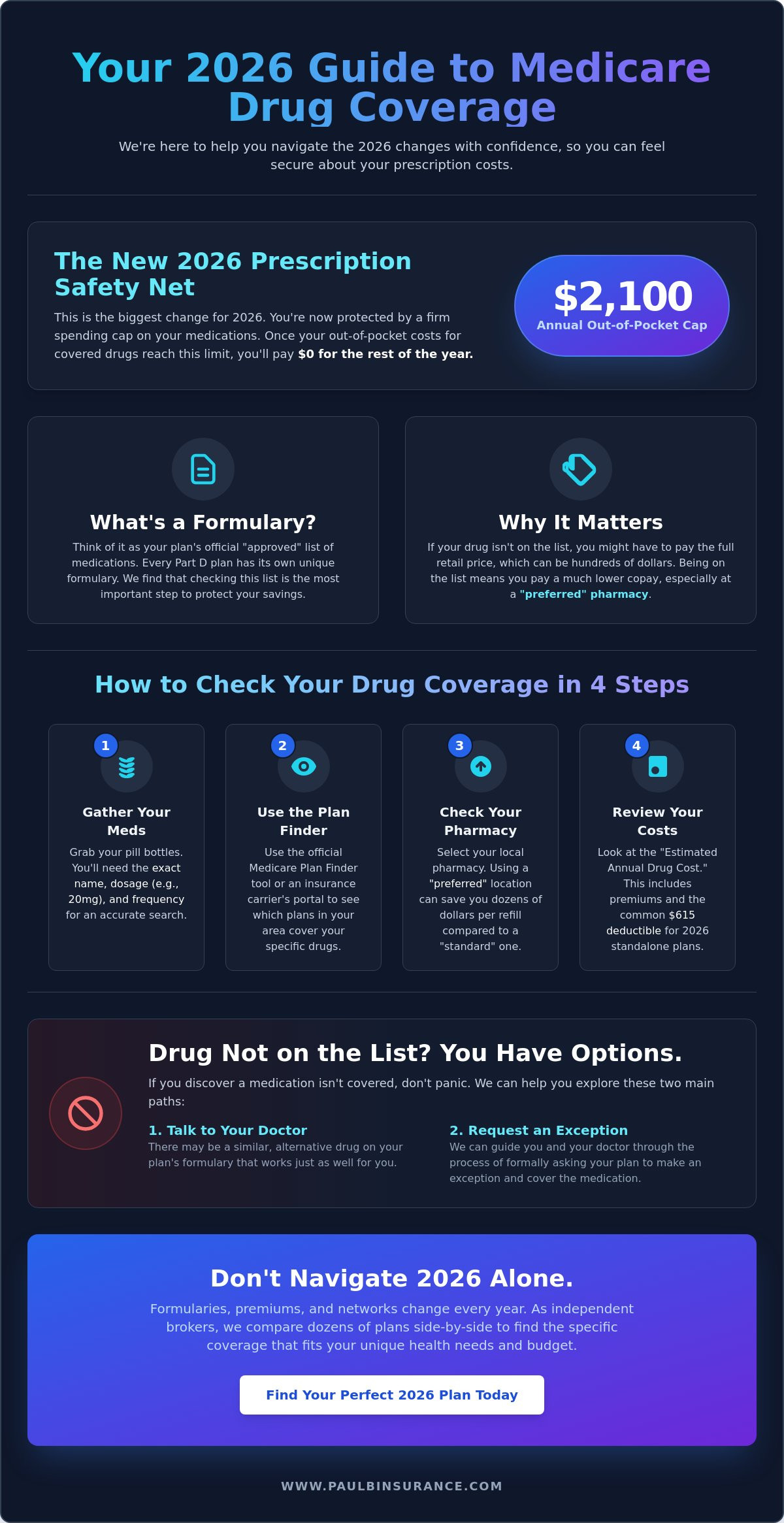
We often talk to people who feel a bit overwhelmed when they see the thick stack of papers their insurance company sends every year. That document is called a formulary, and it’s simply the official list of prescription drugs your plan covers. Since every Medicare Part D plan has its own unique list, understanding how to check if a drug is covered by medicare part d is the most important step you can take to protect your savings. If a drug isn’t on that list, you might end up paying the full retail price, which can be hundreds of dollars more than a copay.
Insurance companies use these lists to keep their own costs down while still providing the care you need. We’ve seen that these lists also dictate which pharmacies you can use. Most plans have a “preferred pharmacy network” where your drugs will cost significantly less. If your medication is on the formulary but you go to a pharmacy outside that network, you could still face unexpectedly high costs. This is why we encourage everyone to review their plan every single year during the Annual Enrollment Period. It’s the only way to be sure your specific medications and your favorite local pharmacy are still a good match for your budget.
The Role of Pharmacy Benefit Managers (PBMs)
You might wonder why one plan covers your blood pressure medication while another plan doesn’t. This often comes down to Pharmacy Benefit Managers, or PBMs. These are the companies that work behind the scenes to negotiate with drug manufacturers. They decide which drugs are included on the list and which ones are left off. A PBM is a third-party administrator that negotiates drug prices and manages the list of covered medications, which directly impacts the monthly premiums you pay for your 2026 coverage. Because different PBMs make different deals, the Medicare Part D market offers a wide variety of coverage options that can change from one year to the next.
Why Formularies Change in 2026
In 2026, drug lists are shifting more than usual. This is largely due to new medical research and the release of more affordable generic versions of popular brand-name drugs. When a generic becomes available, many plans will remove the expensive brand-name version from their formulary to save money. We’re also seeing the continued impact of the Inflation Reduction Act. While the new $2,100 out-of-pocket cap provides a wonderful safety net, it has caused some insurance companies to adjust their drug lists to manage their new financial responsibilities. Staying ahead of this “formulary churn” ensures you aren’t surprised by a “not covered” message when you go to refill your prescriptions next January. Knowing how to check if a drug is covered by medicare part d allows you to spot these changes early and switch plans if necessary.
Step-by-Step: How to Check If Your Drug Is Covered
We know the feeling of looking at a medicine cabinet and wondering if your coverage will hold up. It’s why we suggest a methodical approach to your 2026 review. Before you open a single website, start by gathering your current prescription bottles. It isn’t enough to know the drug name; you need the exact dosage and frequency. A 10mg pill might be covered on a low tier, while a 20mg version of the same medication could require extra paperwork. Having these details ready ensures your search results are accurate from the start.
Once your list is ready, you have a few ways to verify coverage. The most common method for how to check if a drug is covered by medicare part d is using the official Plan Finder tool or a specific insurance carrier’s portal. You’ll enter your zip code and your medications to see which plans in your area include your drugs on their formulary. If you’d rather not handle the technical side alone, we can run a comprehensive multi-carrier comparison for you. This helps you see how different Medicare Part D plans handle your specific pills side by side.
Using the Medicare Plan Finder Tool
When you use the online tool, take your time entering each drug name. The system will often suggest generic alternatives, which can save you money. After your drugs are entered, the tool asks you to select your preferred local pharmacies. This is a vital step because, in 2026, the price difference between a “preferred” and “standard” pharmacy can be dozens of dollars per refill. Look closely at the “Estimated Annual Drug Cost” results. This number includes your monthly premiums and the $615 deductible that many standalone plans charge this year, giving you a realistic picture of your yearly spending.
Reading the Evidence of Coverage (EOC)
Don’t stop at the search results. You should also check the Evidence of Coverage (EOC) document for any hidden “rules” attached to your medications. For instance, the Center for Medicare Advocacy points out that plans frequently use “Step Therapy” or “Prior Authorization” to manage costs. Step Therapy means you might have to try a less expensive drug before the plan will pay for the one your doctor preferred. You should also look for “Quantity Limits,” which might restrict how many pills you can get in a 30-day window. Understanding these details now prevents a stressful surprise at the pharmacy counter later. If you want to ensure your plan fits your lifestyle without the guesswork, you can schedule a quick chat with us to review your options together.
Deciphering Drug Tiers and the 2026 $2,100 Cap
When you look up your medications, you’ll see a number assigned to each one. This is the drug’s tier. Understanding these levels is just as important as knowing how to check if a drug is covered by medicare part d because it tells you exactly how much your plan expects you to pay. In 2026, most plans use a five tier system. The lower the tier, the lower your out-of-pocket cost will be. Even if a drug is covered, being on a higher tier could mean you pay a percentage of the price rather than a flat copay.
Understanding the 5-Tier System
Tiers 1 and 2 are usually your best friends for savings. These are preferred generic and generic drugs that often come with very low or even $0 copays. We always suggest checking with your doctor to see if a Tier 1 or 2 drug can replace a more expensive brand name option. Tiers 3 and 4 include preferred and non-preferred brand name drugs. These often require a higher copay or a percentage of the cost, called coinsurance. Finally, Tier 5 is the specialty tier. This is for complex treatments like biologics. Because these drugs are so expensive, you’ll almost always pay a significant coinsurance until you reach your yearly limit.
The 2026 Out-of-Pocket Revolution
The most reassuring change this year is the permanent limit on your spending. While the $2,000 cap was a major milestone introduced in 2025, the 2026 out-of-pocket cap has been set at $2,100 for the year. This means that once your total out-of-pocket spending reaches $2,100, you pay $0 for your covered prescriptions for the remainder of the year. We’ve seen how much stress this removes for people managing chronic conditions. You no longer have to worry about the old “Donut Hole” or a coverage gap surprise in the middle of summer. Instead, you have a clear, predictable ceiling on your healthcare costs. This peace of mind is why we focus so much on helping you find a Medicare Part D plan with the right formulary, since only covered drugs count toward this protection. Even if your medication has a high coinsurance in the spring, you can rest easy knowing your costs will stop entirely once you hit that 2026 threshold.
What to Do If Your Medication Is Not Covered
It is a stressful moment when you realize your medication isn’t on your plan’s list. We’ve seen many people feel stuck or worried they’ll have to pay full price, but you have several paths to get the care you need. First, remember the “Transition Fill” rule. If you’re a new member in the first 90 days of your plan, most companies must provide a one-time, 30 day supply of your current medication. This gives us time to work on a long-term solution together. You might also look into Patient Assistance Programs (PAPs) or manufacturer coupons, which can provide temporary relief while we sort out your permanent coverage.
Knowing how to check if a drug is covered by medicare part d before you reach the pharmacy is the best way to avoid these surprises. If you find a drug is missing during your annual review, don’t lose hope. We can help you navigate the system to find an alternative or request special permission from the insurance company. It’s important to act quickly so your treatment isn’t interrupted when the new plan year begins in January.
The Formulary Exception Process
If your doctor believes a specific drug is the only one that works for you, we can request a Formulary Exception. Your doctor will need to submit a “Statement of Support” explaining why other drugs on the list aren’t suitable for your condition. For standard requests, the insurance company usually makes a decision within 72 hours. If your health is at risk, we can ask for an expedited request, which requires a decision within 24 hours. If the plan denies your request, you have the right to appeal, and we can help you understand the next steps in that process.
Exploring Therapeutic Alternatives
Often, the simplest solution is talking to your doctor about therapeutic alternatives. These are different drugs that treat the same condition but are already on your plan’s formulary. Many people find that moving to a Tier 1 or Tier 2 generic drug provides the same results for a fraction of the cost. This is a great time to bring up “Step Therapy” with your physician. They can help you document why a lower tier drug might or might not work for you. You can learn more about how these lists are built by visiting our page on Medicare Part D. If you’re feeling stuck with a non-covered medication, reach out to us today so we can help you find a plan that actually covers what you need.
Navigating 2026 Changes with an Independent Broker
We know that looking at a list of dozens of different insurance companies can make anyone feel a bit dizzy. It’s exactly why we do what we do. While a representative at a large insurance firm is only allowed to tell you about their specific products, we represent you. Our primary mission is to move you from a state of worry to a state of absolute certainty. We compare over 40 different carriers to find the exact formulary that matches your current medications. This ensures you don’t overpay for the prescriptions you rely on every day.
Our support doesn’t end once you pick a plan. We provide year-round help because we know that life changes. Maybe your doctor prescribes a new medication in June, or perhaps your current plan decides to move a drug to a higher tier mid-year. When these things happen, you don’t have to face the system alone. We’re here to help you understand your options and file for exceptions if necessary. Knowing how to check if a drug is covered by medicare part d is a great skill, but having an advocate to handle the heavy lifting provides a level of security that a website simply can’t match.
The Independent Advantage
One of the biggest hurdles in 2026 is choosing between Medicare Advantage plans and stand-alone Part D coverage. We help you spot the hidden costs that automated online tools often miss. For instance, a plan might look affordable on a search result, but if your favorite local pharmacy isn’t in their preferred network, your out-of-pocket costs could be much higher than expected. We take the time to check those network details for you. We’re committed to unbiased, empathetic guidance. We want you to feel protected and empowered, not pressured by high-stakes sales tactics.
Your Next Steps for Peace of Mind
Ready to find clarity? Scheduling a personalized review with our team is a simple, no-pressure process. We suggest you bring your current prescription bottles and your Medicare card to our conversation. This allows us to double-check every dosage and brand name against the latest 2026 drug lists. We’ll look at the tiers, the deductibles, and how quickly you’ll reach the new $2,100 spending limit. Schedule your 2026 Medicare review with us today. Let’s work together to make sure your health and your budget are both well-protected for the coming year.
Secure Your Peace of Mind for 2026
Your health is too important to leave to chance. We’ve explored the importance of checking plan formularies and how the new $2,100 out-of-pocket cap provides a vital safety net this year. Knowing how to check if a drug is covered by medicare part d is a powerful tool, but you don’t have to navigate these technical tools alone. Whether you’re dealing with “Step Therapy” or just want to ensure your local pharmacy is in-network, having an expert in your corner makes all the difference. We’re here to help you move from a state of uncertainty to one of total confidence.
Paul Barrett and his dedicated team offer personalized support to help you compare options from over 40 insurance carriers. We are licensed in over 34 states and focus on finding the specific coverage that fits your unique needs. You deserve a partner who prioritizes your health over high-pressure tactics. Let us help you find the perfect 2026 plan; contact The Modern Medicare Agency today. We look forward to helping you protect your health and your budget with a plan you can trust.
Frequently Asked Questions
How often do Medicare Part D plans change their drug lists?
Plans usually update their formularies at the start of every year on January 1st. However, they can also make smaller changes throughout the year, such as adding new generic options or removing a drug that the FDA has deemed unsafe. We recommend checking your specific drug list every autumn to ensure your coverage remains stable for the following year.
Can a plan stop covering my drug in the middle of the year?
Yes, a plan can remove a drug or change its tier during the year, but they must notify you first. Usually, you’ll receive a written notice at least 30 days before the change takes effect. If the change is sudden, the plan might provide a one-month transition refill to ensure you don’t miss a dose while you and your doctor find a new solution.
What is the difference between a Preferred and Non-Preferred pharmacy?
A preferred pharmacy has a contract with your insurance provider to offer the lowest possible prices for your medications. While you can still use a non-preferred pharmacy, you’ll likely pay a higher copay or coinsurance for the exact same pill. We always suggest verifying your pharmacy’s status because using a preferred location is one of the easiest ways to save money.
Does Medicare Part D cover over-the-counter (OTC) medications?
Standard Part D plans don’t cover over-the-counter medications like cough syrup or basic pain relievers. These plans are strictly for drugs that require a prescription from a licensed healthcare provider. If you need help with OTC costs, some Medicare Advantage plans offer a monthly or quarterly allowance that can be used for these pharmacy staples.
What happens if I reach the $2,100 out-of-pocket limit in 2026?
Once you reach the $2,100 out-of-pocket limit in 2026, your costs drop to $0 for all covered prescriptions for the remainder of the calendar year. This is a wonderful safety net that protects you from unlimited spending on expensive specialty drugs. It’s one of the most significant improvements to the program, providing true peace of mind for those with chronic health conditions.
Can I switch my Part D plan if they drop my medication?
You typically can’t switch plans mid-year just because a drug was dropped from the list. Most people must wait for the Annual Enrollment Period in the fall to make a change. If you’ve learned how to check if a drug is covered by medicare part d and find your medication is missing, we can help you file for a formulary exception so you can keep your current medication.
How do I know if my drug requires Prior Authorization?
You can find this information by looking at your plan’s drug list, where it’s usually indicated by the abbreviation “PA.” This requirement means your plan needs more information from your doctor to prove the drug is medically necessary before they’ll cover it. We can help you understand these codes so you aren’t surprised when you get to the pharmacy counter.
Is there a penalty for not having Part D coverage?
Yes, Medicare charges a late enrollment penalty if you go without creditable drug coverage for 63 days or more after your Initial Enrollment Period. This penalty is a permanent addition to your monthly premium. Even if you don’t take any medications today, we often suggest enrolling in a low-cost plan to protect yourself from these lifelong extra costs.

Article by
Paul Barrett
Paul Barrett, CMIP is the founder of The Modern Medicare Agency, an independent Medicare-only brokerage based in Melville, NY. With 18 years of Medicare-exclusive experience, a CMIP designation, and more than 5,000 clients served across 37 states, Paul is one of the most credentialed independent Medicare specialists on Long Island — and one of the most direct.
He represents 40+ carriers with no quotas and no allegiances, which means his recommendations are based entirely on what fits each client's specific situation. He is the author of Medicare Mastery Unlocked and host of the Wise Guys Retirement Talk podcast. His content is grounded in primary sources, real carrier intelligence, and 18 years of watching what happens when people get Medicare right — and when they don't.
📞 631-358-5793 | paulbinsurance.com