
What if the right Medicare choice isn’t the plan with the most features, but the one that fits what matters most to you? If you’re wondering how to feel confident in your medicare choice in 2026, start with your own needs, then compare plan details against them.
It’s understandable to feel unsure. You may be weighing whether your doctors are covered, how your prescriptions fit, what you could pay out of pocket, and whether you’ve missed an important detail. Unfamiliar Medicare terms can make those questions harder to sort through. You don’t need to find a perfect plan. You need to understand the trade-offs and feel comfortable with your decision.
This guide gives you a practical way to do that. You’ll identify your healthcare priorities, compare the main coverage paths, and check doctors, medicines, and costs before deciding. Personalized guidance can also make a long list of options easier to compare. The aim is to help you move from uncertainty to a choice you understand.
Key Takeaways
- Understand the basic differences between Original Medicare, Medicare Advantage, Part D, and Medigap before comparing plans.
- Use your doctors, prescriptions, costs, and care preferences to decide what deserves the most attention.
- Learn how to feel confident in your medicare choice by reviewing current 2026 plan details and weighing the trade-offs that matter to you.
- Use a simple checklist to organize your comparison and record why an option fits your priorities.
- When plan details are difficult to reconcile, personalized guidance from an independent brokerage can make comparing options more manageable.
Why Medicare choices can feel overwhelming, and what confidence really means
Choosing coverage for 2026 can feel stressful because it affects everyday essentials: seeing your doctors, filling prescriptions, and getting care while understanding what you may pay. Unfamiliar terms can make the decision feel even more complicated. You might understand the basic parts of Medicare and still be unsure which option fits your circumstances. Those are separate questions, and you can work through them one at a time.
Medicare includes several parts and ways to receive coverage. For a broad introduction, the Medicare (United States) Wikipedia article offers background on the program. But knowing the basics doesn’t tell you which option fits your needs. That depends on your priorities and the details of options available where you live in 2026.
What makes a Medicare decision feel difficult?
Several concerns may compete for your attention. You might want to keep a trusted doctor, confirm your prescriptions are covered, understand potential costs, and know how a plan handles care. The details that matter most vary from person to person. Someone who sees several specialists may put provider access first, while another person may focus on costs or a particular medicine.
Your location, healthcare needs, and budget all shape which questions deserve attention. You don’t have to master every insurance term before comparing options. Start by noting what feels unclear, then look for a plain-language explanation of the detail that could affect your decision. If dental care is also on your mind, include dental insurance options in your broader coverage picture.
What does it mean to feel confident in your choice?
Confidence doesn’t mean predicting every future health need or finding a plan without trade-offs. It means checking the details that matter to you and understanding what you gain and give up with each option. Take time to compare relevant information and ask clear questions. That’s different from choosing quickly just to end the uncertainty, and it doesn’t mean your circumstances will never change.
A confident Medicare choice is one you make after checking the details that matter to you and understanding the trade-offs. It’s a practical standard, not a demand to know everything.
So, how to feel confident in your medicare choice? Separate two kinds of uncertainty: “What does this Medicare term mean?” and “Does this coverage fit what I need?” The first calls for a clear explanation. The second calls for comparing your priorities with plan details. You deserve to understand what you’re considering before you decide.
Understand your Medicare coverage paths before comparing details
Before comparing specific 2026 plans, get familiar with the main ways Medicare coverage is arranged. The decision isn’t simply about having “more” or “less” coverage. Consider how you receive care, which coverage pieces you may need, and what details matter for your situation.
How Original Medicare and Medicare Advantage differ
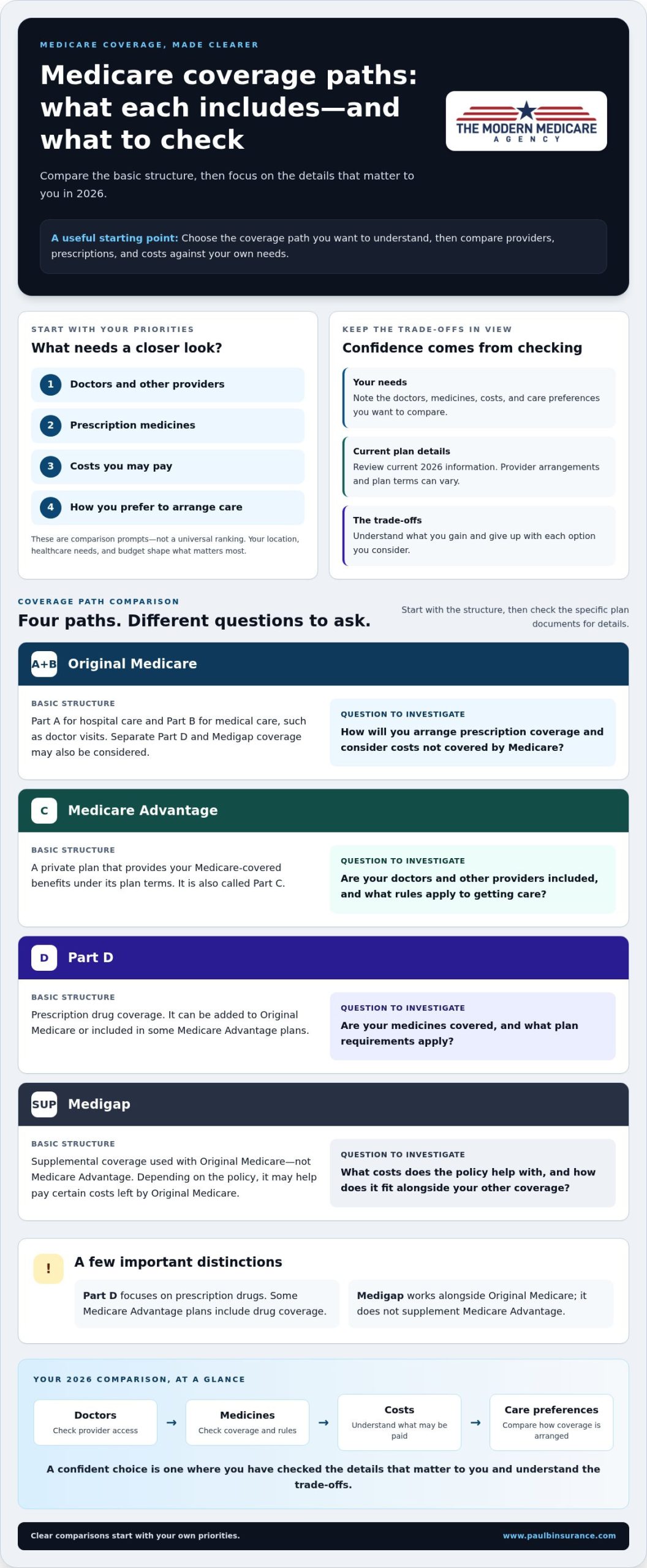
Original Medicare includes Part A for hospital care and Part B for medical care, such as doctor visits. You can add separate Part D coverage for prescriptions and may consider a Medigap policy to help with certain costs. Medicare Advantage, also called Part C, is an alternative way to receive Medicare benefits through a private plan. Plan details and provider arrangements vary, so don’t assume every plan works the same way. For a deeper overview, explore this Medicare Advantage guide.
Consider how you prefer to arrange care. Would you rather have Original Medicare with separate coverage choices, or review a plan that brings Medicare benefits together? The right questions depend on the options available and your priorities. KFF’s analysis of Medicare Advantage trends for 2026 provides wider context. To understand a particular plan’s terms, review its current documents.
| Coverage path | Basic structure | Questions to investigate |
|---|---|---|
| Original Medicare | Part A and Part B, with the option to consider separate Part D and Medigap coverage. | How will you arrange prescription coverage and consider costs not covered by Medicare? |
| Medicare Advantage | A private plan that provides your Medicare-covered benefits under its plan terms. | Are your doctors and other providers included, and what rules apply to getting care? |
| Part D | Prescription drug coverage that can be added to Original Medicare or included in some Medicare Advantage plans. | Are your medicines covered, and what plan requirements apply? |
| Medigap | Supplemental coverage used with Original Medicare, not Medicare Advantage. | What costs does the policy help with, and how does it fit alongside your other coverage? |
Where Medigap and Part D fit into the decision
Medigap is a separate type of insurance that works alongside Original Medicare. Depending on the policy, it may help pay certain costs left by Original Medicare. It isn’t a way to supplement Medicare Advantage. Part D focuses on prescription drugs. If you choose Original Medicare, you can review a separate Part D plan; some Medicare Advantage plans include drug coverage. For 2026, check current plan information for covered medicines and requirements instead of relying on last year’s details.
You don’t need to settle every question at once. First identify the coverage path you want to understand, then compare its provider arrangements, prescription coverage, and costs. Explore personalized Medicare guidance to make the options easier to compare.
Compare Medicare options using the priorities that matter to you
Once you understand the main coverage paths, bring the comparison back to your everyday needs. Plan details can differ by location and year, so use current 2026 materials rather than assuming last year’s information still applies. Ranking your priorities can help you focus on what would make the biggest difference in your care.
Start with doctors, prescriptions, and expected care
Before reviewing plans, make a short list of your current doctors and other providers, the medicines you take, and any care you expect to need. Mark each item as a must-have or a preference. Keeping a particular specialist may be essential, while an extra benefit may be appealing but less important. This distinction helps you compare options when no plan meets every preference.
Provider networks, prescription lists, sometimes called formularies, and coverage rules are specific to each plan. For every 2026 option you’re considering, check whether your providers are included and how your medicines are handled. A Medicare Advantage plan guide can explain the types of details to compare, but current plan information is what describes an individual plan.
Balance costs, access, and extra benefits
Compare the full picture, not just one number. Look at the premium alongside costs you may face when using care, such as deductibles, copayments, or coinsurance, as described in the plan materials. Consider provider access and plan rules, too. A lower premium by itself doesn’t tell you whether a plan fits your needs.
The lowest premium alone can’t show whether a plan fits your doctors, medicines, care needs, and budget.
Try ranking these five areas from most important to least important:
- Providers: Which doctors, specialists, or facilities do you want to keep using?
- Prescriptions: Which medicines should you check against each plan’s current coverage information?
- Costs: Which costs matter most to your budget, both regularly and when you need care?
- Benefits: Which covered services or extra benefits would you actually use?
- Care preferences: How much do provider choice, plan rules, or coordinated care matter to you?
Compare options against your highest priorities first. If keeping a particular doctor is essential, verify that before giving extra benefits much weight. If two plans meet your core needs, use your lower-ranked preferences to help distinguish them. This is a practical way to apply how to feel confident in your medicare choice: make the comparison reflect your life, not an abstract idea of the “best” plan.
Give dental care its own check. Don’t assume a Medicare option covers the dental services you want. Review the plan’s 2026 details and consider whether separate dental insurance options belong in your comparison. A priority list won’t remove every trade-off, but it can help you see which compromises you’re comfortable making.
Follow a 2026 checklist to verify your Medicare choice
A careful review can turn a promising option into a choice you understand. Use this sequence to check the details that matter, then keep a record you can revisit. For 2026, rely on current plan materials and official Medicare information rather than assumptions or documents from a previous year.
- Define your priorities. Write down your must-haves, such as a doctor you want to keep, a medicine you take, or a cost concern that affects your budget.
- Identify your options. List the coverage paths and specific plans available to you. Enrollment timing and available choices depend on your situation, so don’t assume the same dates or options apply to everyone.
- Verify the details. Check provider participation, prescription coverage, plan rules, and costs for the services you expect to use.
- Compare the trade-offs. Review each option against your priorities. Note where it meets a need and where it may involve a compromise.
- Record your decision. Write down the option you chose and why it fits your needs. Save the plan documents you used.
Check the details that could affect your care
For each option, review current 2026 materials for your doctors, specialists, and other providers. Check your prescriptions against the plan’s drug coverage information, and look for rules that could affect how you receive care. Then consider the services you expect to use and how the plan describes their coverage and costs. Don’t rely on a general summary if a specific detail could change your decision.
Use Medicare’s official plan comparison tool and other current information on Medicare.gov to review available plans and applicable details. If something is unclear, note the question and where you found the information. You’ll have a specific point to resolve instead of leaving a gap for assumptions to fill.
Make a decision record you can revisit
Your notes can be simple: keep your priority list, the options you compared, and a short explanation of why your final choice made sense for 2026. Save relevant plan documents and note where you found official answers. This record can help you understand your reasoning later, especially if your health needs or plan details change.
Before deciding, confirm your providers, medicines, expected-care coverage, costs, and the plan rules that matter to you. That final check can’t guarantee future circumstances, but it can help you make a considered choice based on the information available now. If the details still feel difficult to compare, get personalized Medicare guidance to connect your priorities with options you can understand.
Get personal Medicare guidance and move forward with greater peace of mind
Sometimes you’ve made a thoughtful list and still have questions. Your preferred doctor, prescription needs, and budget may point in different directions. Or plan documents may leave you unsure which detail matters most. Personalized guidance can help turn those concerns into a clearer comparison, so you can consider your options without working through every detail alone.
What an independent Medicare broker can help you work through
The Modern Medicare Agency is an independent brokerage that helps people compare Medicare Advantage, Medigap, and Part D plans from more than 40 carriers. A broker helps compare private plan options. The agency is not Medicare or a government plan provider, and it doesn’t replace official Medicare information about coverage or enrollment.
Guidance can start with your specific questions. Which providers do you want to keep seeing? Which prescriptions need attention? What plan rules or costs are still unclear? An independent broker can help organize those questions and compare relevant plan details across carriers, using your priorities as a guide. This can be useful when one option appears stronger for provider access while another seems to fit a different concern.
The goal is not to promise a particular plan, savings, or coverage outcome. It’s to help you understand the options and their trade-offs so you can make a considered decision. If you’re working out how to feel confident in your medicare choice, clear explanations and a comparison based on your needs can make the next step easier.
Take the next step at your own pace
Bring your priority list, the plan materials you’ve reviewed, and any questions that remain. You don’t need to arrive with everything figured out. A conversation can help you sort what you understand from what you’d like explained, then focus on the details that matter for your situation in 2026.
The Modern Medicare Agency provides personalized guidance and year-round support across more than 34 states. Whether you’re comparing options or trying to make sense of a particular plan detail, you can take the discussion one question at a time. The decision remains yours, and you can take the time you need to understand what you’re considering.
If you’re ready to talk through your priorities, talk with an independent Medicare guide. A calm, clear conversation can help you understand your options and move forward with greater peace of mind.
Take your next step with clarity
You don’t need to predict every healthcare need to make a thoughtful Medicare decision in 2026. You need a choice that reflects what matters to you now, based on details you’ve had a chance to understand. That’s a practical way to think about how to feel confident in your medicare choice: not as a promise that nothing will change, but as a decision you can explain and feel comfortable making.
If questions remain, write down the details that would help you move forward. A conversation about your priorities can make those questions easier to sort through and help you consider relevant private plan options. You set the pace, and the choice stays yours.
Talk with an independent Medicare guide when you’re ready to discuss your options. You deserve clear information and room to make a decision that feels right for you. Take the next step when you’re ready.
Frequently Asked Questions
How do I know if I chose the right Medicare plan?
You may feel more assured when you can explain why your plan fits your needs today. For example, you may have checked a specialist you rely on, a regular prescription, and how the plan handles care you expect to use. Keep the documents you used to make your choice, too. They can help you understand your reasoning if your health needs or plan details change during 2026.
Is it normal to feel unsure about choosing Medicare coverage?
Yes. Uncertainty is an understandable response to an important decision filled with unfamiliar terms. You don’t have to become an insurance expert before taking a useful next step. Choose one question to resolve first, such as whether a medicine is covered or what a plan means by a referral. Getting a clear answer to one specific concern can make the rest feel less daunting.
Can someone help me compare Medicare plans without choosing for me?
Yes. An independent broker can explain private plan options and help you compare them, while you make the final decision. Bring a short list of questions and ask for unfamiliar terms to be explained in plain language. Take notes and give yourself time to decide, rather than feeling you need to enroll during the conversation.
What should I check before enrolling in a Medicare plan?
Check the details that could affect your routine care: whether your providers participate, how your prescriptions are covered, and whether the plan has rules relevant to services you expect to use. Review the plan’s current 2026 materials and official information on Medicare.gov. If a detail is unclear, record the exact question and where you looked. This helps you get a specific answer instead of relying on memory or an older summary.
Should I choose Medicare Advantage or Original Medicare?
There isn’t one right answer for everyone. Consider how you prefer to arrange coverage and what matters most in your situation. For instance, if you see providers in different locations, pay close attention to access rules. If you take regular prescriptions, check how each option handles them. Compare current choices available to you, and use personalized guidance to clarify differences you’re unsure about.
Can I change my Medicare choice if my needs change?
Possibly, but the choices and timing available depend on your circumstances and Medicare’s current enrollment rules. Don’t assume you can switch whenever you want. If your doctor, health needs, or prescriptions change, note what’s different and review the official 2026 Medicare information that applies to your situation. That gives you a starting point for understanding whether a change may be available and what details you’ll need to consider.
How can I tell whether Medicare advice is unbiased?
Look for advice that connects options to the priorities you shared and explains meaningful trade-offs without pressure or promises. Ask which plans the person can compare and how they’re paid. An independent brokerage can compare options across carriers. If an explanation feels unclear, ask for the reasoning in everyday language and take time to consider it before making a decision.

Article by
Paul Barrett
Paul Barrett, CMIP is the founder of The Modern Medicare Agency, an independent Medicare-only brokerage based in Melville, NY. With 18 years of Medicare-exclusive experience, a CMIP designation, and more than 5,000 clients served across 37 states, Paul is one of the most credentialed independent Medicare specialists on Long Island — and one of the most direct.
He represents 40+ carriers with no quotas and no allegiances, which means his recommendations are based entirely on what fits each client's specific situation. He is the author of Medicare Mastery Unlocked and host of the Wise Guys Retirement Talk podcast. His content is grounded in primary sources, real carrier intelligence, and 18 years of watching what happens when people get Medicare right — and when they don't.
📞 631-358-5793 | paulbinsurance.com