
Short answer: it depends, and the deciding factor is who paid your premiums and whether that money was pre-tax or after-tax. If you paid the premiums yourself with after-tax dollars, your benefit is generally tax-free. If your employer paid the premiums, or you paid through a pre-tax payroll plan, the payout is generally taxable. Check your pay stub or benefits summary first: that one line tells you almost everything.
TL;DR:
- Section 125 payroll deductions count as before tax funding, while mixed premiums usually make only the employer funded share taxable; request a written allocation.
- Taxable benefits may appear in Box 1 of an employer wage statement or as other income; a large payout without withholding may require estimated payments.
- Documented medical reimbursements may be excluded, but reimbursement for previously deducted expenses is generally taxable up to the amount deducted.
- A taxable payout raises adjusted gross income for its year, and Medicare premium surcharges use income from two years earlier.
- If you receive Medicaid or Supplemental Security Income, report a lump sum promptly to your caseworker because state rules determine whether it affects eligibility.
Table of Contents
- The legal rule: IRC sections and IRS guidance that control tax treatment
- Common scenarios: individual purchase, employer-paid, and mixed funding
- How benefits are reported and what to report on your tax return
- Special cases that commonly change the tax outcome
- If your payout is taxable: step-by-step actions to verify, document, and file correctly
- Practical notes from Paul Barrett and what Medicare-focused agents see in practice
- How cancer insurance interacts with Medicare and what Medicare beneficiaries should know about taxes
- Does a cancer insurance payout affect Medicaid or other senior assistance programs?
- Why I tell every client to check their pay stub before they panic
- How Paul B Insurance can help you sort out the paperwork
- FAQ
- Sources
The legal rule: IRC sections and IRS guidance that control tax treatment
The federal tax code does not care what you call your cancer policy. It cares about the money trail. Under 26 U.S.C. §104, amounts received through accident or health insurance are excluded from gross income, with one major exception: benefits attributable to employer contributions that were never included in your taxable wages. That exception is spelled out in 26 U.S.C. §105, which pulls employer-funded or pre-tax benefits back into gross income.
In plain terms:
- Premiums you paid yourself, after-tax: benefits are generally excluded from income.
- Premiums your employer paid, or you paid pre-tax through payroll: benefits are generally taxable as wages.
- The policy’s name, marketing, or “cancer insurance” label has no bearing on this test.
The premium source, not the policy type, decides the tax outcome. According to the IRS FAQ on insurance proceeds, benefits from a policy you paid for with after-tax dollars are not taxable, and this holds whether you bought the policy individually or paid the full premium yourself through an employer plan.
Common scenarios: individual purchase, employer-paid, and mixed funding
Most readers fall into one of four situations. Here is how each one typically plays out:
- You bought the policy yourself and pay premiums with after-tax money. Your benefit is generally tax-free under §104, as confirmed by the IRS guidance on insurance proceeds.
- Your employer pays some or all of the premium. Any benefit tied to that employer-paid share is generally taxable under §105.
- You pay through a Section 125 cafeteria plan. This money comes out of your paycheck before taxes, which makes it functionally employer-funded for tax purposes, so the payout is usually taxable.
- Your policy is funded partly by you and partly by your employer. The payout is typically allocated proportionally, with the employer-funded share taxable and the portion you paid after-tax excluded.
To tell these apart, look at your pay stub for a deduction labeled “Section 125,” “cafeteria plan,” or “pre-tax,” or ask your HR department directly. For mixed funding, request a written premium allocation from your plan administrator rather than guessing at the split.
How benefits are reported and what to report on your tax return
Reporting follows the same logic as the tax treatment itself.
- If your benefit is taxable because of employer or pre-tax funding, it is often folded into wages and shown in Box 1 of your Form W-2.
- If the insurer treats the payout as miscellaneous income rather than wages, you may instead receive a Form 1099-MISC, which generally gets reported as other income on Schedule 1 of your Form 1040.
- If your benefit qualifies for exclusion under §104 because you paid after-tax premiums, you usually do not report it at all, but you should still keep proof of those after-tax payments in case the IRS asks.
- A large taxable lump sum with no withholding can push you into owing estimated taxes, which the IRS explains through Form 1040-ES.
Pro Tip: If you receive a large taxable cancer insurance payout mid-year, calculate whether it changes your total tax liability enough to require a Form 1040-ES payment before the next quarterly deadline.
Special cases that commonly change the tax outcome
A few situations shift the usual rule, and they trip people up every tax season.
- Fixed indemnity lump sums often become taxable even when you thought you had a simple cancer policy, because the determining factor is still premium source, not payout structure. IRS written determinations addressing fixed indemnity and cafeteria-funded benefits, including CCA 201719025, confirm that pre-tax or employer-paid premiums generally make these lump sums includible in income.
- Reimbursements of actual medical expenses are more likely to be excluded under §105(b) when you can document the expenses and the reimbursement matches them directly.
- Recapture applies if you previously deducted medical expenses on a prior tax return and later received a reimbursement for those same expenses. Under §104, you generally must include the reimbursed portion in income up to the amount you deducted earlier.
- Some arrangements fail to qualify as insurance for federal tax purposes if they do not shift and distribute risk the way true insurance does, which can affect whether the §104 exclusion applies at all.
If your payout is taxable: step-by-step actions to verify, document, and file correctly
Once you know (or suspect) your payout is taxable, work through these steps in order:
- Request a payout statement from your insurer showing how the claim was categorized.
- Ask your plan administrator or HR department for a written premium-allocation letter, especially if funding was mixed.
- Pull old pay stubs to confirm whether deductions were coded as pre-tax or after-tax.
- Report the income correctly: wages on your W-2 if your employer included it, or other income on Schedule 1 if you received a 1099-MISC.
- Set aside funds for estimated taxes if a large payout arrived without withholding.
Pro Tip: Bring your insurer’s payout statement, pay stubs, and any premium-allocation letter to your tax preparer; these three documents resolve most taxability questions in a single meeting.
If your situation involves mixed funding, a prior-year medical deduction, or a payout large enough to change your tax bracket, a tax professional can confirm the correct treatment faster than trial and error.
Practical notes from Paul Barrett and what Medicare-focused agents see in practice
We have seen that premium confusion, not the cancer policy itself, causes most tax surprises for clients. A short verification checklist catches nearly every problem before it becomes a filing headache:
- Check your pay stub or benefits portal for a Section 125 or “pre-tax” code before assuming your premiums were after-tax.
- Request a written premium-allocation letter from your employer’s benefits administrator if your funding was split.
- Keep copies of pay stubs and premium statements for at least the tax year the benefit was paid, plus the following year.
- Ask your insurer directly how they intend to report the payout, since not every company issues a 1099 for taxable amounts.
These steps take less time than most people expect, and they prevent the far more painful process of amending a return later.
How cancer insurance interacts with Medicare and what Medicare beneficiaries should know about taxes
Cancer insurance is not a Medicare product. It is a supplemental policy you buy separately, and Medicare does not pay or administer the premiums, so the usual after-tax versus pre-tax test still applies exactly as described above. If you are retired and paying your cancer policy premium directly from a personal bank account or Social Security deduction, that is after-tax money, and a benefit payout is generally excluded from income under §104.
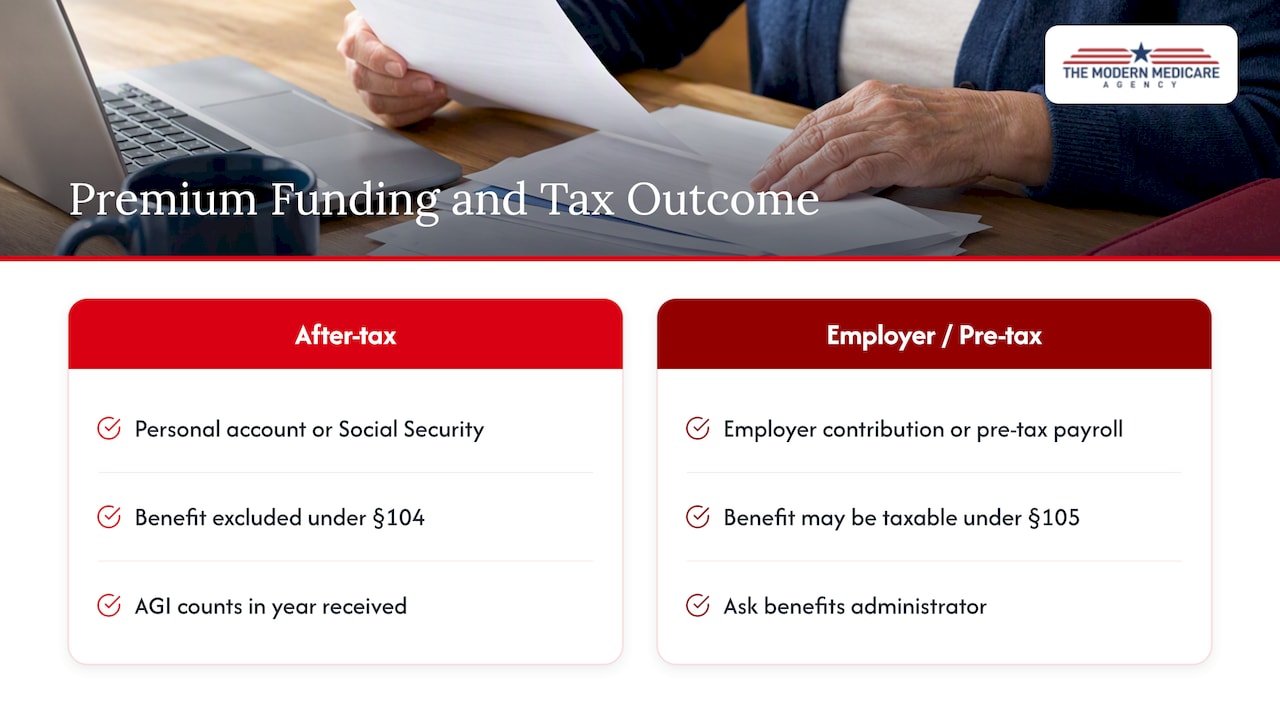
The complication shows up for beneficiaries who kept a policy originally set up through a former employer’s retiree benefits plan. If that employer still contributes to the premium, or if the premium was ever paid through a pre-tax payroll arrangement before retirement, the taxable treatment under §105 can carry forward into the claim years later. It is worth asking the retiree benefits administrator directly whether any portion of your current premium is still employer-funded.
Cancer insurance benefits also do not affect your Medicare Part B premium calculation or your Income-Related Monthly Adjustment Amount in the way that ordinary taxable income might, but a large taxable payout does add to your adjusted gross income for the year it is received, and IRMAA is based on a two-year lookback of that figure. Readers coordinating a cancer supplement with existing Medicare coverage can find more detail in our guide on how cancer insurance works with Medicare.
Does a cancer insurance payout affect Medicaid or other senior assistance programs?
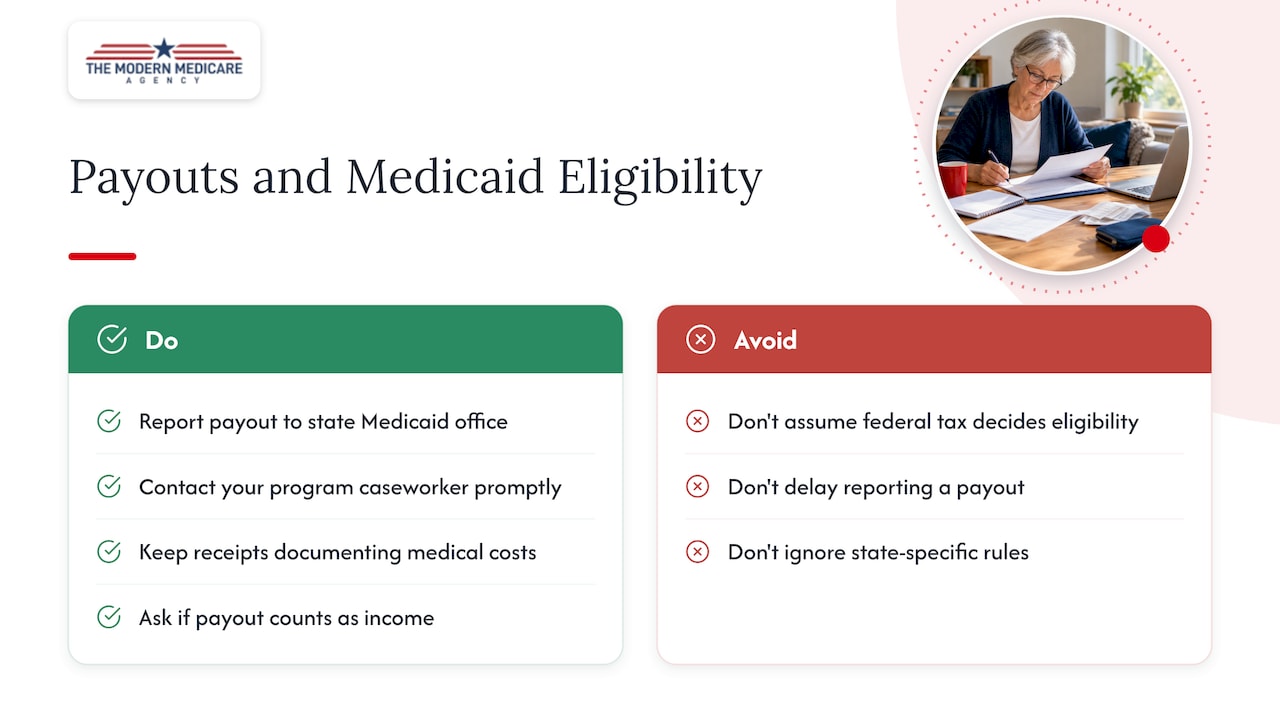
Medicaid eligibility and many senior assistance programs are based on income and asset limits that reset periodically, and a taxable cancer insurance payout can temporarily raise your countable income for the month or period you receive it. Because Medicaid eligibility rules vary by state and by program category (aged, blind, disabled, or long-term care Medicaid each have different thresholds), there is no single national answer, and the correct treatment depends on your state’s specific Medicaid rules and the program you are enrolled in.
A lump-sum payout is more likely to create a temporary eligibility question than a reimbursement for actual medical expenses, since many programs exclude reimbursements tied to documented medical costs from countable income. If you receive a cancer insurance payout while enrolled in Medicaid, Supplemental Security Income, or a similar needs-based program, contact your state Medicaid office or program caseworker promptly to confirm how the payout should be reported and whether it affects your continued eligibility. Acting quickly protects your coverage and avoids a retroactive eligibility dispute.
Because these programs are administered at the state level and tied to income snapshots rather than the federal tax rules discussed above, the tax treatment of your premiums under §104 or §105 is a separate question from the eligibility question, and resolving one does not automatically resolve the other.
Why I tell every client to check their pay stub before they panic
I have watched too many retirees assume the worst about a cancer insurance payout, only to find their premiums were after-tax the whole time and the benefit was never taxable. The pay stub or benefits summary answers the question in minutes, long before a tax bill ever arrives. Verifying this one detail protects retirement income from an unnecessary surprise, and our team is always available to help you track down the paperwork if you get stuck.
— Paul
How Paul B Insurance can help you sort out the paperwork
We spend our days helping Medicare-age clients make sense of exactly this kind of paperwork, and a benefits-review appointment is often the fastest way to get a clear answer about your specific policy.

- We help you request a premium-allocation letter from an employer or former employer’s benefits office.
- We review your existing cancer, critical illness, or hospital indemnity coverage alongside your Medicare plan to flag any funding questions before claim time.
- We walk you through which documents to keep and which to hand to your tax preparer.
If you want a second set of eyes on your coverage or help gathering the right paperwork, visit our Medicare Supplement plans page to schedule a benefits-review appointment with our team.
This article is general information, not a substitute for advice from a qualified doctor. Consult a qualified healthcare professional about your own circumstances before acting on anything here.
FAQ
Can I deduct cancer insurance premiums on my taxes?
Premiums you pay yourself with after-tax dollars are generally not deductible as a straightforward write-off, though they may count toward the broader medical expense itemized deduction if your total qualifying medical costs exceed the applicable threshold. Premiums paid through a pre-tax payroll arrangement are already excluded from your taxable wages, so they are not deducted again. Check with a tax preparer about how your specific premiums fit into your itemized deductions.
I have cancer and lost my job. What should I do?
Contact your insurer immediately to confirm your cancer policy and any other coverage remain active, since job loss can affect employer-sponsored benefits but typically does not affect an individually owned cancer policy. Look into COBRA continuation for your health coverage and check whether you qualify for Medicaid or a Marketplace plan during the transition. If a payout is pending, request the premium-allocation documentation now, since gathering it is easier while you are still in contact with your former employer’s benefits office.
Is there a tax break for cancer patients?
There is no single “cancer patient” tax credit, but unreimbursed medical expenses above a percentage of your adjusted gross income can be itemized as a deduction under general IRS rules outlined in Publication 525. Cancer insurance benefits themselves may be tax-free if you paid the premiums after-tax, which functions as its own form of tax relief. A tax professional can confirm which deductions apply to your specific medical expenses for the year.
Are Aflac cancer insurance payments taxable?
Taxability depends on premium source rather than the insurance carrier, so the same after-tax versus pre-tax test applies to any cancer insurance policy, including those purchased through payroll at work. If you paid the premium yourself with after-tax dollars, the payout is generally tax-free under §104. If your employer contributed or you paid through pre-tax payroll deduction, the payout is generally taxable, and you should verify the specific arrangement with your HR department.
Is critical illness benefit taxable?
Critical illness benefits follow the identical premium-source rule as cancer insurance: after-tax individual premiums generally produce a tax-free benefit, while employer-paid or pre-tax premiums generally make the benefit taxable. Readers comparing these products can find more background in our guide to critical illness insurance. Confirming your premium treatment before a claim arrives avoids any confusion at tax time.
Sources
- IRS — Life insurance, disability insurance proceeds, and other types of income (FAQs)
- 26 U.S.C. §104 — Compensation for injuries or sickness
- IRS Chief Counsel Advice / Written Determination (201719025)