
Most healthy applicants in their 50s and early 60s qualify for traditional long term care insurance, but underwriting is stricter than many people expect. Simulations modeling industry criteria estimate that about 30% of wealth-qualified Americans aged 50 to 71 would be rejected, and roughly 40% of the general population would be turned down. Coverage is medically underwritten at application, though tax-qualified policies become guaranteed renewable once issued.
TL;DR:
- About 30% of wealth-qualified applicants aged 50 to 71 are rejected for long term care insurance, with nearly 40% rejection among the general population.
- Underwriting mainly assesses near-term health decline over five to seven years, focusing on recent health issues rather than lifetime risk.
- Conditions like dementia, recent strokes, advanced cancers, uncontrolled diabetes, or severe heart failure frequently lead to policy declines or higher ratings.
- Applying earlier in your 50s improves approval chances and locks in lower premiums, especially if health conditions are well-controlled and documented.
- Working with an independent agent to gather records and compare multiple carriers can significantly increase approval odds and reduce rating risks.
Table of Contents
- How long term care underwriting works, step by step
- Medical criteria and common disqualifiers
- Timelines, approval probabilities, and likely outcomes
- Policy types and underwriting differences
- How pricing and risk classes are set
- How to improve approval odds: a pre-application checklist
- Practical notes from an agent’s perspective
- The role of financial underwriting in long term care eligibility
- How age and gender affect underwriting outcomes
- How prior long term care claims or benefits affect new applications
- Post-approval reviews and policy adjustments
- How functional and cognitive assessments shape decisions
- When buying long term care coverage still makes sense
- How PaulB Insurance can help with your long term care application
- FAQ
- Sources
How long term care underwriting works, step by step
Long term care underwriting is a carrier’s structured process for deciding whether to accept an applicant, charge a higher premium, or decline coverage. It starts with a detailed application and ends weeks later with a decision letter, but a lot happens in between.
The application itself asks about current medications, past diagnoses, hospitalizations, and whether the applicant needs help with activities of daily living such as bathing, dressing, or managing finances. These questions are not a formality. A carrier’s underwriting team uses them to build a risk profile long before a nurse or physician ever gets involved.
From there, most carriers follow a similar sequence:
- Telephone health interview. A trained interviewer asks follow-up questions about health history, lifestyle, and cognitive function, often catching details the paper application missed.
- Medical records retrieval. The carrier orders records from the applicant’s physicians, covering roughly the past two to five years.
- Attending physician statement. For borderline cases, the carrier requests a direct statement from the applicant’s doctor about current treatment and prognosis.
- Paramedical exam. Some carriers send a nurse to the applicant’s home to check vitals, cognitive screening, and mobility, especially for applicants over 65 or with flagged conditions.
- Underwriting decision. An underwriter weighs everything together and issues a decision: approved at standard rates, approved with a rating or exclusion, or declined.
Carriers are not trying to predict whether someone will eventually need long term care. Nearly everyone does, eventually. Instead, underwriting focuses on near-term functional decline, typically a five to seven year horizon. That distinction matters for how specific conditions get treated. A stable, well-managed chronic illness from a decade ago often raises fewer flags than a recent acute event, because the underwriter is really asking: how likely is this person to need paid care in the next several years, not over a lifetime.
This is also why the interview and records review carry more weight than the initial application. Self-reported health status is a starting point, but carriers cross-check it against pharmacy records, physician notes, and sometimes a cognitive screening tool administered during the phone interview or home visit. Inconsistencies between what an applicant reports and what the records show are one of the fastest ways to trigger a decline or a request for more information, which extends the timeline and sometimes shifts the outcome entirely.
Medical criteria and common disqualifiers
Certain diagnoses and functional limitations show up repeatedly as reasons for decline or substandard offers. Knowing them ahead of time helps applicants understand why a seemingly healthy person might still face a rating, and why someone with a chronic condition might still qualify.
Conditions that most often lead to a decline include:
- Alzheimer’s disease or other dementia diagnoses, even in early stages, because cognitive decline is difficult to predict and directly affects care needs.
- Dependency on another person for two or more activities of daily living, which mirrors the benefit trigger carriers use to pay claims and signals current, not future, care need.
- Recent stroke or transient ischemic attack, particularly within the past one to two years, due to elevated risk of recurrence and residual impairment.
- Advanced or metastatic cancer, as opposed to early-stage cancers that are fully treated and in remission.
- Uncontrolled diabetes with complications such as neuropathy, kidney disease, or vision loss, which compounds mobility and self-care risks.
- Severe or advanced heart failure, especially with recent hospitalizations or reduced ejection fraction.
Medication lists and lab results often tell a more current story than an applicant’s self-description. A recently added insulin prescription, a new anticoagulant, or lab values outside normal ranges can prompt an underwriter to request additional records or reclassify the risk, even when the applicant feels and describes themselves as healthy.
Borderline cases illustrate how much nuance exists. Someone with well-controlled Type 2 diabetes, normal A1C levels, and no complications might be approved at standard rates. The same diagnosis with early kidney involvement might result in a rating, a higher premium for the same benefit, or an exclusion rider that limits coverage for diabetes-related claims specifically. A single fall with no recurrence and full recovery may draw a few follow-up questions, while two falls within a year often prompts a more thorough functional assessment.
Pro Tip: Ask your prescribing physician to document any resolved or stabilized condition in writing before you apply. A clear paper trail showing stability over 12 months or more often converts a potential decline into a standard or rated approval.
Timelines, approval probabilities, and likely outcomes
Most long term care applications take four to eight weeks from submission to decision. The telephone interview typically happens within a week or two, but medical records retrieval is usually the slowest step, especially when multiple physicians or older records are involved. A paramedical exam, when required, adds another one to two weeks for scheduling and reporting.
Independent simulations applying industry underwriting criteria estimate that roughly 30% of wealth-qualified applicants aged 50 to 71 would be rejected, with rejection rates closer to 40% across the general population. This gap reflects how much health status, rather than the ability to pay premiums, drives underwriting outcomes.
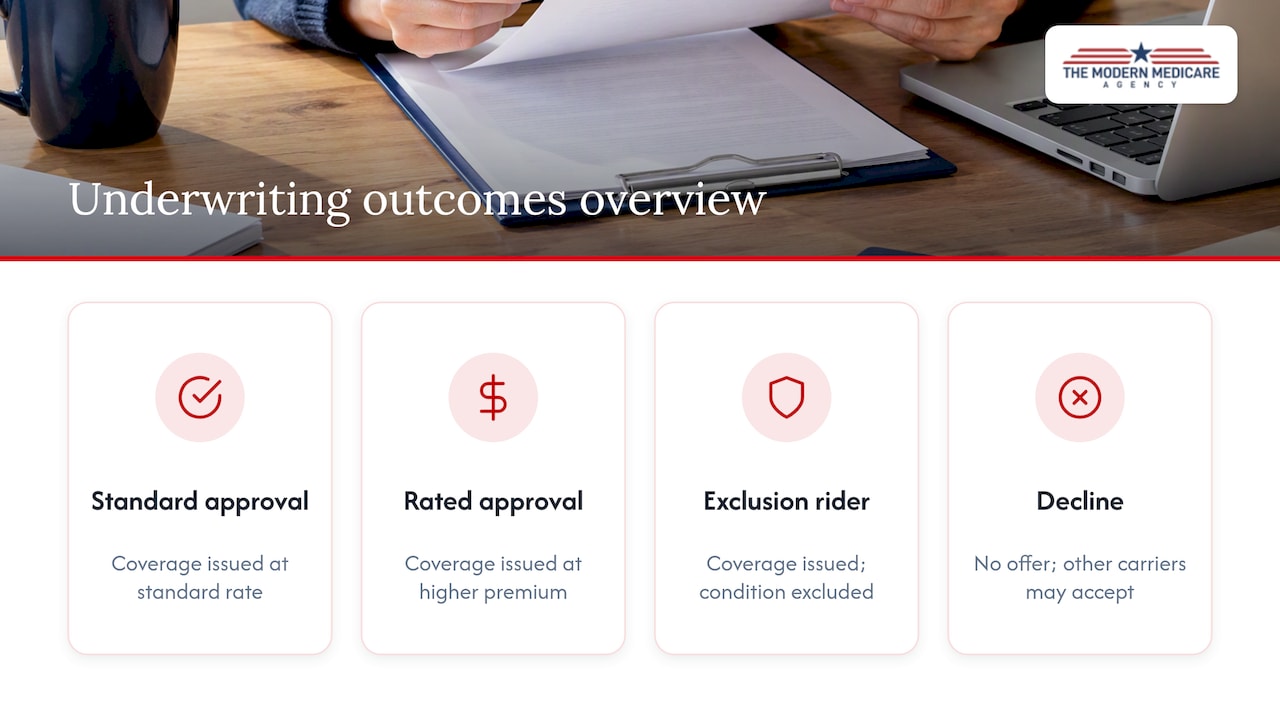
Outcomes generally fall into four categories. Approved at standard rates means the applicant’s health profile matched the carrier’s expectations with no adjustments. A rated approval means coverage is issued but at a higher premium for the same benefits, reflecting elevated but still acceptable risk. An approval with an exclusion rider means coverage is issued but a specific condition is carved out from benefit eligibility. A decline means the carrier will not offer coverage at any price, though another carrier with different underwriting guidelines may still accept the same applicant.
Policy types and underwriting differences
Not all long term care products underwrite the same way, and the differences can matter as much as the applicant’s health history.
- Traditional standalone LTCI applies the strictest underwriting of the three, since the carrier is taking on open-ended risk with no offsetting cash value or death benefit.
- Hybrid or linked-benefit policies, which combine long term care benefits with life insurance or an annuity, sometimes apply different underwriting thresholds and occasionally accept applicants that traditional carriers decline, though usually at a higher upfront cost. Read more in our comparison of traditional and hybrid long term care policies.
- Group, simplified-issue, and guaranteed-issue options appear most often through employer plans or during open enrollment windows, trading fewer health questions for narrower coverage or higher pricing.
The Congressional Research Service notes that linked-benefit products have grown partly because they remove some of the premium-increase risk tied to stand-alone policies, often through a single premium or fixed payment structure. For applicants who are borderline on health but want certainty, a hybrid product can be worth the added cost precisely because it may bypass some of the underwriting hurdles a traditional policy applies.
How pricing and risk classes are set
Premiums for long term care insurance depend on a combination of personal factors and the underwriting class an applicant lands in.
- Age at application is one of the largest drivers, since younger applicants lock in lower lifetime premiums and face less restrictive underwriting.
- Daily or monthly benefit amount, benefit period, and elimination period (the waiting period before benefits start) all scale the premium up or down.
- Inflation protection riders increase premiums substantially but help the benefit keep pace with rising care costs over a decade or more.
- Underwriting class, typically labeled preferred, standard, or substandard, reflects the carrier’s assessment of health risk and can swing the same applicant’s premium by a meaningful margin depending on which carrier reviews the file.
Carriers vary in how many underwriting classes they offer and how strictly they define each one, which is part of why getting quotes from multiple carriers matters. Market history also shapes today’s pricing: many stand-alone policies sold before the mid-2000s experienced steep premium increases after insurers underestimated claims costs and overestimated investment returns. That history pushed several carriers out of the stand-alone market entirely and explains why current pricing tends to build in larger margins than policies issued two decades ago.
How to improve approval odds: a pre-application checklist
Preparation before submitting an application often has more influence on the outcome than anything that happens during underwriting itself.
- Gather your medication list and recent lab results before applying, since gaps between what you report and what records show slow down or jeopardize approval.
- Request a brief summary letter from your physician for any condition that is stable or resolved, specifying dates and current status.
- Avoid major medication changes in the months before applying, since a recent prescription change can prompt additional underwriting scrutiny even when the change is routine.
- Ask directly how each carrier defines its underwriting classes, since the same health profile can land in different classes at different companies.
- Compare elimination periods and inflation riders across carriers, not just the headline premium, since these features affect both cost and claim experience later.
Applicants documenting a pre-existing condition should also avoid common application mistakes such as inconsistent dates or incomplete physician summaries, which can slow underwriting regardless of the actual severity of the condition.
Pro Tip: If your health history includes anything borderline, ask an independent agent to run informal pre-screens with two or three carriers before submitting a formal application. A soft inquiry can reveal which carrier’s underwriting guidelines fit your profile best, without triggering a formal decline on your record.
A hybrid product or a multi-carrier quote comparison makes the most sense when an applicant’s health history includes one or two flagged items but no outright disqualifiers, since underwriting thresholds vary enough between carriers that shopping around frequently changes the outcome. For cost ranges and timing guidance, see our breakdown of long term care insurance costs and when to buy.
Practical notes from an agent’s perspective
Paul Barrett has worked with Medicare and long term care insurance consumers since 2007, and one pattern shows up consistently in underwriting outcomes: applicants who prepare their documentation in advance get faster, more favorable decisions than those who let the carrier’s record request process run cold.
An independent agent’s main value during underwriting is less about selling a policy and more about case management: organizing medical records before submission, identifying which carrier’s underwriting guidelines best fit a specific health profile, and flagging state partnership policy considerations for applicants interested in Medicaid asset protection. Because underwriting standards differ meaningfully across carriers, working with an agent who can compare multiple companies at once often changes whether an application is approved, rated, or declined.
The role of financial underwriting in long term care eligibility
Medical underwriting gets most of the attention, but financial underwriting plays a real role too. Carriers generally want assurance that an applicant can sustain premium payments over the long term without financial strain, since a lapsed policy after years of premiums paid benefits no one.
This usually means a review of income, assets, and sometimes existing insurance coverage relative to the proposed premium. Consumer guidance from AARP and the NAIC suggests premiums should not consume an outsized share of income, and some carriers build informal affordability checks into their application process for this reason. Applicants with limited retirement income may be steered toward a lower daily benefit or longer elimination period rather than declined outright, since financial underwriting typically shapes policy design more than it blocks approval entirely.
Financial underwriting also factors into decisions about inflation protection and benefit period length. A carrier may flag an application for a maximum benefit period paired with full inflation protection if the premium looks disproportionate to the applicant’s stated income, prompting a conversation about adjusting the benefit structure rather than a denial.
How age and gender affect underwriting outcomes
Age at application is one of the clearest levers in long term care underwriting. Applying in your early 50s typically means fewer accumulated health conditions, which translates into a higher likelihood of standard approval and a lower lifetime premium. Waiting until the mid-60s or later increases both the premium and the chance of a rated or declined outcome, since health conditions tend to accumulate with time.
Gender also factors into pricing, since women statistically file long term care claims more often and for longer durations than men, leading most carriers to charge women higher premiums for identical coverage. Some carriers have introduced unisex pricing for specific product lines, but gender-distinct pricing remains common across the traditional LTCI market. This is a pricing and risk-classification difference rather than an underwriting pass or fail criterion. It will not disqualify an applicant, but it does shape the quote they receive once approved, and it is one more reason comparing quotes across carriers is worth the time.
How prior long term care claims or benefits affect new applications
Applicants who have previously filed a long term care claim, even a resolved one, face a different underwriting conversation than first-time applicants. A past claim signals to underwriters that a care need already existed at some point, which raises questions about recurrence risk even if the applicant has since recovered functional independence.
In practice, this usually surfaces for people seeking a second policy after a previous one lapsed, or for those applying for supplemental coverage alongside an existing policy. Carriers will typically request full claims history and the resolution outcome, and a documented full recovery with no ongoing care needs improves the odds of approval. A claim tied to a condition likely to recur, such as a progressive neurological disease, is far more likely to result in a decline for new coverage, regardless of current functional status.
This is also why maintaining continuous coverage matters more than many applicants realize. Letting an existing policy lapse and then trying to re-enter the market later means starting the underwriting process over, often with a less favorable health profile than the one the applicant had originally.
Post-approval reviews and policy adjustments
Underwriting does not entirely end once a policy is issued. Most tax-qualified long term care policies are guaranteed renewable, meaning the carrier cannot cancel coverage or deny renewal based on health changes after issue, as long as premiums are paid on time. That protection is one of the strongest arguments for buying earlier rather than later.
What can change after approval is premium pricing at a class level, not an individual level. Carriers occasionally file for rate increases across an entire block of policies, typically tied to claims experience running higher than originally priced, a pattern that contributed to the premium increases seen industry-wide over the past two decades. Individual policyholders are not re-underwritten or singled out for a rate hike based on their personal health changes.
When benefits are eventually claimed, a separate process applies: a licensed practitioner must certify that the policyholder is chronically ill, generally meaning they need substantial help with at least two activities of daily living or require supervision due to severe cognitive impairment, before benefits begin paying out. That certification process is distinct from underwriting but draws on some of the same functional assessment tools used earlier in the application.
How functional and cognitive assessments shape decisions
Functional and cognitive assessments are where underwriting becomes less about paperwork and more about direct observation. During the phone interview or an in-home paramedical exam, assessors often run brief cognitive screening tools designed to catch early signs of memory or processing issues that a self-reported health history would miss entirely.
Functional assessments focus on activities of daily living: bathing, dressing, toileting, transferring, continence, and eating. An applicant who needs help with even one of these tasks faces a much closer look, since needing help with two or more typically disqualifies an applicant outright under most carriers’ guidelines, mirroring the benefit trigger used later to pay claims.
Mobility and balance also get evaluated, often informally during a home visit, since fall history correlates strongly with near-term care needs. An applicant who walks unassisted, manages medications independently, and scores normally on a brief cognitive screen is generally viewed favorably, even if they carry one or two chronic diagnoses elsewhere in their file. The assessment is less about the diagnosis list and more about how well the applicant currently functions day to day.
When buying long term care coverage still makes sense
Underwriting limits are real, but they do not erase the case for coverage. Buying in your early to mid-50s, while health profiles are typically cleanest, is the single biggest lever applicants control. For those focused on protecting retirement assets or planning around a family history of chronic illness, applying earlier and considering a hybrid or group option when health is borderline both meaningfully improve the odds of a workable outcome. Working with an agent who can compare carriers adds another layer of protection against an avoidable decline.
— Paul
How PaulB Insurance can help with your long term care application
We have experience guiding consumers through the long term care insurance underwriting process and understand how different carriers apply underwriting guidelines to various health profiles. We provide consultations, quote comparisons from multiple carriers, and assistance with preparing documentation to support the underwriting process.

- Start with our Medicare Supplement and long term care insurance page to explore quote comparisons and discuss your options with an independent agent.
This article is general information, not a substitute for advice from a qualified financial advisor. Consult a qualified financial professional about your own circumstances before acting on anything here.
FAQ
What does Dave Ramsey say about LTC insurance?
Financial commentators generally recommend considering long term care coverage in your 60s, before health issues complicate underwriting, while weighing the premium cost against other retirement savings priorities. Specific guidance varies by source, so it is worth reviewing the reasoning behind any recommendation rather than following it blindly.
What is the biggest drawback of long term care insurance?
The most commonly cited drawback is the risk of future premium increases on policies already in force, a pattern that affected many stand-alone policies sold before the mid-2000s. Hybrid products reduce this risk through fixed or single premium structures, though they typically cost more upfront.
What are common complaints about long term care insurance companies?
Consumer concerns most often center on premium increases over time and the complexity of comparing benefit structures across carriers. Consumer guidance from AARP and the NAIC recommends comparing elimination periods, benefit caps, and premium stability history before choosing a policy, rather than focusing on price alone.
How strict is long term care insurance underwriting really?
Underwriting is meaningfully strict: simulations estimate that about 30% of wealth-qualified applicants aged 50 to 71 would be rejected, with rejection rates near 40% across the general population. Healthy applicants without major chronic conditions or functional limitations are still likely to qualify, especially if they apply earlier rather than later.
Sources
- Medical Underwriting In Long-Term Care Insurance: Market Conditions Limit Options For Higher-risk Consumers
- Long Term Care Insurance | FLTCIP
- Congress
- Making sense of your long-term care insurance options — AARP