
Qualified long-term care insurance premiums and unreimbursed qualified long-term-care services can be deducted on a federal tax return, through one of two routes: as an itemized medical expense on Schedule A above the 7.5% of adjusted gross income floor, or as part of the self-employed health-insurance deduction on Form 7206 and Schedule 1. Premiums are capped by age, and insurance payouts above a daily threshold can become taxable income.
TL;DR:
- Eligibility requires practitioner certification within 12 months of either two impaired daily living activities lasting 90 days or severe cognitive impairment, plus a written care plan.
- Itemizers report qualifying expenses on Schedule A, while eligible self employed taxpayers may deduct capped premiums through Form 7206; the same premium cannot be claimed twice.
- The 2025 premium cap reaches $6,020 per covered person age 71 or older, and spouses with qualifying policies may combine their separate limits.
- Unreimbursed qualified care services have no separate dollar cap, but they count with other medical expenses only to the extent they exceed 7.5% of AGI.
- For 2025, fixed daily benefits may become taxable above $420 or actual qualified expenses, whichever is greater; insurance reimbursements also reduce deductible costs.
Table of Contents
- Who qualifies: chronically ill triggers and whose expenses you may include
- What counts as deductible: premiums versus care services
- IRS numeric rules and limits: how the caps and floor work together
- How to claim it: the right forms and filing steps
- Nursing home and facility costs: when meals and lodging count
- Documentation checklist: records that survive an IRS review
- Taxability of benefits: how payouts affect what you can deduct
- Common mistakes and planning tips worth knowing
- Reviewing your long-term care policy with an independent Medicare insurance agency
- FAQ
- Sources
Who qualifies: chronically ill triggers and whose expenses you may include
The IRS does not let every home-care bill or assisted-living invoice count as a medical expense. To claim long-term care costs, the person receiving care generally has to meet the legal definition of “chronically ill.” That means a licensed health care practitioner has certified, within the prior 12 months, that the individual either cannot perform at least two activities of daily living without substantial help for at least 90 days, or needs substantial supervision because of severe cognitive impairment, according to guidance tied to Form 1099-LTC. Activities of daily living typically include bathing, dressing, eating, toileting, transferring, and continence.
On top of that certification, the care has to be provided under a written plan of care prescribed by a licensed health care practitioner. This paperwork is not optional. Insurers and the IRS both rely on it to distinguish deductible medical care from ordinary personal assistance.
You are not limited to your own expenses. The deduction can cover costs for:
- Yourself, as the taxpayer filing the return.
- Your spouse, if you file jointly or otherwise support that spouse’s care.
- A dependent you claim, including a parent who meets the support test even if they do not live with you.
Reimbursements from insurance, Medicaid, or any other source reduce the deductible amount dollar for dollar. Only the unreimbursed portion of qualified expenses ever reaches your tax return.
What counts as deductible: premiums versus care services
Long-term care tax treatment splits into two distinct buckets, and mixing them up is one of the most common filing errors.
Premiums you pay for a qualified long-term care insurance contract are treated as a medical expense, but only up to an age-based dollar limit set each year by the IRS. Pay more than the cap and the excess simply does not count as a medical expense for tax purposes.
Unreimbursed qualified long-term-care services, by contrast, are not capped by a flat dollar figure. They are added in full to your other medical expenses and measured against the 7.5% of AGI floor on Schedule A.
Examples that typically qualify:
- A home health aide helping a chronically ill parent with bathing, dressing, or mobility.
- Skilled nursing care provided for a diagnosed medical condition rather than convenience.
- Case-management services coordinated under a prescribed plan of care.
Examples that typically do not qualify:
- Housekeeping or meal delivery with no connection to a medical condition.
- Companionship or transportation services that are purely for convenience, not required by a plan of care.
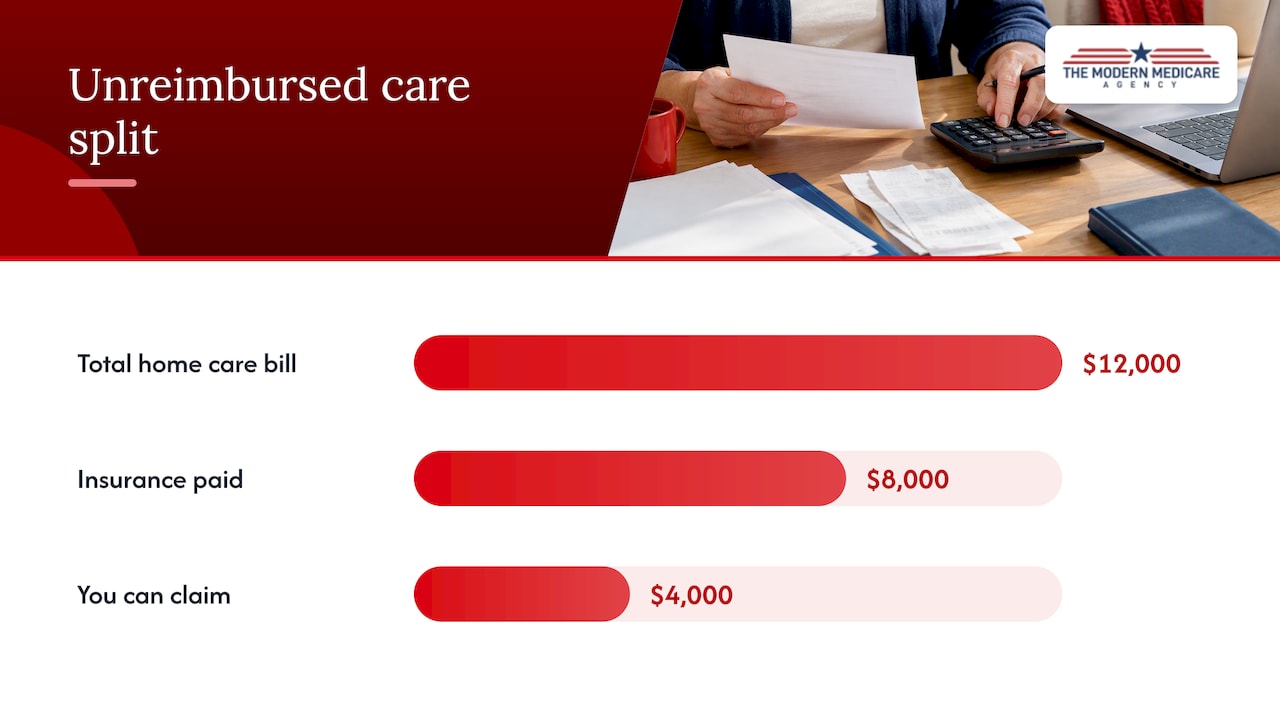
Employer-provided long-term care benefits and any insurance reimbursement reduce the unreimbursed total you can claim. If your policy paid $8,000 toward a $12,000 home care bill, only the remaining $4,000 enters the medical expense calculation.
Pro Tip: Ask your insurer in writing whether your policy meets the federal definition of a “qualified long-term care insurance contract” under section 7702B. Hybrid or cash-value policies sometimes do not, which changes how premiums and benefits are taxed.
IRS numeric rules and limits: how the caps and floor work together
Two separate limits govern long-term care deductions, and confusing them leads to overstated or understated claims.
The first is the age-based premium cap. The IRS sets a maximum dollar amount of long-term care insurance premium that counts as a medical expense, based on the covered person’s age at the end of the tax year. For premiums paid in 2025, the per-age limits are:
The limit applies separately to each covered person, so a married couple filing jointly can combine two caps if both spouses hold qualifying policies, according to Form 7206 instructions.
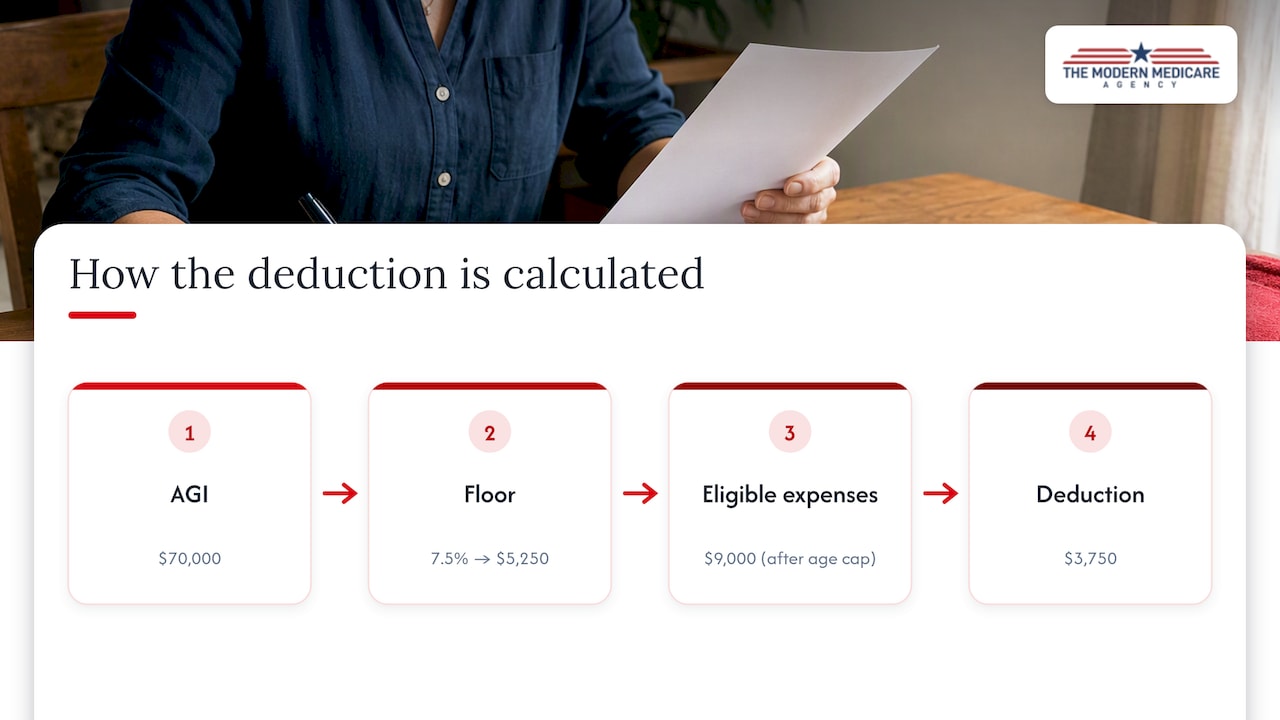
The second limit is the 7.5% of AGI floor that applies to all itemized medical expenses, long-term care included, under Publication 502. Say your AGI is $70,000. The floor is $5,250. If your eligible premiums (after applying the age cap) plus unreimbursed care services total $9,000 for the year, you can deduct $3,750 on Schedule A, assuming you itemize rather than take the standard deduction.
A third figure matters for people receiving benefits rather than paying them: the per-diem threshold. For 2025, long-term care insurance payouts structured as a fixed daily (per-diem) benefit are generally tax-free up to $420 per day; amounts paid above that daily figure, or above actual qualified expenses if higher, can be included in taxable income.
How to claim it: the right forms and filing steps
Where you report long-term care costs depends on your employment status and how you pay for insurance.
- Determine whether to itemize. Add your eligible long-term care premiums (capped by age) to other unreimbursed medical expenses, then subtract 7.5% of your AGI. If the result is positive and exceeds your standard deduction, itemizing on Schedule A is worthwhile.
- Check self-employment status. If you are self-employed and otherwise eligible for the self-employed health insurance deduction, you can include qualifying long-term care premiums on Form 7206, carrying the result to Schedule 1 as an above-the-line deduction. The same age-based caps still apply; self-employment does not remove the limit.
- Reconcile any Form 1099-LTC. If you or a family member received long-term care insurance benefits, the insurer reports them on Form 1099-LTC. Per-diem payments above the daily threshold may need to be reported as income, while reimbursements for actual qualified expenses generally do not.
- Avoid double counting. Premiums you deduct through Form 7206 cannot also be claimed on Schedule A, and any benefit payments that reimbursed you for care reduce the unreimbursed expense total you report.
Nursing home and facility costs: when meals and lodging count
Whether an entire nursing home bill qualifies as a medical expense comes down to one question: is the person there primarily for medical care, or primarily for personal and custodial reasons? The IRS test looks at the facts of the stay, not the name on the building.
- If the primary reason for being in the facility is medical care, the full cost, including meals and lodging, can be included as a medical expense.
- If the stay is primarily personal, such as an assisted-living arrangement for convenience rather than treatment, only the specific medical-care portion of the bill counts.
- A resident requiring constant skilled nursing for a diagnosed condition looks very different, for tax purposes, from someone who simply prefers not to live alone.
Keep documentation connecting the facility stay to a diagnosed medical need, including the plan of care and any physician notes, since this distinction is one the IRS scrutinizes closely.
Documentation checklist: records that survive an IRS review
Long-term care deductions draw attention because they are easy to overstate. Keep a clear paper trail before you file.
- A licensed practitioner’s certification and the written plan of care describing the chronic illness and the services it prescribes.
- Dated invoices and receipts for every care service claimed, itemized by provider and date.
- Annual premium statements from your long-term care insurer.
- A written confirmation from the insurer that the policy is a qualified long-term care insurance contract under section 7702B.
- Form 1099-LTC, if you or a dependent received benefit payments during the year.
Track every reimbursement against the expense it covered. A simple spreadsheet matching invoices to insurance payments makes it far easier to calculate the unreimbursed total and defend it later.
Pro Tip: Keep a short contemporaneous log noting who provided each care service and why, even a one-line note per visit. It takes minutes and can resolve a records request years later.
Taxability of benefits: how payouts affect what you can deduct
Most long-term care insurance benefits are not taxable income, but the structure of the payout matters.
- Reimbursement-style benefits, which pay back actual qualified expenses under a qualified contract, are generally excluded from income.
- Per-diem or indemnity benefits, paid as a fixed daily amount regardless of actual costs, can become partially taxable once they exceed the $420 daily threshold for 2025 or your actual qualified expenses, whichever is greater.
- Accelerated death benefits paid under a life insurance policy because the insured is chronically ill follow similar rules, but nonqualified contracts can be treated differently, so the contract type matters.
Whatever benefit you receive reduces the unreimbursed expense total you are allowed to deduct, so premiums paid and benefits received always need to be reconciled together rather than claimed separately.
Common mistakes and planning tips worth knowing
The mistake we see most often is treating custodial or convenience care as deductible without a plan of care behind it, and forgetting that reimbursements reduce the claim. Document early, reconcile benefits against expenses before filing, and bring borderline cases to a tax professional rather than guessing.
— Paul
Reviewing your long-term care policy with an independent Medicare insurance agency
A long-term care insurance contract only delivers the tax treatment described above if it qualifies under federal rules, and not every policy on the market does. We review long-term care contracts for qualified-contract features and help you weigh a purchase against your broader Medicare and retirement coverage.

| What we help with | Why it matters |
|---|---|
| Confirming qualified-contract status | Determines whether premiums and benefits get favorable tax treatment |
| Coordinating with Medicare planning | Avoids gaps and overlapping coverage decisions |
| Year-round policy checkups | Catches changes in carrier terms or your eligibility |
If you are weighing a new long-term care policy or want a second opinion on an existing one, start with our long-term care insurance page for a free, no-pressure review.
This article is general information, not a substitute for advice from a qualified financial advisor. Consult a qualified financial professional about your own circumstances before acting on anything here.
FAQ
Who is eligible for the new $6,000 tax deduction for seniors?
This figure does not refer to long-term care insurance. It is a separate, broader senior tax provision unrelated to the age-based long-term care premium caps described above, which top out at $6,020 for those 71 and older under current IRS rules.IRS limits](https://apps.irs.gov/app/vita/content/00/00_25_005.jsp). Check current IRS guidance for the specific eligibility rules of any general senior deduction before assuming it applies to care costs.
What is the most overlooked tax deduction?
Among long-term care related costs, unreimbursed qualified services, such as a home health aide helping with daily living activities, are frequently missed because people assume only insurance premiums count. These services are added to your other medical expenses and deducted above the 7.5% of AGI floor on Schedule A, with no separate dollar cap.
Are long-term care benefits taxed by the IRS?
Reimbursement-style benefits that repay actual qualified expenses under a qualified contract are generally not taxable. Per-diem or indemnity benefits can become partly taxable once they exceed $420 per day for 2025 or your actual qualified expenses, whichever amount is greater.
What expenses are 100% tax deductible?
No medical expense, long-term care included, is fully deductible on its own; it is added to your total medical expenses and only the amount above 7.5% of your adjusted gross income is deductible on Schedule A. Self-employed taxpayers can instead deduct qualifying long-term care premiums above the line through Form 7206, subject to the same age-based caps.
Sources
Three federal references anchor everything above: Publication 502 governs the 7.5% AGI floor and what counts as a medical expense, Form 7206 instructions govern the self-employed premium deduction and age caps, and Form 1099-LTC guidance governs how insurance payouts get reported.
Before claiming anything, confirm four things: that your policy is a qualified long-term care insurance contract, that a licensed practitioner has certified the chronic illness and plan of care, that you have preserved invoices and insurer statements showing reimbursements, and whether itemizing or the self-employed deduction route produces the better result for your situation.