
A Medicare recommendation is useful only when it fits your doctors, prescriptions, budget, and preferences. Medicare choices can feel hard to compare, especially if you’re unsure whether an adviser represents one insurer or can show you options from several. Getting unbiased help with Medicare choices in 2026 starts with understanding who’s providing the guidance and how they reach a recommendation.
You’re right to want more than a sales pitch. Useful guidance should make trade-offs clear, consider the care and medicines you rely on, and explain which options are being compared. An independent broker can compare plans from multiple carriers. State Health Insurance Assistance Program (SHIP) counselors offer free, objective Medicare counseling and aren’t affiliated with insurance companies.
This guide will help you recognize impartial support, compare the kinds of help available, and prepare questions for a conversation. You’ll also learn what to gather about your doctors, prescriptions, and spending priorities before reviewing Medicare Advantage, Medicare Supplement, or Part D coverage. A clear process can help you take your next step with confidence.
Key Takeaways
- Getting unbiased help with medicare choices means looking for a clear process: your needs come first, options are explained, and you have room to decide.
- Use official Medicare information to understand coverage pathways, then seek personalized guidance to see how choices relate to your situation.
- Prepare for a conversation by listing your doctors, medications, budget, current coverage, and preferences.
- Compare options step by step, review the trade-offs, and verify applicable 2026 enrollment dates through current official information.
- The Modern Medicare Agency helps eligible people compare Medicare Advantage, Medigap, and Part D plans from over 40 carriers.
Why getting unbiased help with Medicare choices matters in 2026
Medicare decisions can feel stressful because several questions come up at once: Which doctors can you see? Are your prescriptions covered? What costs could you face when you use care? Unfamiliar terms and different trade-offs can make it hard to know where to begin. Getting unbiased help with Medicare choices can bring structure to the process, but no one should promise a perfect plan.
Unbiased Medicare help means seeing relevant options, understanding their trade-offs, and receiving a recommendation shaped by your needs rather than pressure to enroll. No single plan or source of guidance is right for everyone. A useful conversation gives you room to ask questions, weigh what matters, and make your own decision.
What does unbiased Medicare guidance actually mean?
Judge impartiality by the process, not by a claim that someone has found the one “best” plan. A helpful discussion considers your doctors, prescriptions, budget, travel habits, and preferences. For example, a plan’s costs may look appealing, but that matters only if its provider network and prescription coverage work for you.
Good guidance also separates education from enrollment pressure. You should understand why options are being considered and what trade-offs they involve. A recommendation should be explained in plain language, not presented as a decision you need to make immediately.
Why can choosing Medicare coverage feel so difficult?
Medicare has several parts and coverage paths. Original Medicare includes Part A and Part B. Medicare Advantage, also called Part C, is another way to receive Medicare coverage. Medigap, or Medicare Supplement insurance, can work alongside Original Medicare, while Part D relates to prescription drug coverage. These names are only a starting point. The practical differences can affect access to doctors, prescription coverage, and what you pay when you receive care.
Comparing coverage involves more than choosing an option with a familiar name or an appealing feature. If you want to keep particular doctors, provider access may be a priority. If you take several prescriptions, pay close attention to how drug coverage applies to them. Your budget and preferences matter, too. The Medicare Advantage guide offers a deeper overview of that coverage path.
For a broad introduction to the program and its parts, you can also consult the Medicare (United States) Wikipedia page. Use general information as a foundation, then consider how plan details relate to your needs in 2026. The right guidance can make those details easier to compare without deciding for you.
Who can help with Medicare choices, and what each source can do
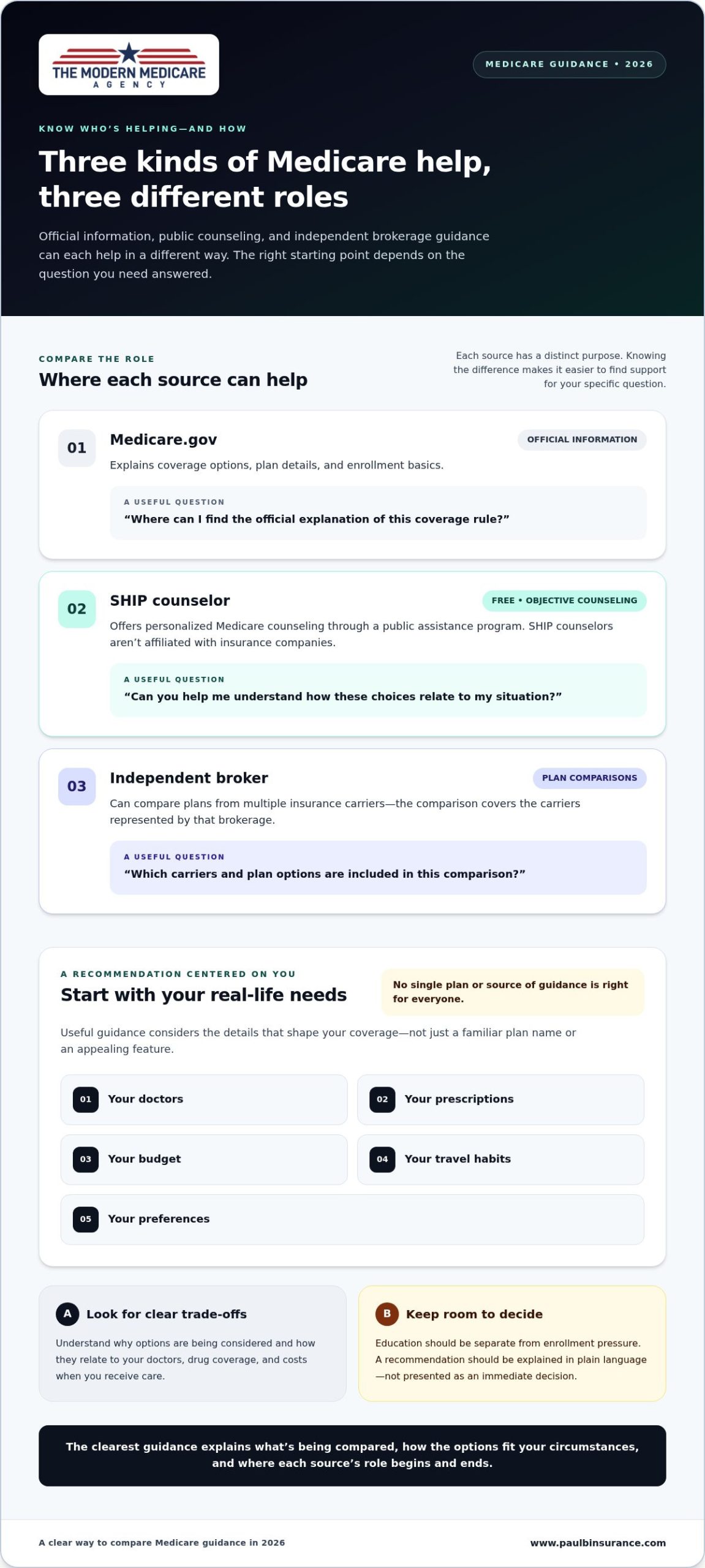
In 2026, you can turn to official information, public counseling, or an independent insurance brokerage. Each serves a different purpose. Official resources explain the program and its coverage paths. Public counselors can offer objective help understanding choices. A broker can compare insurance plans from the carriers they represent. Knowing the difference helps you choose support that matches the question you need answered.
| Source | Typical help | Useful question to ask |
|---|---|---|
| Medicare.gov | Official information about coverage options, plan details, and enrollment basics. | Where can I find the official explanation of this coverage rule? |
| SHIP counselor | Objective, personalized Medicare counseling through a public assistance program. | Can you help me understand how these choices relate to my situation? |
| Independent broker | Plan comparisons across the insurance carriers the brokerage represents. | Which carriers and plan options are included in this comparison? |
When official Medicare information may be enough
For a clear explanation of Medicare’s coverage structure or enrollment basics, start with the official Medicare website. It’s a useful source for program information and plan details. General rules won’t tell you automatically which option fits your doctors, prescriptions, budget, or preferences. Applying the information to your circumstances may call for a personalized conversation.
How independent Medicare brokerage guidance can help
An independent brokerage can compare plans from multiple insurance carriers, giving you a wider view than a representative limited to one carrier’s offerings. The Modern Medicare Agency helps eligible people compare Medicare Advantage, Medigap, and Part D options from over 40 carriers, with recommendations shaped around individual needs.
Public counseling and brokerage guidance serve different purposes. SHIP counselors provide free, objective Medicare counseling and aren’t affiliated with insurance companies. A broker can help compare plans from the carriers represented by the brokerage. In either conversation, ask what’s included in the comparison and how the options relate to your situation. Getting unbiased help with medicare choices means finding the right kind of support for your question, not assuming one source can do everything.
For personalized guidance on plan options and your needs, explore Medicare guidance from The Modern Medicare Agency.
How to tell whether Medicare advice is truly centered on you
In 2026, a helpful Medicare conversation should begin with your circumstances, not a ready-made recommendation. You don’t need to know every plan detail before asking for guidance. You do deserve clear answers, relevant questions, and enough time to consider what you hear.
Trustworthy Medicare guidance explains both why a recommendation may fit and the meaningful trade-offs that come with it. That gives you a practical standard: assess whether the advice is transparent and tied to your priorities, not whether someone promises a perfect result.
Signs that guidance is tailored to your situation
A conversation should make space for your current doctors, prescriptions, expected care, location, budget, and preferences. Your adviser should explain how those details affect the comparison. If keeping a particular doctor is important, ask how that priority is being considered rather than assuming every option handles provider access the same way.
Look for explanations, not just conclusions. An adviser should be able to describe why an option may suit your stated needs, where it may involve a compromise, and what information you may want to review. You should feel comfortable asking follow-up questions or taking time to consider your choices.
Questions that make the advice process more transparent
Direct questions can clarify how a comparison is put together. Compensation and carrier relationships are reasonable topics to discuss. Understanding them helps you see the context of a recommendation.
- Which insurance carriers and plan types are included in this comparison?
- How did you match these options to my doctors, prescriptions, budget, and preferences?
- What trade-offs should I consider, including any limits in the comparison?
- How are you compensated, and does that affect which plans you can show me?
- Can I take time to review the options before deciding?
Listen for specific, understandable answers. If your priorities affect the recommendation, the adviser should explain how. The Modern Medicare Agency compares plans from over 40 carriers, and you can ask which carriers and plan options are included in your discussion. Independent support can broaden the options considered, while a clear explanation helps you understand the scope of the comparison.
If you’d like objective counseling as you review your questions, the State Health Insurance Assistance Programs (SHIP) provide Medicare counseling independent of insurance companies. This can offer perspective alongside a clear explanation of plan options. Getting unbiased help with medicare choices means having enough information to understand the recommendation and make your decision without pressure.
A step-by-step way to get unbiased help with Medicare choices
A little preparation can make Medicare discussions easier to follow. In 2026, use this five-step process to move from gathering information to making a decision you understand. Keep notes on paper or in a document so you can track what was compared and what you still need to clarify.
Prepare for a Medicare guidance conversation
Before you speak with someone, collect details that will make the discussion relevant. Share only what’s needed, and avoid sending sensitive personal information through informal or unsecured channels.
- List your preferred doctors and facilities, and note any care needs you expect.
- Write down your prescriptions, including their names and dosages, so coverage can be reviewed accurately.
- Gather information about your current coverage and any plan documents you already have.
- Record your budget priorities, travel habits, and preferences, such as keeping certain providers or having more flexibility in where you receive care.
- Choose your main questions in advance, including questions about access, costs, and differences between plan types.
Compare options, then review the trade-offs
As you discuss choices, ask why each option is being considered and how it relates to the priorities you shared. Keep track of the options discussed, their meaningful differences, unanswered questions, and the reasons you may favor one path. For practical comparisons, ask how provider access and prescription coverage were assessed, and review plan information for the options being considered.
If you’re weighing Medicare Supplement coverage, the Medigap coverage guide can help you understand that option. For prescription coverage, review the relevant Part D details as part of your comparison, including how your medications are considered.
- List your needs. Note what matters most, such as keeping preferred doctors, covering prescriptions, managing costs, or having a particular kind of provider access.
- Gather current coverage details. Bring your existing plan information and the doctor and medication details needed to discuss how options may fit.
- Compare the options. Ask which plan types and carriers are included, and whether important providers and prescriptions have been considered.
- Review trade-offs. Make sure you understand why an option was raised, what it may offer, and where it may not match your priorities. Write down anything that’s still unclear.
- Decide without pressure. Take time to consider the comparison and ask follow-up questions before choosing. A decision should make sense to you, not just sound appealing in a conversation.
Keep timing separate from plan fit. Enrollment opportunities and deadlines depend on your circumstances and the coverage change you’re considering. Verify the applicable 2026 dates and rules using current official Medicare information before acting. Your notes can help you keep that timing question distinct from the comparison itself.
To discuss options with your needs in view, explore personalized Medicare guidance.
Getting personalized Medicare help from The Modern Medicare Agency
In 2026, useful Medicare guidance should help you understand how options relate to your situation. The Modern Medicare Agency is an independent insurance brokerage led by founder Paul Barrett. It helps eligible people compare Medicare Advantage, Medigap, and Part D plans from over 40 carriers, with personalized guidance and year-round support across more than 34 states.
Comparing plans from multiple carriers gives you a broader set of options to consider. The goal is to make relevant differences easier to understand so you can weigh them against the care, prescriptions, budget, and preferences that matter to you.
What to expect from a personalized plan discussion
A thoughtful conversation starts with you. Explain your current coverage, the doctors you prefer, the prescriptions you take, and the questions you want answered. The discussion can then focus on plan options and how their features relate to those priorities, rather than beginning with a one-size-fits-all recommendation.
As options are compared, ask what makes each one worth considering and what trade-offs to keep in mind. If keeping a particular doctor is a priority, make provider access part of the conversation. If prescription coverage is central, ask how your medications factor into the comparison. Clear explanations give you a stronger basis for deciding, but the final decision remains yours.
Take your next step with confidence
You don’t need every answer before starting a conversation. Bringing a few useful details can help keep it focused:
- Your current Medicare and insurance coverage information.
- The doctors, facilities, or pharmacies you prefer.
- A current list of prescriptions and any questions about coverage.
- Your budget priorities and preferences for accessing care.
- The questions you still have about plan differences or next steps.
Getting unbiased help with medicare choices means understanding your options, asking questions, and taking time to consider what fits your needs. Year-round support can also give you a point of contact for questions that come up after your initial discussion, providing continuity as you review your coverage.
You’re welcome to discuss your needs and understand the options before deciding whether to enroll. Take the time you need to feel comfortable with what you’ve learned. Start a conversation about Medicare options with The Modern Medicare Agency.
Make your next Medicare decision at your own pace
You don’t have to solve every Medicare question at once. Decide what would help you feel ready: a clearer explanation, answers about a particular coverage concern, or time to compare what you’ve learned. That gives the conversation a purpose and helps keep your priorities in view.
Getting unbiased help with medicare choices isn’t about handing someone else control. It’s about having space to understand your options, ask questions, and choose when you feel comfortable. In 2026, take the time you need to reach that point. A thoughtful discussion can help turn uncertainty into a decision you understand, even if the first step is simply talking things through.
Talk through your Medicare choices with a caring guide. You can begin with the questions on your mind and move forward one step at a time.
Frequently Asked Questions
Who can give unbiased help with Medicare choices?
Official Medicare information, public counseling, and independent brokers can all help, but they do different things. Official resources explain program rules and coverage paths. Public counselors can help you understand choices, while brokers compare plans from the carriers they represent. Don’t rely on a title alone to judge impartiality. Ask how the options were selected and whether the explanation addresses your situation, not just general plan features.
Is a Medicare broker unbiased if they earn commissions?
A broker’s commission is a fair question to ask, but it doesn’t by itself tell you whether the guidance suits your needs. Insurance carriers pay brokers commissions, and compensation arrangements can vary. Ask how the broker is paid, which carriers are included, and whether the comparison is limited to those carriers. Then consider whether the reasons for each recommendation are clear and connected to the priorities you shared.
Can I get help comparing Medicare plans without being pressured to enroll?
Yes. You can use a conversation to understand options and trade-offs before deciding whether to enroll. Ask for unfamiliar terms to be explained in plain language, and pause if you need time to review what you’ve heard. If a detail is unclear, request a specific answer or written information to consider. Enrollment should reflect your informed choice, not pressure or urgency from someone else.
How do I know whether Medicare advice considers my doctors and prescriptions?
Ask the adviser to show how your doctors and medications were considered in the options discussed. Name a specialist you rely on and ask how provider access is assessed, then ask how each prescription is reviewed. Networks and drug coverage can differ by plan, so use current 2026 plan information for the decision you’re making. If a detail hasn’t been reviewed, make it a follow-up question.
What should I bring when getting help with Medicare choices?
Bring your current coverage information, preferred providers, medication list, budget priorities, and a few questions you most want answered. A written list can help you track details and notice if an important concern hasn’t been addressed. Share only information needed for the discussion. If you’re unsure how personal details will be handled, ask before providing them, especially through email or an online form.
When should I review my Medicare plan choices again?
Review your coverage when your health needs, prescriptions, providers, or living situation change, and during enrollment opportunities that apply to you. For 2026, check current official Medicare guidance for the dates and rules relevant to your situation rather than relying on a general calendar reminder. You might set a reminder to review your coverage and note any changes, but don’t assume your current plan still fits automatically.
What is the difference between a Medicare broker and a Medicare agent?
The terms can be used differently, so the title alone may not tell you which plans someone can discuss. Ask what carriers and plan types they represent, and whether they can compare options across multiple carriers. Also ask how recommendations are made and what factors are considered. A clear answer will explain the scope of the comparison and how it relates to your priorities.

Article by
Paul Barrett
Paul Barrett, CMIP is the founder of The Modern Medicare Agency, an independent Medicare-only brokerage based in Melville, NY. With 18 years of Medicare-exclusive experience, a CMIP designation, and more than 5,000 clients served across 37 states, Paul is one of the most credentialed independent Medicare specialists on Long Island — and one of the most direct.
He represents 40+ carriers with no quotas and no allegiances, which means his recommendations are based entirely on what fits each client's specific situation. He is the author of Medicare Mastery Unlocked and host of the Wise Guys Retirement Talk podcast. His content is grounded in primary sources, real carrier intelligence, and 18 years of watching what happens when people get Medicare right — and when they don't.
📞 631-358-5793 | paulbinsurance.com