
What if voicing your frustration with your insurance company was actually the fastest way to improve your healthcare? We know how exhausting it feels to be treated like just another policy number. You might worry that speaking up will put your coverage at risk or lead to even more confusion. It’s common to feel ignored when a billing error occurs or when service isn’t what you expected, but you don’t have to stay silent.
You deserve to be heard. Learning how to file a complaint against a medicare plan is your right as one of the 44 million Americans currently enrolled in Medicare. We are here to protect your peace of mind and simplify this journey. In this 2026 guide, we will show you exactly how to resolve issues with your Medicare Advantage or Part D plan. We’ll explain the specific timelines for filing grievances, the difference between a grievance and an appeal, and how to document your case so you can get the quality care you were promised.
Key Takeaways
- Learn the difference between a grievance for poor service and an appeal for coverage denials so you can take the right path to a resolution.
- We’ll walk you through the simple steps for how to file a complaint against a medicare plan, whether you prefer to speak with someone on the phone or send a formal letter.
- Discover how to escalate your concerns to 1-800-MEDICARE or the Medicare Ombudsman if your plan doesn’t provide a fair response by 2026 standards.
- Find out why keeping a Medicare Log is your most powerful tool for protecting your rights and ensuring your records are accurate.
- See how an independent broker acts as your personal advocate all year long to help you interpret confusing insurance notices and resolve disputes.
Understanding Your Rights: Grievance vs. Appeal
Understanding the difference between a grievance and an appeal is the most important step when you’re trying to figure out how to file a complaint against a medicare plan. Many of our clients feel overwhelmed because these terms often sound like legal jargon; however, they simply represent two different paths to getting the help you need. If you choose the wrong path, your request might be delayed or even ignored by the insurance company. We want to make sure that doesn’t happen to you.
The Medicare program was designed with these protections in place to ensure you receive both quality care and fair treatment. Think of it this way: a grievance is about your experience, while an appeal is about your coverage and your wallet. We are committed to helping you identify which path fits your specific situation so you can move forward with confidence and peace of mind.
When to File a Grievance (The Service Path)
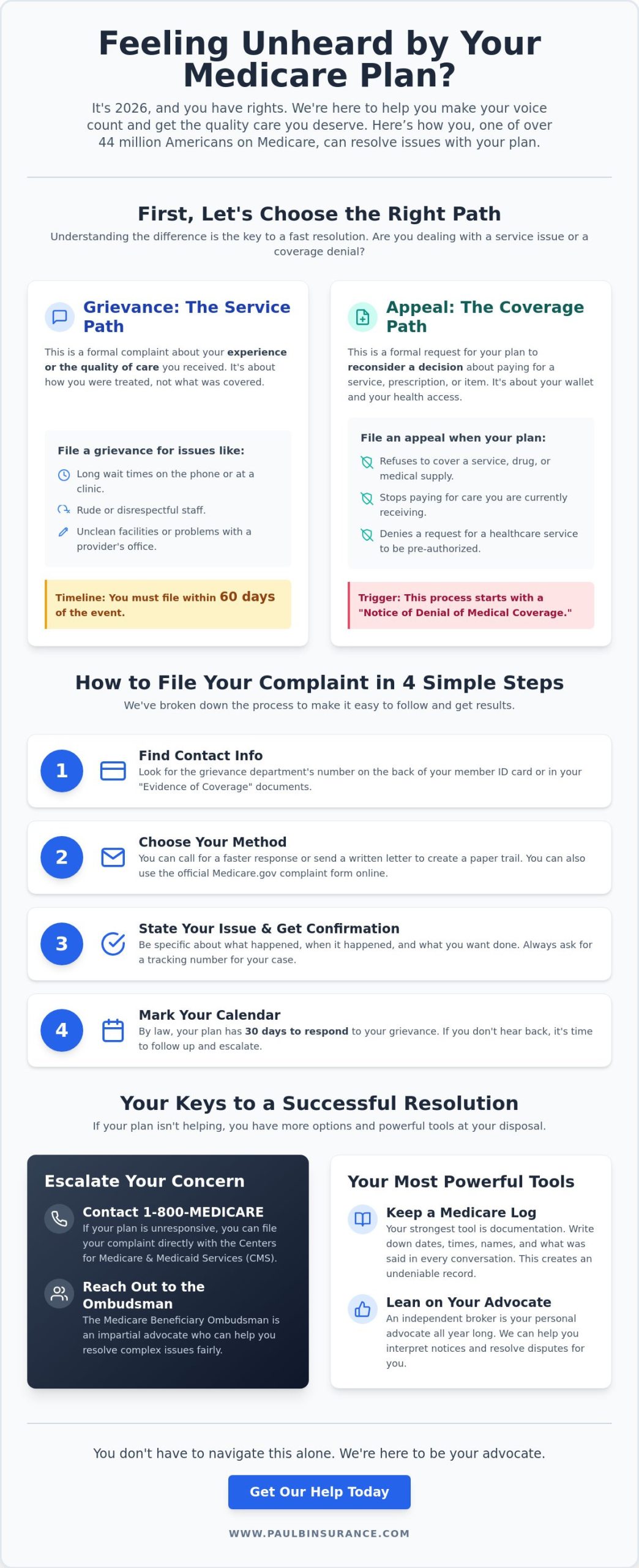
A grievance is essentially a formal complaint about the quality of care or the service you received. It doesn’t usually involve money or coverage decisions. Instead, it focuses on how you were treated by the plan or its providers. Filing a grievance tells the insurance company that their service didn’t meet the standards you deserve.
You should consider filing a grievance if you experience:
- Long wait times on the phone or in a provider’s waiting room.
- Rude or disrespectful behavior from customer service staff or medical professionals.
- Unclean or unsafe conditions at a doctor’s office or facility.
- Difficulty getting through to the plan’s representatives to ask a simple question.
In 2026, these complaints are vital because they help Medicare track how well plans are performing through Star Ratings. You must file your grievance within 60 days of the event that caused the problem. Acting quickly ensures your voice is heard while the details are still fresh in your mind.
When to File an Appeal (The Coverage Path)
An appeal is a much more specific request. You use this path when your plan makes a decision you disagree with regarding what they will pay for or which services they will allow. This is common when a prescription is denied at the pharmacy or a specialist visit isn’t authorized. Because these decisions affect your health and finances, the process is very structured.
This process is different because it follows a strict legal timeline for reconsideration. If you’ve received a “Notice of Denial of Medical Coverage,” you are looking at an appeal, not a grievance. For more help navigating these specific decisions, you can read our Understanding Medicare Advantage Guide. Knowing how to file a complaint against a medicare plan often starts with recognizing that a coverage denial is an invitation to advocate for your health needs through the appeal process.
How to File a Formal Complaint with Your Medicare Plan
We understand that the thought of calling a massive insurance company can be stressful. You might worry about being stuck on hold or getting lost in a maze of automated prompts. However, knowing how to file a complaint against a medicare plan is much easier when you have a clear map to follow. We’ve broken the process down into five simple steps to help you regain control and find a resolution.
The first step is to locate your plan’s specific grievance department. This information is usually found on the back of your member ID card or in the “Evidence of Coverage” document your plan sends each year. Once you have the contact details, you need to decide if you want to make a verbal complaint over the phone or submit a written one. While a phone call is faster, a letter provides a permanent record of your concerns. You can also use the official Medicare complaint form online if you prefer a digital option that goes directly to the Centers for Medicare & Medicaid Services (CMS).
When you state your issue, be as specific as possible. Describe what happened, when it happened, and exactly what you want the plan to do to fix it. Always request a tracking number or a written confirmation of receipt. This ensures your complaint doesn’t simply disappear into a computer system. Finally, mark your calendar. Your plan has 30 days to respond to a standard grievance. If you haven’t heard back by then, it’s time to follow up. If these steps still feel a bit daunting, we can help you navigate the process together.
Calling Your Plan: What to Say
When you call, you’ll likely face an automated system. Don’t let this discourage you. Press the numbers for “Member Services” or “Customer Service” to reach a representative. Once you have a real person on the line, use this specific phrase: “I would like to file a formal grievance.” This tells the representative that you aren’t just venting; you’re starting a formal process they are legally required to document. Keep a pen and paper handy to write down the date, the time of the call, and the name of the person you spoke with.
Writing a Complaint Letter
Writing a letter gives you the space to gather your thoughts without the pressure of a live conversation. You can find the mailing address for grievances on your member ID card or your plan’s website. If you’re dealing with a medication issue, our Medicare Part D Explained guide can help you understand your rights regarding drug coverage. In 2026, we still recommend sending these letters via certified mail. This gives you peace of mind because you’ll have a receipt proving the plan received your letter. Learning how to file a complaint against a medicare plan doesn’t have to be a lonely process, and having a paper trail is your best defense.
Escalating Your Complaint: When the Plan Doesn’t Help
If you’ve followed the initial steps for how to file a complaint against a medicare plan and still haven’t received a satisfying answer, don’t lose heart. It’s incredibly frustrating to feel like a large insurance company is simply waiting for you to give up. We are here to tell you that the process doesn’t end with the plan’s decision. There are powerful escalation tools available in 2026 that put the pressure back on the insurers. These resources are designed to move you from a state of distress toward the certainty that your rights are being protected.
Your first point of escalation should be 1-800-MEDICARE. This federal resource is available 24 hours a day, seven days a week, to help you navigate these roadblocks. When you file a complaint with Medicare, it creates a record that the federal government monitors. If the plan is consistently failing its members, Medicare can take action. You can also reach out to the Medicare Beneficiary Ombudsman. This office is dedicated to making sure your voice is heard and that your complaints are resolved fairly, serving as a vital bridge between you and the healthcare system.
For issues specifically related to the quality of your care, we recommend contacting a Beneficiary and Family Centered Care Quality Improvement Organization (BFCC-QIO). These organizations, such as Acentra or Commence, are staffed by medical experts who review complaints about treatments or hospital discharges. They provide an independent medical perspective that doesn’t rely on the insurance company’s internal rules. Having this expert review can give you immense peace of mind when you’re questioning the care you’ve received.
Contacting 1-800-MEDICARE Directly
While the phone line is always open, the online Medicare Complaint Form at Medicare.gov is a very effective tool. You’ll need your Medicare number and the specific details of your grievance. Once you submit it, the federal government keeps a close eye on the resolution. We’ve seen that plans often move much faster once they know a federal agency is watching the case. It’s a simple way to ensure your problem isn’t ignored.
Seeking Local Advocacy Support
Sometimes a local voice makes all the difference. The State Health Insurance Assistance Program (SHIP) provides free, one-on-one counseling in your community. These local advocates understand the specific challenges in your state and can help you organize your documentation. We believe in the power of local support, and we often work alongside these programs to ensure our clients never feel like they are fighting the system alone. You aren’t just another number; you have a team on your side.
Tips for a Successful Resolution: Documentation is Key
We’ve found that the biggest reason people give up on their complaints isn’t because they’re wrong. It’s because they feel lost in the paperwork. When you’re learning how to file a complaint against a medicare plan, your best defense is a clear record of the facts. Think of documentation as your shield. It protects you from being “misplaced” in an insurance company’s system. Organization equals power; when you have your facts in order, you move from a state of uncertainty to a position of strength.
We recommend starting a “Medicare Log” immediately. This is simply a dedicated notebook or digital folder where you track every single interaction. Don’t rely on memory alone when dealing with large corporations. When you speak to someone, ask for their name and their unique employee ID number. Write down the exact date and time the call started. If a representative tells you a specific service is covered or that a check is in the mail, record that promise word-for-word. Having these facts ready changes the dynamic of your complaint from an emotional plea to a professional demand for fairness. If you’re feeling overwhelmed by the paperwork, contact us for personalized support so we can help you stay organized.
The 2026 Documentation Checklist
To ensure your 2026 complaint is taken seriously, your log should include these specific details for every incident:
- The exact date and time of the incident or poor service.
- The names of any doctors, nurses, or office staff members involved.
- A brief summary of the conversation and any specific promises or claims made.
- Copies of all bills, notices, and medical records related to the issue.
- A record of any physical evidence, such as photos of unclean facilities or screenshots of long hold times.
Setting Realistic Expectations
Standard plans in 2026 generally have 30 days to notify you of their decision on a grievance. We know that waiting can be stressful, but following the established timeline is part of the process. However, some problems can’t wait a month. If you believe your health is in immediate danger because of a plan’s delay, you can request a “Fast Grievance.” In these urgent cases, the plan must respond within 24 hours. Patience is a tool, but persistence is what often leads to a resolved issue. Knowing how to file a complaint against a medicare plan means knowing when to wait and when to demand immediate action for your safety.
How an Independent Broker Supports You Beyond Enrollment
We believe that your relationship with your insurance shouldn’t end the moment you sign up. Many people only think of brokers during the busy enrollment season, but our true value often shows up when things go wrong. If you’re struggling with how to file a complaint against a medicare plan, you don’t have to face the carrier alone. We act as your dedicated advocate throughout the entire year, providing a buffer between you and the complex systems that can feel so cold and indifferent.
When a confusing letter or a denial notice arrives in your mailbox, it’s natural to feel a surge of anxiety. We are here to remove that stress. We help you interpret exactly what the plan is saying and determine if their decision is fair. Because we are independent, we aren’t restricted by a single company’s rules. We prioritize your needs over high-pressure tactics, facilitating communication with the carrier to ensure your voice is heard and respected. This impartial support is the key to your peace of mind, transforming a difficult process into a manageable one.
The Advantage of Personalized Support
We know your history and the specific details of your plan, which makes us a much faster resource than a generic national hotline. While the steps for how to file a complaint against a medicare plan involve specific forms and timelines, having a guide who already knows your situation saves you from repeating your story to five different people. If your current coverage consistently fails to meet the standards you deserve, we can help you explore other options during the next enrollment period, such as those detailed in our Medicare Advantage Guide. We are committed to making sure you’re never stuck in a plan that ignores your needs.
Your Next Steps to Certainty
As we move through 2026, take a moment to review your current coverage. Does it still meet your medical and financial needs? If you feel your plan isn’t living up to its promises, reach out to us. We can help you document your concerns and start the grievance process correctly the first time. Your voice matters in the Medicare system, and your feedback helps improve care for everyone. We are here to protect your rights and ensure your journey through healthcare is one of certainty and security. You’ve worked hard for your benefits; let’s work together to make sure you get the quality care you were promised.
Taking Control of Your Medicare Experience
You’ve learned that you don’t have to accept poor service or confusing coverage denials. By distinguishing between grievances and appeals and keeping a detailed Medicare Log, you are already ahead of the curve. These steps ensure that the system works for you rather than against you. Knowing exactly how to file a complaint against a medicare plan gives you the power to protect your health and your finances throughout 2026 and beyond. Your voice is a vital part of the healthcare system. Using it ensures that insurance carriers stay accountable to the people they serve.
You don’t have to walk this path alone. We offer independent guidance from over 40 carriers and provide personalized support across more than 34 states. With decades of combined expertise in Medicare planning, we are here to be your advocate and remove the stress from these complex processes. Let us help you navigate your Medicare journey with confidence. Contact The Modern Medicare Agency today. We are ready to help you move from a state of uncertainty to one of complete peace of mind. You’ve worked hard for your benefits, and we’re here to help you protect them.
Frequently Asked Questions
Can my Medicare plan drop me if I file a complaint?
No, your Medicare plan cannot drop you or change your coverage because you filed a complaint. Federal law protects your right to voice concerns without fear of retaliation or losing your benefits. We want you to feel completely secure when speaking up about poor service. Your plan is legally required to maintain your coverage as long as you continue to meet the eligibility requirements and pay any necessary premiums.
How long do I have to file a grievance against my Medicare Advantage plan?
You must file a grievance within 60 days of the event that led to your complaint. This 60 day window is a firm deadline set by Medicare to ensure that issues are addressed while the details are still fresh. We recommend acting as soon as a problem occurs so you don’t miss this opportunity. Starting the process quickly often leads to a faster resolution and gives the plan less room to delay.
What is the difference between a grievance and an appeal in 2026?
A grievance is a complaint about the quality of your care or service, while an appeal is a request to reconsider a coverage or payment denial. For example, you would file a grievance if you experienced long wait times or rude staff. You would file an appeal if the plan refused to pay for a specific doctor visit. Understanding this distinction is a vital part of how to file a complaint against a medicare plan correctly.
Where can I find the phone number to file a complaint?
The fastest way to find the correct number is to look at the back of your member ID card. Most plans have a specific line for member services or grievances listed right there. If you cannot find your card, you can call 1-800-MEDICARE (1-800-633-4227) at any time of day or night. They can provide you with the direct contact information for your plan’s grievance department to get you started.
What happens if the insurance company denies my grievance?
If your plan doesn’t resolve your grievance to your satisfaction, you can escalate the issue to the federal government. We suggest using the online Medicare Complaint Form at Medicare.gov or contacting the Medicare Beneficiary Ombudsman. These offices provide an independent layer of review to ensure the plan followed all rules. This process moves your concern beyond the insurance company’s internal system and into the hands of federal regulators who protect your rights.
Is there a cost to file a complaint or appeal with Medicare?
There is never a cost to file a complaint, grievance, or appeal. These protections are a free right provided to all 44 million Americans enrolled in the Medicare program. You should never be asked for a fee or payment to have your concerns heard. We are here to guide you through these steps at no charge, ensuring that your path to a resolution is clear and free of financial stress.
Can a family member or broker file a complaint on my behalf?
Yes, a family member, friend, or your independent broker can file a complaint for you if you appoint them as your representative. You will need to fill out an “Appointment of Representative” form to give them legal permission to speak with the plan. This is a wonderful option if you’re feeling overwhelmed or unwell. We often handle these details for our clients to ensure their how to file a complaint against a medicare plan journey is as smooth as possible.
How do I file a complaint about the quality of care at a hospital?
If you have concerns about the quality of care you received at a hospital, you should contact your state’s Beneficiary and Family Centered Care Quality Improvement Organization (BFCC-QIO). Depending on where you live, this will be either Acentra or Commence in 2026. These organizations are independent medical experts who review the care provided to Medicare patients. They act as a neutral third party to ensure that hospitals meet the high standards you deserve.

Article by
Paul Barrett
Paul Barrett, CMIP is the founder of The Modern Medicare Agency, an independent Medicare-only brokerage based in Melville, NY. With 18 years of Medicare-exclusive experience, a CMIP designation, and more than 5,000 clients served across 37 states, Paul is one of the most credentialed independent Medicare specialists on Long Island — and one of the most direct.
He represents 40+ carriers with no quotas and no allegiances, which means his recommendations are based entirely on what fits each client's specific situation. He is the author of Medicare Mastery Unlocked and host of the Wise Guys Retirement Talk podcast. His content is grounded in primary sources, real carrier intelligence, and 18 years of watching what happens when people get Medicare right — and when they don't.
📞 631-358-5793 | paulbinsurance.com