
Medicare plan disenrollment is the formal process of ending your membership in a Medicare Advantage or Part D plan, and it can only happen during specific enrollment windows set by the Centers for Medicare and Medicaid Services (CMS). Most beneficiaries do not realize how strict these windows are until they miss one. The consequences of poor timing include coverage gaps, lifetime financial penalties, and loss of rights that cannot be recovered. Understanding the Medicare disenrollment process before you act is the difference between a smooth transition and a costly mistake.
What are the official disenrollment windows and how do they work?
Disenrollment from Medicare Advantage plans is only allowed during three official periods. Each period has its own rules, and acting outside of them means your request will be denied.
The three official windows are:
- Annual Enrollment Period (AEP): Runs from october 15 through december 7 each year. You can drop your Medicare Advantage or Part D plan and switch to a different plan or return to Original Medicare. Changes take effect january 1.
- Medicare Advantage Open Enrollment Period (MA-OEP): Runs from january 1 through march 31. During this window, you can leave a Medicare Advantage plan and return to Original Medicare, or switch to a different Medicare Advantage plan. You cannot use this period to switch from Original Medicare into a Medicare Advantage plan.
- Special Enrollment Periods (SEPs): Triggered by qualifying life events. SEP windows typically last 60 days from the date of the qualifying event. Missing that 60-day window means waiting for the next AEP.
Outside these three periods, CMS does not allow disenrollment. You cannot simply call your plan and cancel because you are unhappy with your coverage. That is a rule many beneficiaries learn the hard way.
Pro Tip: If you are in the MA-OEP and return to Original Medicare, you also have a one-time opportunity to enroll in a standalone Part D drug plan. Do not skip this step.

Check the Medicare enrollment periods guide at Paulbinsurance for a full breakdown of every key date and deadline.
What happens when you disenroll from a Medicare Advantage plan?
Leaving a Medicare Advantage plan has real and immediate consequences for your coverage. Disenrolling reverts you to Original Medicare, which means Parts A and B only. That sounds simple, but the coverage shift is significant.
Here is what you lose when you leave a Medicare Advantage plan:
- Dental, vision, and hearing benefits. Original Medicare does not cover routine dental cleanings, eye exams, or hearing aids. These extras disappear the moment your disenrollment takes effect.
- Fitness benefits. Programs like gym memberships bundled into many Medicare Advantage plans are not part of Original Medicare.
- Prescription drug coverage. Most Medicare Advantage plans include Part D drug coverage. When you disenroll, that drug coverage ends. You must enroll in standalone Part D immediately to avoid a lifetime penalty.
- Coordinated care networks. Medicare Advantage plans often include care coordination and disease management programs. Original Medicare does not provide these automatically.
The Part D penalty is one of the most overlooked risks in the entire Medicare disenrollment process. Failing to enroll in Part D after disenrolling triggers a lifetime penalty of roughly 24% of the national base beneficiary premium for every two years of delay. That penalty compounds as the base premium rises each year. A two-year gap could cost you hundreds of dollars annually for the rest of your life.
There is one important protection for new enrollees. Beneficiaries who first joined Medicare Advantage at age 65 have a 12-month trial period with guaranteed issue rights to purchase a Medigap policy within 63 days of disenrolling. Guaranteed issue means the insurance company cannot deny you or charge you more based on your health. After that trial period ends, Medigap insurers in most states can use medical underwriting, which means they can reject your application or charge significantly higher premiums based on pre-existing conditions.
What special circumstances allow Medicare plan disenrollment outside standard windows?
Special Enrollment Periods exist because life does not follow a calendar. CMS recognizes that certain events make it unreasonable to wait for the next AEP. SEPs are triggered by qualifying life events that change your coverage situation in a meaningful way.
Common qualifying events that trigger a SEP include:
- Moving out of your plan’s service area permanently
- Gaining or losing Medicaid eligibility
- Qualifying for Extra Help with Part D costs
- Your plan leaving the Medicare program or losing its contract with CMS
- Your plan receiving below a three-star quality rating from CMS for three consecutive years
- Moving into or out of a skilled nursing facility, long-term care hospital, or similar institution
The plan quality SEP is one that many beneficiaries do not know about. If CMS rates your Medicare Advantage plan below three stars for three straight years, you earn a one-time SEP to switch to a higher-rated plan. This is CMS’s way of protecting beneficiaries from persistently underperforming plans.
For people in institutional settings, the rules are even more flexible. People residing in skilled nursing or similar facilities can disenroll or switch Medicare Advantage plans monthly during their stay. After discharge, they receive a two-month SEP window to make further changes.
Pro Tip: Document the date of your qualifying event carefully. CMS requires proof, and your 60-day SEP window starts from that date, not from when you report it to your plan.
Learn more about qualifying life events and how they affect your Medicare options at Paulbinsurance.
How do you disenroll strategically to avoid gaps and penalties?
The formal act of disenrolling is straightforward. The planning around it is where most beneficiaries make costly errors. The disenrollment process itself is less complex than properly arranging replacement coverage to prevent gaps and penalties.
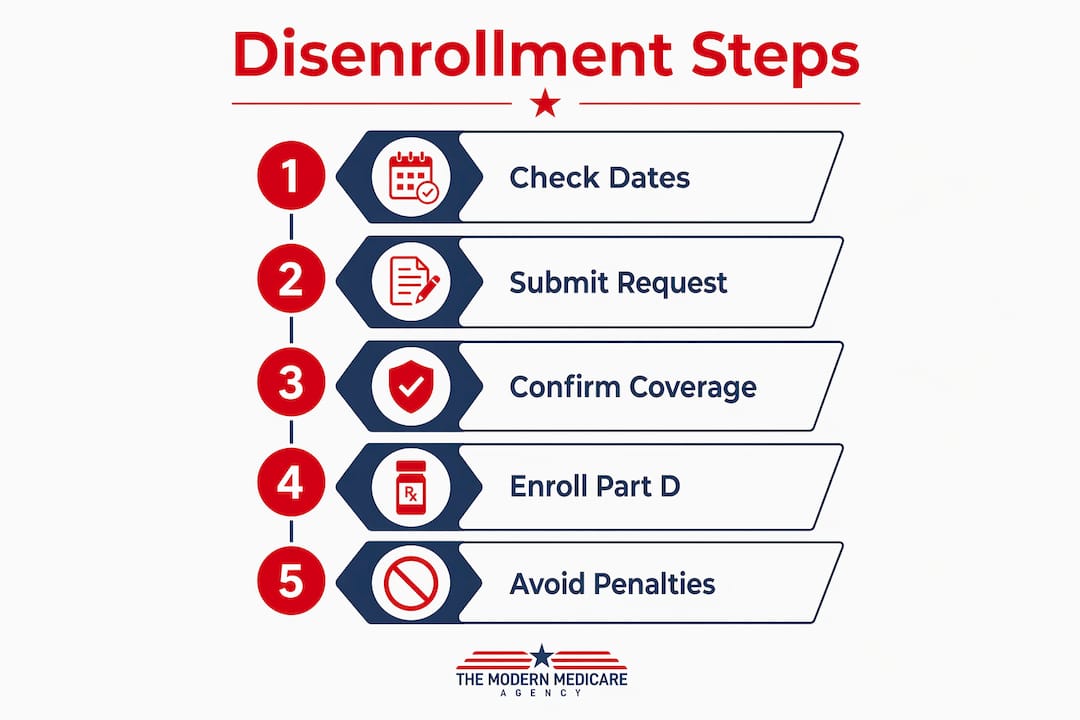
Follow this sequence to protect yourself:
- Decide on your replacement coverage first. Know exactly what plan you are moving to before you initiate any disenrollment. Returning to Original Medicare without a Part D plan or Medigap in place leaves you exposed.
- Enroll in your new plan simultaneously. Enrolling in a new Medicare Advantage or Part D plan automatically disenrolls you from your current plan. You do not need to make a separate cancellation call in most cases. This eliminates the risk of an accidental coverage gap.
- Enroll in standalone Part D if returning to Original Medicare. Do this at the same time as your disenrollment. Do not wait to see how Original Medicare works first. The penalty clock starts immediately.
- Apply for Medigap during your guaranteed issue window. If you are within your 12-month trial period, apply for a Medigap policy before your disenrollment takes effect. Medigap guaranteed issue rights expire 63 days after you leave your Medicare Advantage plan.
- Confirm your disenrollment in writing. Call your plan to confirm the effective date and request written confirmation. Errors do happen, and documentation protects you.
“The biggest mistake beneficiaries make is underestimating timing requirements, which can lock them into unwanted plans and cause real financial hardship.” — Medicare coverage expert
Common Medicare enrollment mistakes are well-documented, and most of them come down to acting too late or assuming the process is automatic. It is not. You are responsible for your own enrollment actions, and CMS holds you to that responsibility strictly.
One more risk worth naming: many beneficiaries are surprised at the difficulty of getting Medigap coverage after the trial period ends. Medical underwriting is real. A beneficiary with diabetes, heart disease, or a recent hospitalization may find that no Medigap insurer will accept them at a standard rate, or at all, in states without additional protections. The 12-month trial window is not a suggestion. It is a one-time federal protection that disappears permanently once it expires.
Key takeaways
Medicare plan disenrollment requires precise timing, a clear replacement plan, and immediate Part D enrollment to avoid lifetime penalties and permanent loss of Medigap rights.
| Point | Details |
|---|---|
| Disenrollment windows are strict | You can only leave a Medicare Advantage plan during AEP, MA-OEP, or a qualifying SEP. |
| Part D penalty is permanent | Delaying Part D enrollment after disenrolling creates a lifetime penalty that grows each year. |
| Medigap rights expire | Guaranteed issue Medigap rights last only 63 days after leaving a Medicare Advantage plan during the trial period. |
| New enrollment triggers disenrollment | Joining a new plan automatically ends your old one, preventing coverage gaps. |
| SEPs require documentation | Qualifying life events trigger a 60-day window, and you must document the event date to use it. |
What I have learned after nearly two decades of helping Medicare beneficiaries
I have been working with Medicare beneficiaries since 2007, and the disenrollment question comes up constantly. What surprises me most is not that people get confused. It is that the confusion almost always costs them money.
The most common scenario I see: someone joins a Medicare Advantage plan at 65, decides after a year or two that they prefer Original Medicare, and then waits until they feel ready to make the switch. By the time they call me, their 12-month trial period is long gone. Now they face medical underwriting for Medigap, and in many cases, their health has changed enough that approval is not guaranteed. That window was their one federal protection, and it closed quietly while they were thinking it over.
My honest advice is this. Do not treat disenrollment as a decision you can make whenever you feel like it. Treat it like a tax deadline. The calendar is fixed, the penalties are real, and CMS does not grant extensions for good intentions. State Health Insurance Assistance Programs (SHIPs) offer free, unbiased counseling and can help you think through your options before you act. Use them. And if you want someone who knows Medicare plans specifically and can walk you through the numbers, that is exactly what Paulbinsurance does.
The beneficiaries who come out ahead are the ones who plan their exit before they need it.
— Paul
How Paulbinsurance helps you make the right Medicare move
Leaving a Medicare plan is not just paperwork. It is a decision with long-term financial consequences, and getting it right requires knowing your options before you act.

Paulbinsurance specializes in helping Medicare beneficiaries understand their coverage choices at every stage. Whether you are weighing a return to Original Medicare, comparing Medicare Advantage plans, or trying to figure out whether a Medigap policy makes sense for your situation, the team at Paulbinsurance can walk you through it without pressure or confusion. Paul Barrett has been doing this since 2007, and the goal has always been education first. Reach out to Paulbinsurance before your next enrollment window closes.
FAQ
What is Medicare plan disenrollment?
Medicare plan disenrollment is the process of ending your enrollment in a Medicare Advantage or Part D plan. It can only happen during the AEP, MA-OEP, or a qualifying Special Enrollment Period.
When can you disenroll from a Medicare Advantage plan?
You can disenroll during the Annual Enrollment Period (october 15 through december 7), the MA-OEP (january 1 through march 31), or within 60 days of a qualifying life event that triggers a Special Enrollment Period.
Is there a penalty for leaving Medicare Advantage?
There is no penalty for leaving Medicare Advantage itself. However, if you return to Original Medicare and fail to enroll in a standalone Part D plan, you face a lifetime late enrollment penalty of roughly 24% of the national base premium for every two years of delay.
Can I get Medigap after leaving Medicare Advantage?
If you are within your 12-month trial period as a new Medicare Advantage enrollee, you have guaranteed issue rights to buy Medigap within 63 days of disenrolling. After that window closes, insurers in most states can use medical underwriting and may deny coverage based on your health history.
Does enrolling in a new plan automatically cancel my old one?
Yes. Enrolling in a new Medicare Advantage or Part D plan automatically disenrolls you from your current plan. You do not need to make a separate cancellation request, though confirming the effective date in writing is always a good practice.
Recommended
- Medicare Enrollment Help for Seniors: Clear Steps to Choose Plans and Avoid Late Penalties – The Modern Medicare Agency
- Medicare Plan Changes 2026: The Smart Senior’s Guide Before the December 7th Deadline
- What Medicare Advantage Consumers Can Do If Their Plan Was Terminated — or They’re Unhappy With Coverage for 2026 – The Modern Medicare Agency
- Why Are People Leaving Medicare Advantage Plans? The 2026 Reality Check – The Modern Medicare Agency