
You just opened a letter from the Social Security Administration, and the numbers on the page don’t match the plan you carefully selected. It’s a common moment of stress for many retirees. You might be wondering why your monthly cost is higher than the advertised rate. We understand how frustrating it is to face unexpected government surcharges, especially when you’ve worked hard to plan your budget. This extra cost is known as the medicare part d income-related monthly adjustment amount (irmaa).
We want to help you replace that anxiety with total clarity. It’s important to remember that these surcharges aren’t permanent penalties; they’re simply adjustments based on your 2024 tax returns. For 2026, if your individual income was $109,000 or less, you won’t owe any extra amount at all. We’ll walk you through the exact income brackets for this year, explain the “cliff” effect that triggers these costs, and show you how to file an appeal if your life has changed since 2024. Our goal is to give you a structured path back to peace of mind.
Key Takeaways
- Learn exactly how the medicare part d income-related monthly adjustment amount (irmaa) is calculated for 2026 using your tax information from two years ago.
- Identify the specific 2026 income thresholds for individuals and couples to see if you’ll be required to pay a monthly surcharge.
- Discover the simple steps we recommend for appealing a surcharge if your income has dropped due to a life-changing event like retirement or divorce.
- Find out how to use Form SSA-44 to request a new determination and gain peace of mind regarding your healthcare budget.
- Understand how we help you compare Part D and Medigap plans to balance your costs and protect your financial security.
What is the Medicare Part D IRMAA Surcharge for 2026?
If you’ve recently received a letter mentioning a surcharge on your prescription drug coverage, you might feel a bit overwhelmed. We want you to know that you aren’t alone in this. The medicare part d income-related monthly adjustment amount (irmaa) is simply an additional fee that some beneficiaries pay based on their higher income levels. It isn’t a part of your standard plan premium that you pay to a private insurance company. Instead, this is a mandated amount that goes directly to the government to help support the Medicare system. We’re here to help you understand exactly why this notice appeared in your mailbox and what it means for your financial plan.
It’s vital to distinguish between your monthly plan premium and this surcharge. When you sign up for one of the many available Medicare Part D Plans, you pay a premium to the insurance company for your drug coverage. However, the IRMAA is separate. You pay this amount directly to Medicare or it’s deducted from your Social Security check. Even if you have a $0 premium Medicare Advantage plan that includes drug coverage, you’ll still owe this surcharge if your income exceeds the set limits. We know this sounds like a lot of moving parts, but we’ll help you keep them all straight.
Why Does the Government Charge an IRMAA?
The federal government uses a process called means-testing to keep the program sustainable. Most people don’t pay the full cost of their prescription drug insurance. Instead, the government subsidizes a large portion of the expenses for Medicare Part D to keep it affordable for the average retiree. For those with higher earnings, the law requires them to pay a larger share of the total cost. By asking higher earners to contribute more, the system aims to provide security for all beneficiaries regardless of their financial background. We view this as a balancing act designed to protect the program’s longevity.
How You Will Be Notified
The Social Security Administration (SSA) is responsible for determining who owes this surcharge. They’ll send you a formal letter, which usually arrives in late 2025 or the very beginning of 2026. This letter is called a “Notice of Initial Determination.” It explains that they’ve looked at your tax records and decided that an adjustment is necessary. Receiving this notice is a standard process and doesn’t mean you’ve done anything wrong. We’ve helped many people through this exact situation, and we can help you verify if the information the SSA used is still accurate for your current life circumstances.
How the SSA Determines Your IRMAA: The 2-Year Lookback Rule
The way the government calculates your 2026 medicare part d income-related monthly adjustment amount (irmaa) might seem a bit backwards at first. Since the new year has only recently begun, the IRS hasn’t processed your current earnings yet. To solve this, the Social Security Administration looks at your tax return from two years ago. This means your 2026 costs are actually based on the money you earned in 2024. We see many people get caught off guard by this because their life looks very different now than it did two years ago. It’s a system built on historical data rather than your current reality.
The role of the IRS is central to this process. Every year, the IRS automatically sends your tax data to the Social Security Administration. This happens behind the scenes without you needing to lift a finger. While this automation makes the system efficient, it also means the government is making decisions about your 2026 budget using data that is technically two years old. This lack of real-time reporting is exactly why that surprise letter arrives in your mailbox. We believe that understanding this connection is the first step toward regaining control over your healthcare spending.
Understanding Your MAGI
You might hear the term MAGI thrown around quite a bit during these discussions. It stands for Modified Adjusted Gross Income. It’s not the same as your taxable income. Your taxable income is usually lower because of the deductions you take to reduce your tax bill. Instead, the SSA looks at your Adjusted Gross Income and adds back any tax-exempt interest you earned, such as interest from municipal bonds. For your 2026 Medicare costs, your MAGI is the total of your adjusted gross income and any tax-exempt interest income you reported on your 2024 tax return. You can find more details about how these specific figures impact your monthly costs on the official Medicare website.
Why the Two-Year Delay Matters
This delay exists because it takes time for the IRS to process millions of tax returns. They then have to share that data with Social Security. It creates what we call a retirement gap. Imagine you were working a high-paying job in 2024 but retired in 2025. Even though your current income is much lower, the government still sees those 2024 earnings. It can be incredibly frustrating to pay a surcharge based on a salary you no longer receive. We want to reassure you that this isn’t a permanent mistake. If your income dropped because of a major life change, you don’t have to just accept the higher cost. We often help clients review their Medicare Part D Plans to ensure their coverage is still a good fit while we help them address these surcharges.
Calculating the Cost: 2026 Income Brackets and Surcharges
Understanding the math behind your monthly bill is the best way to find peace of mind. The medicare part d income-related monthly adjustment amount (irmaa) is an extra charge added to your base drug plan premium. It’s important to remember that this is entirely separate from the Part B IRMAA surcharge, which applies to your medical coverage and is typically a much larger amount. While Part B costs often get the most attention, the Part D adjustment is its own specific calculation. We’re here to help you see the full picture so there are no surprises when you look at your bank statement.
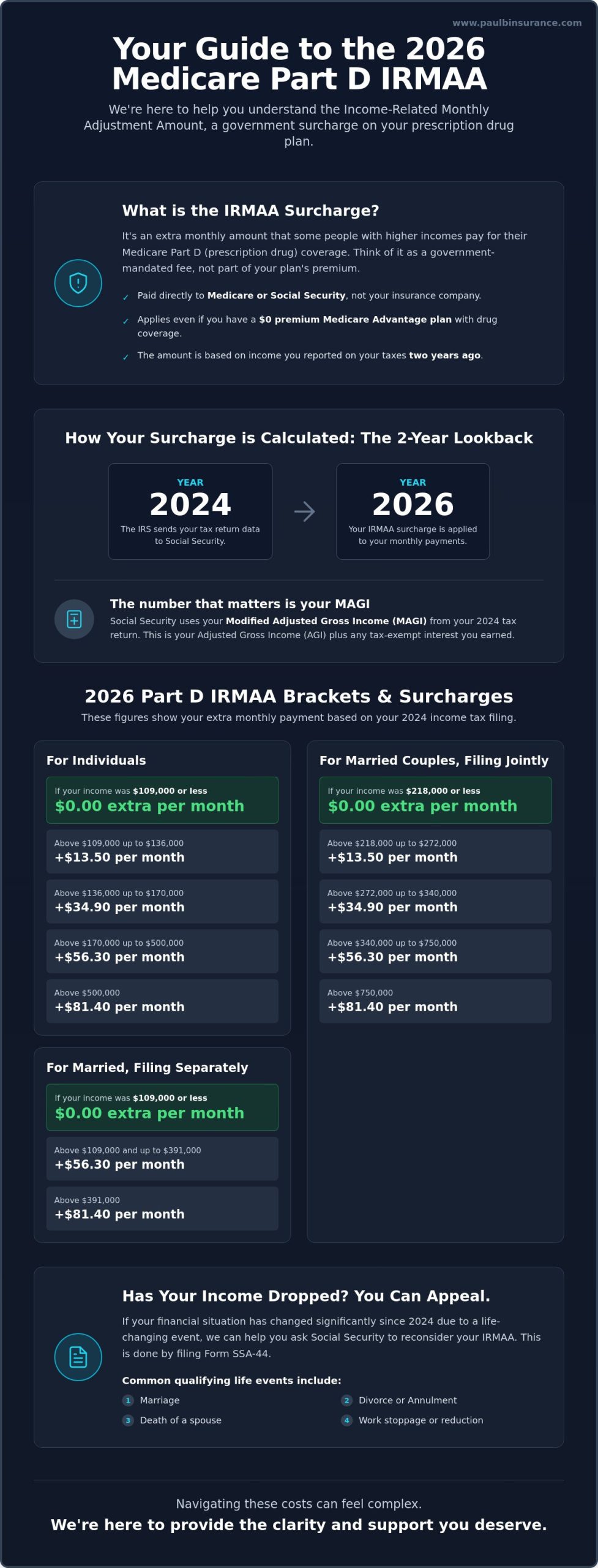
The government uses specific income brackets to decide how much extra you’ll pay each month. For 2026, these thresholds have been adjusted for inflation to reflect the current economy. If your 2024 income was $109,000 or less as an individual, or $218,000 or less as a couple filing jointly, you won’t pay a surcharge at all. However, if you’re even one dollar over these limits, you hit what we call the “cliff” effect. This means you must pay the full surcharge for that specific tier, regardless of how close you were to the boundary. We’ve outlined the 2026 tiers below to help you identify where you stand.
The 2026 Income Thresholds
- Tier 1: Individuals earning over $109,000 up to $137,000 (Joint filers $218,001–$274,000) pay an extra $14.50 per month.
- Tier 2: Individuals earning over $137,000 up to $171,000 (Joint filers $274,001–$342,000) pay an extra $37.50 per month.
- Tier 3: Individuals earning over $171,000 up to $205,000 (Joint filers $342,001–$410,000) pay an extra $60.40 per month.
- Tier 4: Individuals earning over $205,000 up to $500,000 (Joint filers $410,001–$750,000) pay an extra $83.30 per month.
- Tier 5: Individuals earning $500,000 or more (Joint filers $750,000+) pay an extra $91.00 per month.
Even if you’re in a higher bracket, you still have some control over your total healthcare spend. Different Medicare Part D plans have different base costs. By selecting a plan with a lower base premium, we can help you minimize the total impact on your monthly budget.
How to Pay Your IRMAA
Most people find that the payment process is automatic and stress-free. If you’re currently receiving Social Security benefits, the SSA simply deducts the surcharge from your monthly check before it reaches your account. If you aren’t yet collecting Social Security, Medicare will send you a bill directly. You can set up Medicare Easy Pay to handle this electronically and avoid the hassle of writing checks. This same rule applies if you’ve chosen a Medicare Advantage Plan that includes drug coverage. Even if your plan premium is $0, the government will still collect the IRMAA surcharge separately. We can help you navigate these payment options so you can focus on enjoying your retirement.
How to Appeal an IRMAA Surcharge: Life-Changing Events
Receiving a notice about a surcharge doesn’t have to be the final word on your 2026 budget. If your financial situation has changed since 2024, the government allows you to request what they call a “new initial determination.” This is a formal way of asking the Social Security Administration to look at your current life instead of an old tax return. We know paperwork often feels like a heavy burden. However, the potential savings on your medicare part d income-related monthly adjustment amount (irmaa) make this process well worth the effort. The primary tool you’ll use is Form SSA-44, and we’re here to help you navigate every line of it.
The Social Security Administration recognizes eight specific Life-Changing Events (LCEs) that qualify you for a lower surcharge. If any of these happened between 2024 and today, you have a strong case for an appeal:
- Marriage
- Divorce or annulment
- Death of a spouse
- Work stoppage, such as retirement
- Work reduction or a decrease in hours
- Loss of income-producing property due to a disaster or similar event
- Loss of pension income
- Receipt of an employer settlement payment due to a company closure or bankruptcy
Common Life-Changing Events
Retirement is the most frequent reason our clients file an appeal. If you were earning a high salary in 2024 but stopped working in 2025, the SSA doesn’t automatically know that your income has vanished. A divorce or the passing of a spouse can also significantly change your tax filing status and your household earnings. Even a loss of income-producing property, like a rental unit lost to a natural disaster, counts as a valid reason to request a lower cost. We believe your current reality should define your costs, not your past career.
Step-by-Step Appeal Process
The process begins with gathering your evidence. If you retired, you’ll need a letter from your former employer or a retirement statement. If you’re appealing based on a loss of pension, you’ll need a statement from the pension administrator. Once you have your proof, you must fill out Form SSA-44 accurately. Mistakes on this form can cause frustrating delays, so we recommend double-checking your dates and income estimates. After the form is complete, you can mail it or drop it off at your local Social Security office for the fastest processing. If you need help deciding which coverage fits your new budget, you can contact us today to review your options.
Navigating Medicare Costs with a Trusted Partner
We understand that reading about surcharges and income brackets can feel like a heavy weight on your shoulders. It’s our mission to lift that burden. While the medicare part d income-related monthly adjustment amount (irmaa) is a federal requirement, you don’t have to face it alone. We specialize in looking at the complete picture of your healthcare spending to find where we can save you money elsewhere. For instance, if you’re facing a higher Part D surcharge, we can help you compare Medicare Supplement (Medigap) Plans or Medicare Part D Plans to find a base premium that fits your new budget. Our goal is to move you from a state of uncertainty to one of absolute confidence.
Managing your retirement finances shouldn’t feel like a solo battle against a complex bureaucracy. We’ve spent years learning the nuances of these systems so that you don’t have to. By acting as your advocate, we ensure that you aren’t just another number in a government database. We’re here to protect your interests and empower you with clear, actionable information. Whether you need help understanding a specific surcharge or you’re looking for ways to lower your overall monthly costs, we provide the expert guidance you deserve.
The Value of Independent Guidance
There’s a significant difference between talking to a representative from a single insurance company and working with an independent advocate. A restricted representative can only offer you the specific plans their company sells. In contrast, we are autonomous professionals who prioritize your needs over any single brand. We scan the entire 2026 market to find the most reliable and cost-effective options for your specific health needs. We don’t just help you during the enrollment period. We provide impartial support throughout the year, especially when you receive confusing letters from the Social Security Administration. We see ourselves as your personal educators and protectors in a complex system.
Your Next Steps for 2026
The journey to peace of mind starts with a simple check of your mail. As we’ve discussed, the SSA typically sends out IRMAA determination notices in late 2025 or early 2026. When that letter arrives, don’t let it cause you stress. Instead, treat it as a signal to reach out to us. We’ll help you verify the numbers and determine if an appeal is the right path forward for your situation. We invite you to schedule a no-pressure consultation to review your current coverage. Whether you’re looking for drug coverage or dental insurance, we’re here to ensure your plan still fits your life. Let’s work together to make 2026 a year of financial security and clarity.
Take Control of Your Medicare Costs Today
Understanding the medicare part d income-related monthly adjustment amount (irmaa) is the first step toward protecting your retirement budget. We’ve seen how the 2026 thresholds and the two year lookback rule can create unexpected hurdles; however, these challenges are manageable with the right information. Whether you’re identifying your specific income bracket or preparing a Life-Changing Event appeal using Form SSA-44, you have a clear path forward to lower your monthly expenses. Clarity is the best remedy for the anxiety that often comes with government notices.
You don’t have to manage these complex systems on your own. As independent brokers, we represent over 40 carriers and provide personalized guidance across more than 34 states. We’re committed to being your advocate through every stage of your journey, offering year-round support that goes far beyond a simple enrollment window. We’re here to turn your uncertainty into a structured plan for success. Let us help you navigate your Medicare journey with certainty; contact us today. You’ve worked hard for your retirement, and we’re here to help you protect it.
Frequently Asked Questions
Is IRMAA a one-time fee or a monthly charge?
IRMAA is a monthly surcharge that is added to your existing prescription drug plan cost. It isn’t a single payment you make once a year. Because it’s an adjustment to your monthly premium, you’ll see this amount reflected in every billing cycle for the duration of the calendar year. We want to help you budget for this recurring cost so there are no surprises in your monthly bank statements.
Can I avoid the Part D IRMAA if I don’t have a prescription drug plan?
You only pay the medicare part d income-related monthly adjustment amount (irmaa) if you are actually enrolled in a prescription drug plan or a Medicare Advantage plan that includes drug coverage. If you don’t have Part D coverage, you won’t receive this specific surcharge. However, we always remind our clients that going without creditable drug coverage can lead to permanent late enrollment penalties if you decide to join a plan later.
What happens if I don’t pay my IRMAA surcharge?
Failing to pay your IRMAA surcharge can result in the termination of your prescription drug coverage. The law requires Medicare to end your enrollment in your Part D plan if the surcharge remains unpaid, even if you’ve paid your regular plan premium to the insurance company. We find that setting up automatic deductions from your Social Security check is the most reliable way to protect your coverage and ensure your payments are always on time.
Does my income from a Roth IRA conversion count toward IRMAA?
Yes, the amount you convert from a traditional IRA to a Roth IRA is considered part of your Modified Adjusted Gross Income (MAGI). Since the SSA uses a two year lookback, a conversion you made in 2024 will impact your 2026 Medicare costs. This is a common situation where a one time financial decision leads to a temporary surcharge. We can help you look at your overall plan to manage these shifts.
How long does the SSA take to process an IRMAA appeal?
The Social Security Administration typically takes between 30 and 60 days to process an appeal once they receive your completed Form SSA-44 and supporting evidence. While you wait for a decision, you must continue to pay the surcharge to keep your coverage active. If your appeal is successful, you’ll receive a refund for the extra amounts you paid during the processing period. We’re here to help you track this timeline and stay patient.
Will my IRMAA automatically go away next year if my income drops?
Your IRMAA status is recalculated every year based on your most recent tax data. If your income in 2025 falls below the 2027 thresholds, the surcharge will naturally fall away when the new year begins. This annual review ensures that you aren’t stuck with a permanent penalty. We recommend a yearly check in with us to see how your changing finances will affect your future medicare part d income-related monthly adjustment amount (irmaa) costs.

Article by
Paul Barrett
Paul Barrett, CMIP is the founder of The Modern Medicare Agency, an independent Medicare-only brokerage based in Melville, NY. With 18 years of Medicare-exclusive experience, a CMIP designation, and more than 5,000 clients served across 37 states, Paul is one of the most credentialed independent Medicare specialists on Long Island — and one of the most direct.
He represents 40+ carriers with no quotas and no allegiances, which means his recommendations are based entirely on what fits each client's specific situation. He is the author of Medicare Mastery Unlocked and host of the Wise Guys Retirement Talk podcast. His content is grounded in primary sources, real carrier intelligence, and 18 years of watching what happens when people get Medicare right — and when they don't.
📞 631-358-5793 | paulbinsurance.com