




Could you spend two nights in the hospital and still not be admitted as an inpatient? Yes. That can be unsettling, especially because your hospital status may affect how Medicare processes care and what you pay. If you’re asking, “what is the Medicare two-midnight rule?” the key point is that two midnights can guide an inpatient admission, but they don’t guarantee one.
It’s easy to assume that time spent in a hospital bed determines your status. In 2026, the rule generally considers whether your doctor expects you to need hospital care across at least two midnights, based on your medical needs and documented in your record. A shorter stay may still be considered inpatient in some cases, while an overnight stay may be billed as outpatient observation.
This guide explains the rule, what it can and can’t tell you, and why inpatient and observation status may affect costs or later care. You’ll also find practical questions to ask the hospital team and ways to organize notices and bills. This is general information, not a decision about your individual coverage or claim.
Key Takeaways
- Learn what the Medicare two-midnight rule means and how a doctor’s expected need for hospital care can guide inpatient admission.
- Understand why the two-midnight benchmark doesn’t guarantee inpatient status, and why the expected length of care can differ from the time you ultimately spend in the hospital.
- See the difference between inpatient admission and outpatient observation, even when you stay overnight in a hospital bed.
- Find practical questions to ask about your status and admission records, and learn which notices and bills to keep together.
- Separate questions about hospital classification from broader Medicare plan choices, which an independent Medicare broker can help you compare.
What Is the Medicare Two-Midnight Rule?
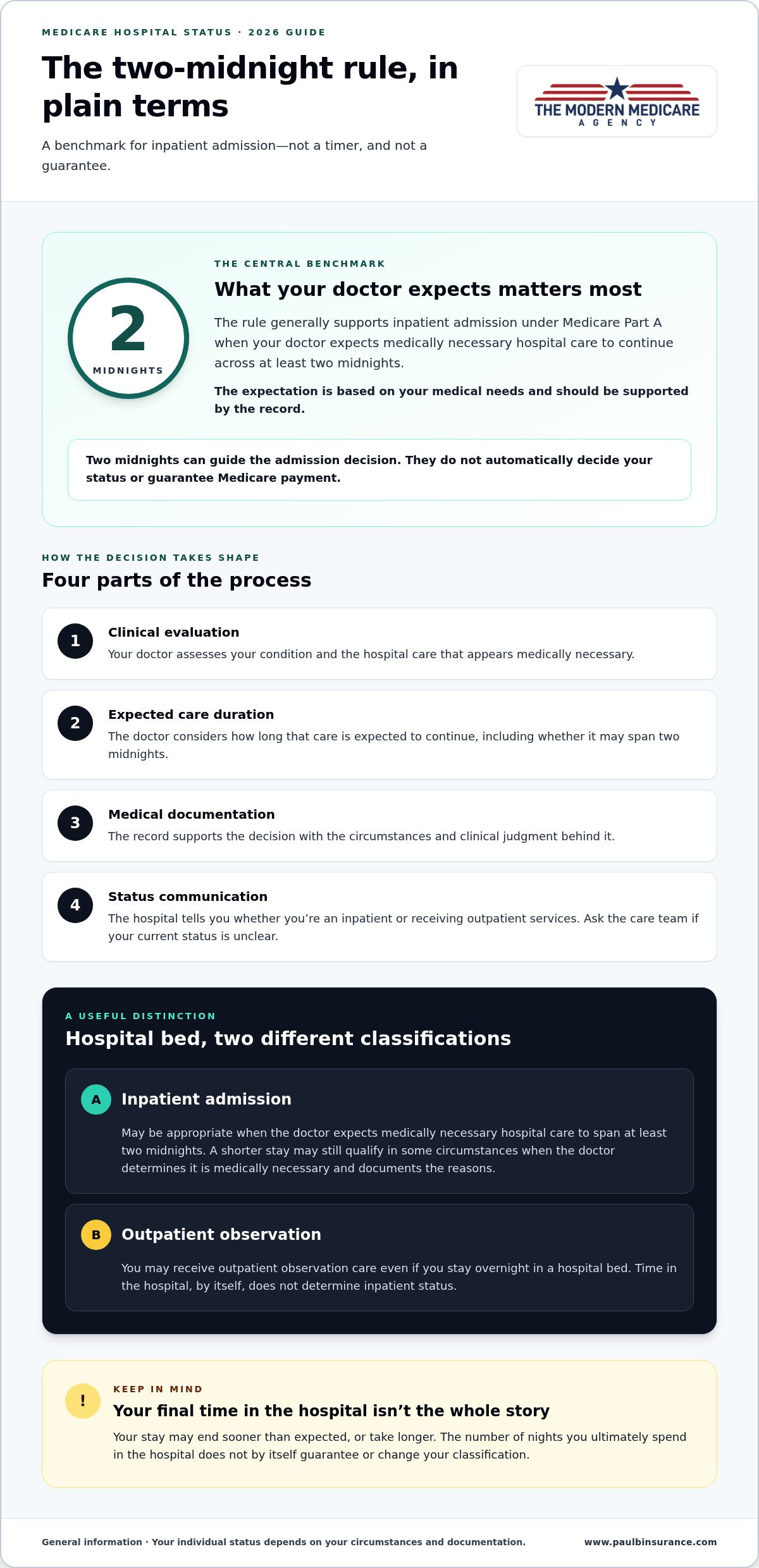
If you’re asking what is the Medicare two-midnight rule, the simplest answer is that it’s a guideline Medicare uses when considering whether a hospital admission may qualify for inpatient payment under Part A. The decision generally considers whether the doctor expects medically necessary hospital care to continue across at least two midnights. The doctor’s medical judgment and supporting documentation matter, too.
The Medicare Two-Midnight Rule is a benchmark that generally supports inpatient admission under Part A when a doctor expects medically necessary hospital care to span at least two midnights.
The benchmark can be confusing if you’re counting nights in a hospital bed. It isn’t a timer, and the number of nights you ultimately stay doesn’t automatically decide your status. Two midnights do not guarantee inpatient classification or payment. Instead, the rule guides the admission decision based on what the doctor reasonably expects when evaluating your care.
What does the two-midnight benchmark mean?
Think of the benchmark as an estimate of how long you’ll need hospital-level care, based on your condition at the time of admission. If your doctor expects tests, treatment, or monitoring to make hospital care necessary across two midnights, the stay may generally be appropriate for inpatient admission under Part A. The focus is on the expected medical need, not simply whether you sleep in the hospital.
For example, your condition may require ongoing treatment and close monitoring, and your doctor may expect that care to continue over two midnights. That expectation informs the admission decision. If your care takes less time than expected, or your stay unexpectedly lasts longer, the final number of nights doesn’t by itself guarantee or change your classification.
Why does Medicare use this rule?
The rule gives doctors and hospitals a framework for deciding whether a person’s care should be treated as an inpatient admission for Medicare Part A payment. It helps distinguish an expected inpatient stay from hospital services that may instead be provided on an outpatient basis. The classification can affect how the hospital bills Medicare, but the benchmark doesn’t promise that Medicare will pay a particular claim.
Documentation is part of the decision. The doctor’s record should support the expected need for hospital care and explain the clinical reasons behind the admission. The decision isn’t based only on a clock or bed assignment. It reflects the patient’s medical situation and the doctor’s judgment at the time.
A stay expected to be shorter than two midnights may still qualify for inpatient payment in some circumstances. Medicare allows case-by-case consideration when the doctor determines inpatient admission is medically necessary and documents the reasons. The decision may be reviewed, so the benchmark is an important guide, not an absolute rule for every case. If your status is unclear, ask the hospital team whether you’re currently classified as an inpatient or receiving outpatient observation care.
How the Medicare Two-Midnight Rule Works in Practice
Knowing what is the Medicare two-midnight rule is only the starting point. In practice, the decision develops from a doctor’s assessment of your needs, the care they expect you’ll require, and the information recorded about your condition. Your actual hospital stay may unfold differently. The rule isn’t a stopwatch, and time spent in the building doesn’t settle your status on its own.
The process can be understood in four steps:
- Clinical evaluation: Your doctor assesses your condition and the hospital care that appears medically necessary.
- Expected care duration: The doctor considers how long that care is expected to continue, including whether it is expected to span two midnights.
- Documentation: The medical record supports the decision with the circumstances and judgment behind it.
- Status communication: The hospital tells you whether you’re classified as an inpatient or receiving outpatient services. If the explanation isn’t clear, ask the care team to explain your current status.
This describes the general framework, not a formula that automatically determines every case. Individual circumstances matter, and Medicare rules can include exceptions. For current guidance on how the rule applies, refer to the CMS Two-Midnight Rule Fact Sheet and other applicable CMS materials. Check any explanation of an exception against current CMS guidance rather than assuming it applies to every patient.
What does the physician consider?
The doctor considers your health situation and the hospital care they believe is medically necessary. Their expected course of care should be supported by the circumstances recorded in your medical file. There isn’t one checklist or timing calculation that fits every patient. The key is the doctor’s clinical judgment, supported by documentation, rather than your preference about how long to stay.
Why can actual hospital time differ from expected time?
At admission, a doctor might expect that you need care across two midnights. If you improve sooner, your stay could end earlier than expected. You might also need more time than first anticipated. These changes don’t, by themselves, prove that the original decision was right or wrong or determine your final status. The decision isn’t simply a count of nights spent in a hospital.
That difference can be frustrating when you’re trying to understand a bill after discharge. The expected course of care informs the admission decision; the actual length of stay is what happened afterward. They’re related, but they aren’t interchangeable. If you have broader questions about how Medicare plan choices fit your needs, you can discuss them in a Medicare review. A plan review doesn’t determine your hospital classification or decide an individual hospital claim.
Inpatient vs. Observation: What the Two-Midnight Rule Does Not Decide Automatically
A hospital room, overnight stay, or even crossing two midnights doesn’t tell you by itself whether you’ve been admitted as an inpatient. The important detail is the status recorded for your stay. The two-midnight rule guides an admission decision; it doesn’t automatically assign your status based on the clock.
Here’s the basic difference in 2026:
| Status | What it means | What to keep in mind |
|---|---|---|
| Inpatient | You’ve been formally admitted to the hospital. | Inpatient services are generally considered under Medicare Part A, subject to applicable Medicare rules. |
| Outpatient observation | You receive care as an outpatient while the hospital monitors or evaluates your condition. | You may stay in a hospital bed, including overnight, and still be an outpatient. Outpatient services are generally considered under Medicare Part B. |
How is inpatient care different from observation?
Inpatient status means there’s a formal hospital admission. Observation is outpatient care in a hospital setting, often while the care team evaluates your condition or decides what care you need next. Your room, wristband, meals, and number of nights may look similar either way, but they don’t establish which status applies.
Check the status documented for your stay instead of relying on appearances or elapsed time. Ask the hospital team directly: “Am I an inpatient, or am I receiving outpatient observation services?” If you’ve received a Medicare Outpatient Observation Notice, or MOON, read it and ask for an explanation of anything that’s unclear. In 2026, hospitals must provide this notice to Medicare beneficiaries receiving observation services for more than 24 hours, no later than 36 hours after observation begins.
Could status affect what Medicare pays?
It can. Inpatient and outpatient care are handled under different parts of Original Medicare, so your classification may affect how services are billed and which cost-sharing rules apply. The impact depends on the services you receive and your circumstances. This comparison is general guidance, not a way to predict your personal bill or decide how a specific claim should be paid.
Status can also matter if you need skilled nursing facility care after leaving the hospital. Under Original Medicare, eligibility for Part A coverage generally requires a qualifying inpatient hospital stay of at least three consecutive days. Time spent in observation doesn’t count toward that stay. If rehabilitation or another care setting may follow your hospital visit, ask how your recorded status affects the next step before discharge, and keep the answer with your notices and billing papers.
Keep the paperwork together: save your MOON, any admission or discharge documents, and later bills. If the notice says observation but you believed you were admitted, ask the hospital to explain the status on record and who can answer questions about related billing. For a broader overview of Medicare, review the applicable Medicare resources, but keep plan questions separate from the hospital’s classification of your stay.
What to Ask if You Are Unsure About Your Hospital Status
Hospital paperwork can be hard to interpret, especially when you’re tired or worried about what care comes next. Start with a direct question: “Am I formally admitted as an inpatient, or am I receiving outpatient observation services?” The answer should describe your current recorded status, not just where you’re staying or how long you’ve been there.
If the explanation isn’t clear, ask for help understanding the record. A patient or caregiver can use questions like these:
- What is my current status: inpatient admission or outpatient observation?
- Where can I see that status in my hospital paperwork or electronic record?
- Which clinician can explain the documented decision and the medical circumstances behind it?
- Has my status changed during this stay, and where is each change documented?
- Who can explain a notice or billing document I don’t understand?
These questions can help you get a clearer picture, but they don’t determine whether a specific classification or payment decision is correct. That requires review of your records and circumstances. The two-midnight benchmark is general guidance, not a substitute for that review. If you’re still wondering what the rule means for your particular stay, ask the hospital to explain how your documented status relates to the care you received.
Questions to ask during a hospital stay
Ask calmly and specifically. You might say, “Could you show me where my status is recorded?” or “Who can explain the reason for this classification?” If the person you speak with can’t answer, ask which hospital team or staff member can. Write down the answer and any next step so you don’t have to rely on memory later.
What documents should patients keep?
Keep hospital notices, admission or discharge paperwork, and Medicare statements together. If you speak with someone about your status or a bill, note the date, the person’s name or role, and what they advised. Avoid recording sensitive personal details in a general notebook. If a notice is confusing, request an explanation before assuming what it means.
After discharge, compare the paperwork you collected with any statements that arrive. Look for the recorded status and the services listed, then note anything inconsistent or unclear. Keep copies of questions you’ve sent and answers you’ve received. If a payment or classification decision is in question, the relevant documents and medical record are needed to understand the specific situation. This article offers general information, not a determination about an individual stay or claim.
Once your hospital-status questions are separate, you may also have broader questions about Medicare plan options. Paul B Insurance, operating as The Modern Medicare Agency, is an independent Medicare broker. Its free Medicare review is for discussing plan choices, not deciding hospital status or reviewing a specific hospital claim. Request a free Medicare review to talk about broader Medicare plan questions.
Next Steps After a Hospital Stay: Understand the Notice Before Choosing a Medicare Plan
After discharge, it’s easy to treat every hospital paper as if it answers the same question. It doesn’t. A hospital notice may describe your status during the stay, while a Medicare statement may explain how a claim was processed. Understanding the general two-midnight rule is different from determining how it applies to your hospital records.
Take one question at a time. First, clarify the status recorded by the hospital. Then review the Medicare statement and ask the organization that issued it to explain anything you don’t understand. Don’t assume one document resolves every question about the other. A specific claim or payment decision depends on the details of your care, coverage, and records, so general article guidance can’t determine the outcome.
How to make sense of paperwork after discharge
Gather your hospital notices, discharge papers, and Medicare statements in one place. Check the dates and type of each document, then note what it says without assuming the wording is interchangeable. If a notice describes observation status or a statement lists services you don’t recognize, contact the hospital or the organization that sent the statement and ask for an explanation of that specific document.
You can ask, “What does this notice say about my hospital status?” or “What does this statement explain about the claim?” Keep a record of the response and any next steps. If the explanation still doesn’t make sense, ask who can clarify the record or billing. An independent Medicare broker can discuss plan options, but doesn’t decide a hospital’s status or an individual claim.
Where independent Medicare guidance fits
Once you’ve separated hospital paperwork questions from broader coverage questions, you may want to review your Medicare choices. Paul B Insurance is an independent Medicare broker, not a Medicare plan provider. Its free Medicare review can help you compare Medicare Advantage, Medigap, and Part D options. That conversation is about plan choices, not resolving hospital billing or deciding whether your stay was inpatient.
If you’re considering supplemental coverage, a Medigap coverage guide can help you learn about that type of plan as you weigh broader options. Take your time. You can first seek an explanation of the hospital notice or statement, then consider whether a separate plan review would be useful. There’s no need to treat a hospital-status question as a reason to make a rushed enrollment decision.
For broader Medicare questions, Paul B Insurance offers a free Medicare review to discuss plan comparisons. The agency is independent, with 40+ carriers to compare and personalized guidance on Medicare Advantage, Medigap, and Part D plans. Questions about your specific hospital status or claim remain tied to your records and the organizations handling them.
Take Your Next Medicare Question One Step at a Time
A hospital billing concern and a question about future Medicare coverage are different issues. Keep following up with the hospital or the organization that sent your statement about your specific stay. For broader plan questions, an independent Medicare broker can help you compare options. Understanding the two-midnight rule can help you ask clearer questions, but it can’t determine how your hospital records or claim should be handled.
Paul B Insurance has 18 years of experience, 5,000+ clients served, and access to 40+ carriers. A free Medicare review is a separate opportunity to discuss your Medicare plan options. It won’t decide your hospital status or promise a billing resolution.
If you’re ready to talk through broader plan questions, book a free Medicare review. You can take the hospital paperwork one step at a time and make Medicare plan decisions with more clarity.
Frequently Asked Questions
Does staying in the hospital for two midnights guarantee inpatient status?
No. Spending two midnights in the hospital doesn’t by itself make your stay inpatient or guarantee Medicare payment. The applicable rules and your documented circumstances matter. If your paperwork doesn’t clearly state your classification, ask the hospital to identify your status and show you where it appears in your records. Keep that explanation with your admission or discharge papers so you can refer to it when reviewing later statements.
What is the difference between inpatient admission and observation status?
Inpatient care means you’ve been formally admitted; observation is outpatient care, even if you’re in a hospital room. To clarify your own case, look for status wording in notices or admission documents, then ask the hospital to explain any terms you don’t recognize. Don’t rely on room location, meals, or an overnight stay as proof of inpatient admission. Your own paperwork is the useful reference.
Can I be in the hospital overnight and still be an outpatient?
Yes. For example, a care team may keep you overnight for observation while evaluating your condition, without formally admitting you as an inpatient. Ask the hospital to confirm whether your recorded status is inpatient or outpatient observation, and review any written notice you receive. The number of nights you stay isn’t a substitute for checking that classification. If a caregiver is helping, they can write down the answer and where it appears in your documents.
Does the Two-Midnight Rule apply to Medicare Advantage plans?
Don’t assume that a general explanation of the rule determines how a particular Medicare Advantage plan handles an admission or payment question. The relevant requirements and plan documents should be reviewed for the specific coverage and situation. Check current CMS guidance and the plan’s member materials in 2026, especially if a decision concerns a particular service or claim. A plan comparison or general article can’t settle an individual coverage determination.
What should I do if I think my hospital status is wrong?
Start by asking the hospital to explain the status it recorded, where the decision appears in your records, and which office can discuss your questions. Keep the response with relevant notices, discharge paperwork, and Medicare statements. If a document or claim still doesn’t make sense, ask the organization that issued it to explain that specific record. The details must be reviewed individually, so general information can’t determine your status or predict an appeal outcome.
Does observation status affect Medicare costs?
It may affect how care is classified and paid for, but the effect on your bill depends on the services received and the coverage involved. Don’t treat a general description of observation as a personal cost estimate. Review the statement and notice together, identify the service or charge you’re asking about, and request an explanation from the organization that issued the document. A personal answer depends on the actual records and coverage details.

Article by
Paul Barrett
Paul Barrett, CMIP is the founder of The Modern Medicare Agency, an independent Medicare-only brokerage based in Melville, NY. With 18 years of Medicare-exclusive experience, a CMIP designation, and more than 5,000 clients served across 37 states, Paul is one of the most credentialed independent Medicare specialists on Long Island — and one of the most direct.
He represents 40+ carriers with no quotas and no allegiances, which means his recommendations are based entirely on what fits each client's specific situation. He is the author of Medicare Mastery Unlocked and host of the Wise Guys Retirement Talk podcast. His content is grounded in primary sources, real carrier intelligence, and 18 years of watching what happens when people get Medicare right — and when they don't.
📞 631-358-5793 | paulbinsurance.com